

Hezbollah allies in Lebanon must ‘choose between bullets and ballots’

An image grab taken from a video posted on Hezbollah's al-Manar TV website on July 25, 2020, shows Hassan Nasrallah, the head of Lebanon's Shiite Muslim movement Hezbollah. (File/AFP)
Short Url
Updated 09 September 2020
Follow

Hezbollah allies in Lebanon must ‘choose between bullets and ballots’

  • Senior US official’s warning comes as Washington blacklists two Lebanese former ministers
  • Assistant Secretary of State for Near Eastern Affairs David Schenker also calls for resolution of Gulf rift

NEW YORK: Hezbollah’s political allies in Lebanon will be held accountable for supporting the militant group, a senior US official said on Tuesday.

The warning, from Assistant Secretary of State for Near Eastern Affairs David Schenker, came shortly after the US Treasury blacklisted Lebanese former finance minister Ali Hassan Khalil and former transport minister Youssef Fenianos.

They are accused of providing material support for, and granting political and economic favors to, Iran-backed Hezbollah, which the US considers a terrorist organization.

“Political allies of Hezbollah should know they will be held accountable for any enabling of its terrorist and illicit activities,” Schenker said after a tour of the Middle east that included visits to Kuwait, Qatar and Lebanon,

During his two-day stop in Lebanon, he chose only to meet with opposition demonstrators, in a sign of Washington’s exasperation with the country’s political establishment.


His visit came a month after the devastating explosion at Beirut’s port that damaged a large part of the city, at a time when people were already reeling from a prolonged political crisis, an economic meltdown and the coronavirus pandemic.

Schenker restated his country’s commitment to helping the Lebanese people recover from the Aug. 4 disaster, which killed more than 200 people.
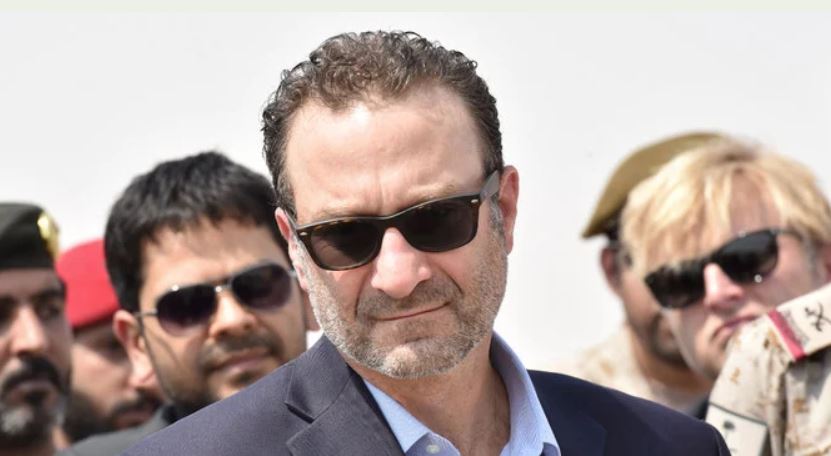


US Assistant Secretary for Near Eastern Affairs David Schenker. (File/AFP)

He added that the US supports “their legitimate calls for economic and institutional reform, transparency, accountability and an end to the endemic corruption that has stifled Lebanon’s tremendous potential.”

Next month marks the first anniversary of public demonstrations that began when hundreds of thousands people in Lebanon took to the streets to protest against the worsening economic and social problems caused by these issues.

“The Lebanese people made clear their desire for meaningful change, and for their government and political leaders to chart a new direction dedicated to reform and the end of corruption, to help Lebanon exit this current crisis,” Schenker said.

He vowed that Washington will maintain its pressure on Hezbollah, its supporters and “other corrupt actors” for obstructing the Lebanese people’s “aspirations for economic opportunity, accountability and transparency.”

He added: “It’s time for different politics in Lebanon.”

Schenker also highlighted the difference of opinion between the US and France about Hezbollah, which Paris views as two separate entities: a political party and a military wing.

French President Emmanuel Macron met with a number of Lebanese political leaders, including Hezbollah MP Mohammad Raad, during his Beirut visit last week.

“In democracies you have to choose between bullets and ballots,” Schenker said. “You cannot have both. Political parties do not have militias.”

However, he said the US and France are on same page when it comes to political and economic reforms being a prerequisite for any unlocking of international financial assistance to Lebanon.

In the wider regional context, Schenker also reiterated Washington’s desire for the Gulf rift to be resolved. Unity among Gulf nations is an important step forward in efforts to counter “Iran’s malign influence in the region,” he said.

Saudi Arabia, the UAE, Bahrain and Egypt severed diplomatic ties with Qatar in June 2017 over Doha’s connections to Iran and its alleged support for terrorism.


The “dispute only serves the interests of our adversaries and harms our mutual interests,” Schenker added.

He also highlighted the united front displayed by the six members of the Gulf Cooperation Council — Saudi Arabia, the UAE, Bahrain, Kuwait, Oman and Qatar — last month, when they called on the UN Security Council to extend the international arms embargo on Iran, as a powerful step that showed “the collective strength of a united Gulf that’s needed for the sake of advancing greater peace and security.”

He acknowledged that there are “long standing and deep-seated disagreements” within the GCC but said US efforts to help resolve the disputes will continue “and we are hopeful that we’ll eventually get to a solution on that.”

Schenker also said the recent Abraham Accord, the agreement between Israel and the UAE to normalize relations, has had a significant effect on his discussions with Gulf partners. He added that he hopes other countries will follow the example set by the UAE and make efforts to establish formal relations with Israel.

“The (UAE-Israel) agreement provides the foundation for advances toward regional peace, and puts the region on a truly transformative path,” he added.


US military launches strikes in Syria against Daesh fighters after American deaths

Updated 20 December 2025
Follow

US military launches strikes in Syria against Daesh fighters after American deaths

  • “This is not the beginning of a war — it is a declaration of vengeance,” Defense Secretary Pete Hegseth says
  • President Trump earlier pledged “very serious retaliation” but stressed that Syria was fighting alongside US troops

WASHINGTON: The Trump administration launched military strikes Friday in Syria to “eliminate” Daesh group fighters and weapons sites in retaliation for an ambush attack that killed two US troops and an American interpreter almost a week ago.
A US official described it as “a large-scale” strike that hit 70 targets in areas across central Syria that had Daesh (also known as Islamic State or IS) infrastructure and weapons. Another US official, who also spoke on condition of anonymity to discuss sensitive operations, said more strikes should be expected.
The attack was conducted using F-15 Eagle jets, A-10 Thunderbolt ground attack aircraft and AH-64 Apache helicopters, the officials said. F-16 fighter jets from Jordan and HIMARS rocket artillery also were used, one official said.
“This is not the beginning of a war — it is a declaration of vengeance. The United States of America, under President Trump’s leadership, will never hesitate and never relent to defend our people,” Defense Secretary Pete Hegseth said on social media.


President Donald Trump had pledged “very serious retaliation” after the shooting in the Syrian desert, for which he blamed Daesh. The troops were among hundreds of US troops deployed in eastern Syria as part of a coalition fighting the terrorist group.
Trump in a social media post said the strikes were targeting Daesh “strongholds.” He reiterated his support for Syrian President Ahmad Al-Sharaa, who he said was “fully in support” of the US effort to target the militant group.
Trump also offered an all-caps threat, warning the group against attacking US personnel again.
“All terrorists who are evil enough to attack Americans are hereby warned — YOU WILL BE HIT HARDER THAN YOU HAVE EVER BEEN HIT BEFORE IF YOU, IN ANY WAY, ATTACK OR THREATEN THE USA.,” the president added.
The attack was a major test for the warming ties between the United States and Syria since the ouster of autocratic leader Bashar Assad a year ago. Trump has stressed that Syria was fighting alongside US troops and said Al-Sharaa was “extremely angry and disturbed by this attack,” which came as the US military is expanding its cooperation with Syrian security forces.
Syria’s foreign ministry in a statement on X following the launch of US strikes said that last week’s attack “underscores the urgent necessity of strengthening international cooperation to combat terrorism in all its forms” and that Syria is committed “to fighting Daesh and ensuring that it has no safe havens on Syrian territory and will continue to intensify military operations against it wherever it poses a threat.”


Daesh has not claimed responsibility for the attack on the US service members, but the group has claimed responsibility for two attacks on Syrian security forces since, one of which killed four Syrian soldiers in Idlib province. The group in its statements described Al-Sharaa’s government and army as “apostates.” While Al-Sharaa once led a group affiliated with Al-Qaeda, he has had a long-running enmity with Daesh.
Syrian state television reported that the US strikes hit targets in rural areas of Deir ez-Zor and Raqqa provinces and in the Jabal Al-Amour area near Palmyra. It said they targeted “weapons storage sites and headquarters used by Daesh as launching points for its operations in the region.”

Trump this week met privately with the families of the slain Americans at Dover Air Force Base in Delaware before he joined top military officials and other dignitaries on the tarmac for the dignified transfer, a solemn and largely silent ritual honoring US service members killed in action.

President Donald Trump, from left, Defense Secretary Pete Hegseth and Chairman of the Joint Chiefs Air Force Gen. Dan Caine attend a casualty return ceremony at Dover Air Force Base, Delaware, on Dec. 17, 2025,of soldiers who were killed in an attack in Syria last week. (AP)

The guardsmen killed in Syria last Saturday were Sgt. Edgar Brian Torres-Tovar, 25, of Des Moines, and Sgt. William Nathaniel Howard, 29, of Marshalltown, according to the US Army. Ayad Mansoor Sakat, of Macomb, Michigan, a US civilian working as an interpreter, was also killed.
The shooting nearly a week ago near the historic city of Palmyra also wounded three other US troops as well as members of Syria’s security forces, and the gunman was killed. The assailant had joined Syria’s internal security forces as a base security guard two months ago and recently was reassigned because of suspicions that he might be affiliated with Daesh, Interior Ministry spokesperson Nour Al-Din Al-Baba has said.
The man stormed a meeting between US and Syrian security officials who were having lunch together and opened fire after clashing with Syrian guards.
When asked for further information, the Pentagon referred AP to Hegseth’s social media post.