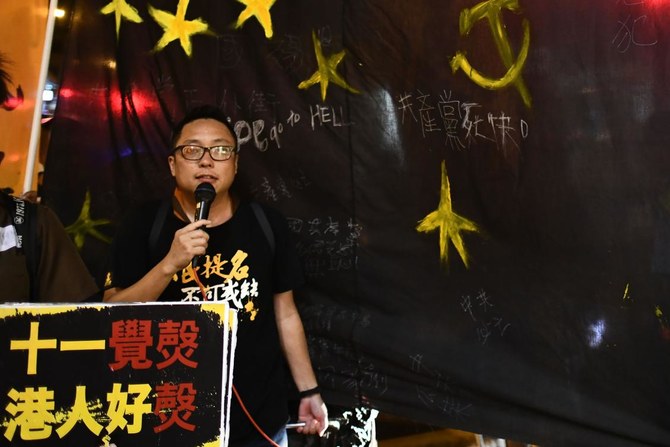
HONG KONG: An opposition activist was arrested in Hong Kong on Sunday by a new police squad for “uttering seditious words,” hours before a rally against a controversial security law.
The arrest of Tam Tak-chi, vice president of radical democratic party People Power, is the latest detention of a high-profile democracy supporter in the financial hub and came on the morning HongKongers had been due to vote in a general election, delayed because of the coronavirus.
An unauthorized protest in opposition to a new law that gives authorities sweeping powers — as well as the poll’s postponement and a Beijing-backed Covid-19 testing program — had more than 10,000 online subscribers.
Tam, a former radio presenter known “Fast Beat,” was arrested at his home in north east Hong Kong by police officers from the national security squad, although he was not detained under the new law, police said.
“The gentleman we arrested this morning was arrested for uttering seditious words under the Crimes Ordinance’s section ten,” senior superintendent Li Kwai-wah said, referring to legislation enacted in the British colonial era to clamp down anti-government expressions.
According to Li, Tam was held for using words that “brought into hatred and contempt of the government and raised discontent and disaffection among Hong Kong people” in speeches made across Hong Kong this summer.
Li said the national security police was leading the arrest because at the initial stage of investigation the force suspected Tam of committing “incitement to secession” in article 21 of the national security law.
“But after collection of evidence and consulting the Department of Justice, we decided that it is more suitable to use the Crimes Ordinance,” Li said.
Since the national security law was passed in Beijing and implemented in Hong Kong on 30 June, 21 people, including pro-democracy media mogul Jimmy Lai and prominent activist Agnes Chow, have been arrested for allegations of “incitement to secession,” “collusion with foreign forces” and “terrorism acts.”
Hong Kong’s administration insists the law has not impinged on the rights to freedom of speech and assembly guaranteed to the territory when it returned to Chinese rule in 1997.
Yet certain opinions and expressions in previously free-wheeling Hong Kong have become illegal, and activists have spoken of a deep chilling effect that has seen books yanked from libraries and publishers rush to amend their titles.

Hong Kong activist arrested for ‘seditious words’ before rally
https://arab.news/rcvdp
Hong Kong activist arrested for ‘seditious words’ before rally
- Arrest of Tam Tak-chi the latest detention of a high-profile democracy supporter in the financial hub
Venezuela says oil exports continue normally despite Trump blockade
- Trump warned “Venezuela is completely surrounded by the largest Armada ever assembled in the History of South America”
- Oil prices surged in early trading Wednesday in London on news of the blockade, which comes a week after US troops seized a sanctioned oil tanker
CARACAS: Venezuela struck a defiant note Wednesday, insisting that its crude oil exports were not impacted by US President Donald Trump’s announcement of a potentially crippling blockade.
Trump’s declaration on Tuesday marked a new escalation in his months-long campaign of military and economic pressure on Venezuela’s leftist authoritarian President Nicolas Maduro.
Venezuela, which has the world’s largest proven oil reserves, shrugged off the threat of more pain, insisting that it was proceeding with business as usual.
“Export operations for crude and byproducts continue normally. Oil tankers linked to PDVSA operations continue to sail with full security,” state oil company Petroleos de Venezuela (PDVSA) said.
Trump said Tuesday he was imposing “A TOTAL AND COMPLETE BLOCKADE OF ALL SANCTIONED OIL TANKERS going into, and out of, Venezuela.”
Referring to the heavy US military presence in the Caribbean — including the world’s largest aircraft carrier — he warned “Venezuela is completely surrounded by the largest Armada ever assembled in the History of South America.”
Oil prices surged in early trading Wednesday in London on news of the blockade, which comes a week after US troops seized a sanctioned oil tanker that had just left Venezuela with over 1 million barrels of crude.
Maduro held telephone talks with UN Secretary-General Antonio Guterres to discuss what he called the “escalation of threats” from Washington and their “implications for regional peace.”
Guterres’s spokesman said the UN chief was working to avoid “further escalation.”
- ‘We are not intimidated’ -
Venezuela’s economy, which has been in freefall over the last decade of increasingly hard-line rule by Maduro, relies heavily on petroleum exports.
Trump’s campaign appears aimed at undermining domestic support for Maduro but the Venezuelan military said Wednesday it was “not intimidated” by the threats.
The foreign minister of China, the main market for Venezuelan oil, defended Caracas in a phone call with his Venezuelan counterpart Yvan Gi against the US “bullying.”
“China opposes all unilateral bullying and supports all countries in defending their sovereignty and national dignity,” he said.
Last week’s seizure of the M/T Skipper, in a dramatic raid involving US forces rappelling from a helicopter, marked a shift in Trump’s offensive against Maduro.
In August, the US leader ordered the biggest military deployment in the Caribbean Sea since the 1989 US invasion of Panama — purportedly to combat drug trafficking, but taking particular aim at Venezuela, a minnow in the global drug trade.
US strikes on alleged drug-smuggling boats in the Caribbean and eastern Pacific have left at least 95 people dead since.
Caracas believes that the anti-narcotics operations are a cover for a bid to topple Maduro and steal Venezuelan oil.
The escalating tensions have raised fears of a potential US intervention to dislodge Maduro.
Mexican President Claudia Sheinbaum waded into the dispute on Wednesday, declaring that the United Nations was “nowhere to be seen” and asked that it step up to “prevent any bloodshed.”
- Oil lifeline -
The US blockade threatens major pain for Venezuela’s crumbling economy.
Venezuela has been under a US oil embargo since 2019, forcing it to sell its production on the black market at significantly lower prices, primarily to Asian countries.
The country produces one million barrels of oil per day, down from more than three million in the early 2000s.
Capital Economics analysts predicted that the blockade “would cut off a key lifeline for Venezuela’s economy” in the short term.
“The medium-term impact will hinge largely on how tensions with the US evolve — and what the US administration’s goals are in Venezuela.”


