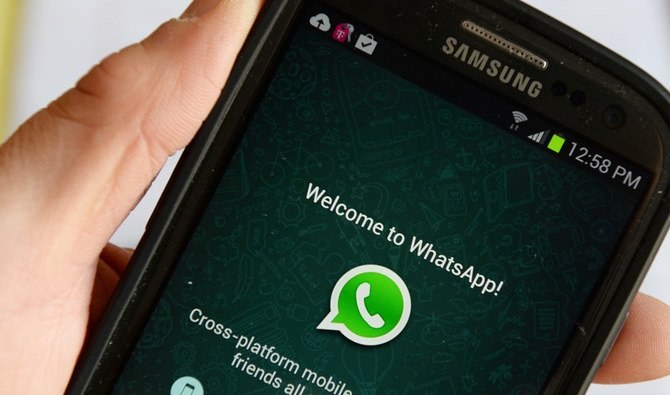

RIYADH: Saudi Arabia is developing a secure alternative to the short messaging service WhatsApp that will help ensure protection of confidential data.
The local messaging service will limit the Kingdom’s reliance on foreign companies and ensure that any confidential or sensitive data is safe on local servers.
A dedicated team of Saudi engineers and researchers at the King Abdul Aziz City for Science and Technology (KACST) is working on this project.
The instant message platform is expected to be ready in a year and will allow users to communicate in a secure environment as an alternative to Facebook’s WhatsApp and Tencent’s WeChat.
“This platform is being built on locally developed encrypted software and algorithms that will protect it from potential security vulnerabilities and help achieve the highest degree of security and privacy,” said Basil Al-Omair, director at the National Information Security Center at the KACST.
In a statement issued to the media, Al-Omair further said that the homegrown platform will also guarantee a safe exchange of both text and voice communications.
“The advantage of the app, designed by the all-Saudi workforce, is that it is free from external servers controlled by foreign agencies and will hence ensure confidentiality,” he added.
They are currently targeting government agencies, institutions and companies, and not the average user, he said.
Speaking to Arab News, Mohammed Khurram Khan, a professor of cybersecurity at the King Saud University in Riyadh, said: “It is indeed a great initiative taken by the KACST to develop an indigenous platform for secured file transfer and multimedia communication, which would have a multitude of benefits.”
He added: “It may create new job opportunities for local talent, develop intellectual property, provide homegrown secure application to public and private sector organizations, and offer bilingual communication interfaces for native users.”
In addition, its local development will ensure that it is free from any security backdoors and loopholes that allow hackers to perform cyberattacks, added Khan, who is also the founder and CEO of Global Foundation for Cyber Studies & Research in Washington, DC.
“This application will harness military-grade security for the confidentiality and integrity of communication and will provide end-to-end encryption for the private exchange of data,” he said.
He added that Saudi Vision 2030 underpins the importance of digitalization and cybersecurity and that this endeavor is in the pursuit of that program.
“Once this platform is successfully implemented and tested, it could be exported to generate revenue and boost the national economy,” said Khan.
The platform, he added, could be made scalable and may integrate with other services to provide additional functionalities, such as securing payment of bills, tickets and money transfer.