



CAIRO: With most credible information on COVID-19 and its symptoms supplied in English, Arabic-speaking populations have faced a significant barrier, falling prey to hysterical and inaccurate social media posts that come from questionable sources.
This urgent and potentially life-threatening problem was quickly identified by the team at DxWand, an Egyptian startup providing conversational artificial intelligence (AI) solutions — and they sought a fast and effective fix for it.
“In late February, we, as a team, were struggling to find credible information about COVID-19, and we found that one needs certain access to find credible information,” said Ahmed Mahmoud, co-founder of DxWand.
“That made us think about others who would find it challenging to make a distinction between credible and false information. Even on official websites it was sometimes hard to find an answer to a specific question. Or worse — you would get your information from social media.”
Enter Ask Nameesa, the startup’s newest conversational AI solution. The DxWand team has fed it all available databases on the precautions and symptoms around COVID-19. The databases are built on credible WHO information, as well as information and updates from local health authorities. The best part? It even answers questions using “day-to-day” language, such as Egyptian slang.
“One would only need to ask Nameesa a question via Facebook messenger or WhatsApp and it will respond within a few minutes with the most credible information it can find in its database, in Egyptian, Arabic or English,” Mahmoud said.
As an AI solution, Ask Nameesa has the ability to independently build up its knowledge based on the inquiries it receives, slowly broadening its scope and ability to answer very specific questions.
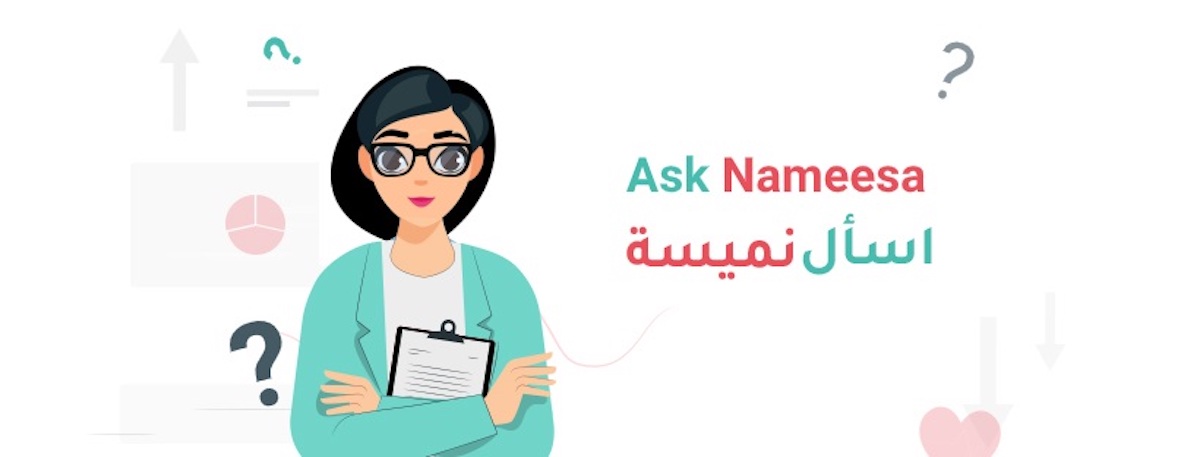
“Users make a valuable contribution to Ask Nameesa,” Mahmoud said. “It started with 22 knowledge-based items or categories; today, it has more than 200, and that comes from subcategories that people ask about, for instance, questions specific to COVID-19 and pregnant women or COVID-19 and alcohol consumption. If you try to find an answer to such questions online, you’d have to read lengthy articles, and you may or may not find the answer. Nameesa does that job for you and gets back to you with the most accurate information available.”
In a testament to its potential, Ask Nameesa was selected among the top 89 solutions out of more than 18,000 in the global #BuildforCOVID19 hackathon sponsored by the likes of Microsoft, Facebook and Google. It was only one of two regional creations to make it to the very top.
It also quickly garnered more than 50,000 followers on Facebook, which inspired the team to look into further expanding on it.
“We’re working on making Nameesa’s services sustainable and increase its reach geographically and demographically, which needs a bit of investment, so we’re looking into that,” Mahmoud said.
“It would also be of great value if we can collaborate with health care authorities so they can update the knowledge database with medication protocols for users who are reporting symptoms of COVID-19. We’re in discussion about that with authorities in the UAE and may soon launch a similar service there.”
However, it is not just tackling misinformation about COVID-19 that is on DxWand’s to-do list, Mahmoud said. The next step for the team could be building a fully fledged personalized health-care solution.
“We are looking into expanding the service beyond COVID-19 so that the platform or solution can basically build up knowledge on your medical record and then provide information about any care plan you should follow. It then follows up to make sure you’re complying with the plan or (determine) if changes are needed. The future is personalized care, not just for COVID-19,” he said.
---------------------
This report is being published by Arab News as a partner of the Middle East Exchange, which was launched by the Mohammed bin Rashid Al Maktoum Global Initiatives to reflect the vision of the UAE prime minister and ruler of Dubai to explore the possibility of changing the status of the Arab region.


