

Photographer uses drones to capture tourist treasures

Saudi photographer Hassan Al-Hresi says many of his followers from around the world are convinced that the Kingdom is a first-class tourist destination with pristine landscapes and magnificent sceneries. (Supplied)
Short Url
Updated 05 September 2020
Follow

Photographer uses drones to capture tourist treasures

  • Hassan Al-Hresi showcases sites such as Wahidah Waterfalls, Ghiyeh and Al-Qahar

MAKKAH: Saudi photographer Hassan Al-Hresi looks for opportunities day and night to venture upwards into the skies and shed light on the archaeological and tourist treasures of the Kingdom’s south.

He takes his audience on journeys during all seasons of the year so that they can experience and witness the southern landscapes that he captures through his lens.
The professional photographer, who is in his thirties, has documented distinctive destinations such as the Wahidah Waterfalls, Ghiyeh, Al-Qahar villages and other locations.
And he offers an exceptional experience, as he seeks to showcase the undiscovered despite the danger that these sites pose.
“These trips spark my passion like a high that has been there since my childhood,” Al-Hresi told Arab News.
“It is a dangerous profession due to the need to move across steep mountains and stay there for days with the necessary equipment to capture moments that immortalize the sites’ beauty and magnificence. These moments shed light on the beauty of the Kingdom’s southern region.”
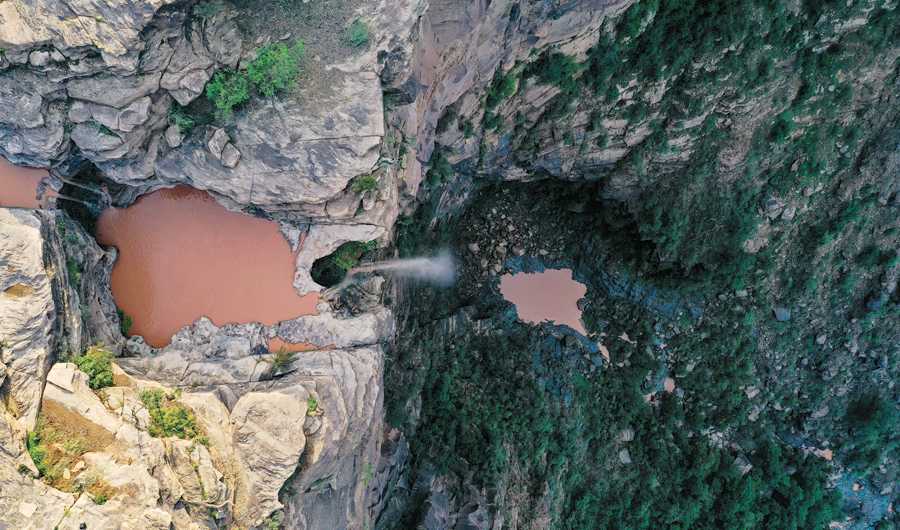

He said that many of his followers from around the world were convinced that Saudi Arabia was not just defined by camels and the desert, that it was a first-class tourist destination with pristine landscapes that were unimaginable by both locals and foreigners.
“Something fascinates you and takes your breath away as you film. It is the clouds covering the mountains and villages, the people living their lives amid continuous rainfall, Sarawat’s cold weather and Tihama’s moderate weather during winter, and how Saudis go about their daily lives in all their details according to a village life full of love.”

It is a dangerous profession due to the need to move across steep mountains and stay there for days with the necessary equipment to capture moments that immortalize the sites’ beauty and magnificence.

Hassan Al-Hresi, Saudi photographer

Al-Hresi said that photographing Al-Qahar mountains — a massif located 80 km northwest of Jazan with peaks rising 2,000 meters above sea level — was a fun trip particularly when using his drone, which has helped to uncover and depict such scenery in a wider and more comprehensive way.
“These images showed the villages located along the Kingdom’s deep south along with the simple village life of their residents, living at the heart of an unending natural beauty found in the greenery, the fog and the rain.”
The volcanic peaks that enrich Asir’s nature invited people to discover their scattered green areas that added to the region’s beauty, which he believed was unmatched by any other place in Saudi Arabia.


“This is particularly true in Mount Tahwi’s Ghiyeh village, which represents beauty in small, eye-catching and breathtaking geographical areas.”
The rock formations showcased in Al-Hresi’s images are, according to him, “some of the most important pillars of tourism in the world.”
He said it became even more worthwhile to document the Kingdom’s natural wealth amid the global coronavirus pandemic, which turned the focus of Saudis inwards and toward local travel and tourism.
He spoke of fortified and beautiful villages that showed off a particular type of architecture and construction, with forts built high in the mountains.
The fog-covered villages stand at high altitudes exceeding 2,400 meters above sea level, particularly those located in the areas of Al-Baha and Asir, and require twice as much effort to reach, especially when moving with equipment and drones.
“Al-Qahar mountains feature narrow valleys containing forest trees, along with drawings and inscriptions,” Al-Hresi said, adding that it was difficult to reach the mountain peaks due to their rough terrain.
“The rainwater falling on top of the mountain ends up in Wadi Bish Dam.”
Al-Qahar mountains stand tall on the cusp of Al-Raith governorate, east of Jazan, forming a fascinating scene. They are considered one of Al-Raith’s most beautiful sites due to their breathtaking nature and terrain, moderate weather and continuous rainfall throughout the year.


National program identifies 165 native plants for afforestation efforts in Asir

Updated 29 December 2025
Follow

National program identifies 165 native plants for afforestation efforts in Asir

  • The survey is part of broader plans focused on restoring degraded land, using native vegetation 

JEDDAH: Saudi Arabia’s National Afforestation Program has identified more than 165 species of native plants suitable for afforestation in the Asir region, highlighting the ecological diversity of one of the Kingdom’s most environmentally varied areas, the Saudi Press Agency reported.

The findings form part of broader national efforts to expand vegetation cover, address land degradation, and support sustainability goals linked to the Saudi Green Initiative and Vision 2030.

According to the program, the identified species are distributed across a wide range of natural environments in Asir, including mountainous terrain, highlands, slopes, valleys, plains, rocky landscapes, and coastal areas stretching from the Red Sea to Tihama.

The species belong to numerous plant families, including Fabaceae, Anacardiaceae, Burseraceae, Capparaceae, Ebenaceae, Euphorbiaceae, Malvaceae, Myrtaceae, Oleaceae, and Primulaceae, among others.

Plants suitable for afforestation range from large and small trees to perennial and annual shrubs, herbs, succulents, bulbs, and climbing plants. 

Among the most notable species identified are the grey mangrove, mastic tree, mooring or ben tree, juniper, sycamore fig, wild olive, henna, wild jasmine, hawthorn, and arak.

The Saudi Arabian Botanical Society described the announcement as an important step in protecting plant diversity and strengthening the ecosystem conservation in the Kingdom. 

Munirah bin Hamad Al-Hazani, founder and president of the society, said that prioritizing native species is central to sustainable afforestation.

“Focusing on the cultivation of native plants adapted to diverse environments forms the cornerstone of sustainable afforestation projects, as it plays a pivotal role in enhancing vegetation cover, combating land degradation, and conserving natural and financial resources,” she told Arab News.

Al-Hazani added that long-term success depends on cooperation between government bodies and the nonprofit sector, alongside community involvement and environmental awareness programs.

The National Afforestation Program has increasingly emphasized community participation, working with government agencies, private companies, and nonprofit organizations to support planting initiatives and environmental education. Its approach includes promoting volunteerism and discouraging harmful environmental practices, while focusing on the use of native plants adapted to local conditions.

Parallel efforts are underway in other regions of the Kingdom to support vegetation restoration through research and infrastructure development. In Jouf, often referred to as the Kingdom’s food basket, the King Salman bin Abdulaziz Royal Reserve Development Authority has established a Central Nursery and a Wild Seeds Research and Production Station to address the growing demand for reliable sources of native seeds and seedlings.

The project was launched in 2023 under the directive of Prince Abdulaziz bin Saud bin Naif, the minister of interior and chairman of the authority’s board of directors. 

Since then, the facilities has become a key component of vegetation restoration efforts within the reserve.

The authority has focused on building operational capacity by recruiting and training specialists to manage cultivation and research activities. The research and production station includes 14 mother-seed production fields containing over 400,000 trees and shrubs. 

Planting began in late 2024, with more than 30 native plant species represented, selected for their role in the reserve’s natural ecosystem. 

The facility also includes two seed storage units with a combined capacity of 3,000 kilograms. Seeds are collected annually from multiple sites within the reserve and used for seedling production habitat rehabilitation.

The Central Nursery spans 6,000 square meters and includes 30 greenhouses spanning 1,500 square meters, as well as two shade houses used during summer months. A plant hardening facility, designed to prepare seedlings for natural environmental conditions, covers 10,000 square meters and is divided into seven sections. The nursery’s annual production capacity reaches 1.5 million seedlings, representing more than 15 native plant species. 

Together, these initiatives underscore the growing role of native plant research and propagation in Saudi Arabia’s afforestation strategy, particularly as the Kingdom works to balance environmental restoration with long-term sustainability goals.