

Rehabilitation of Saudi heritage village of Rijal Alma complete to join UNESCO’s list

1 / 6
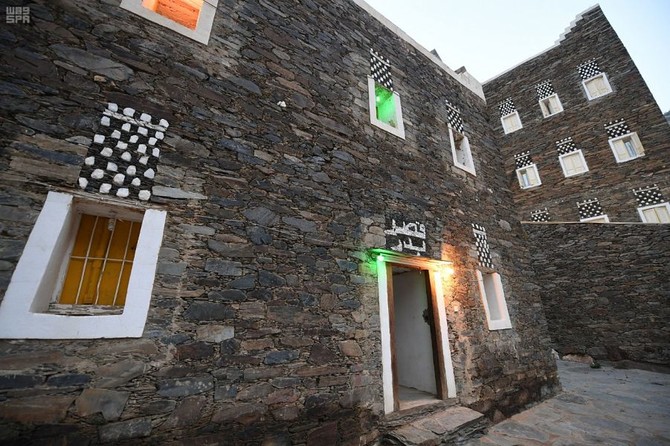
Restoration work at the famed village of Rijal Alma in Asir region is now complete. (SPA)
2 / 6
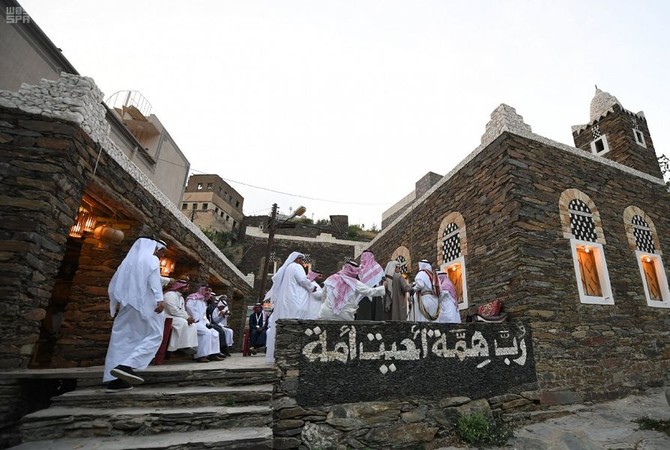
Restoration work at the famed village of Rijal Alma in Asir region is now complete. (SPA)
3 / 6
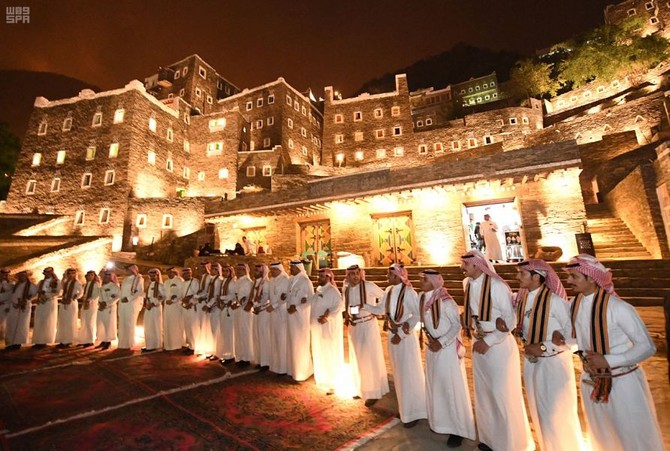
Restoration work at the famed village of Rijal Alma in Asir region is now complete. (SPA)
4 / 6
Restoration work at the famed village of Rijal Alma in Asir region is now complete. (SPA)
5 / 6
Restoration work at the famed village of Rijal Alma in Asir region is now complete. (SPA)
6 / 6
Restoration work at the famed village of Rijal Alma in Asir region is now complete. (SPA)
Updated 05 December 2018
Follow

Rehabilitation of Saudi heritage village of Rijal Alma complete to join UNESCO’s list

  • The famed Saudi village includes tens of castles built with hard stones, painting a unique landscape with its architecture, delicate engravings and the illuminated lamps on its road sides
  • Rijal Alma is just one of many sites in Saudi Arabia that are being readied for the growing tourism industry in the Kingdom

JEDDAH: Some eight government bodies have completed their work in preparing the archaeological site of the village of Rijal Alma in the southern province of Asir to join the UNESCO’s World Heritage List. 

The famed Saudi village, which lies 50 km west of Abha city, includes tens of castles built with hard stones, painting a unique landscape with its architecture, delicate engravings and the illuminated lamps on its road sides. 

A tour by the Saudi Press Agency on Saturday at the site has overseen the village’s rich history and heritage which had made it nominated to join the UNESCO’s World Heritage List.

Work at the site began around two months ago, under instructions from his royal highness Prince Faisal bin Khalid bin Abdel Aziz, Emir of Assir region, and the continuous follow up tom his deputy  Prince Turki bin Talal bin Abdulaziz and Prince Sultan bin Salman bin Abdulaziz, Chairman of the Saudi Commission for Tourism and National Heritage, to meet the requirements of joining the village to the World Heritage List. 

Restoration works as well as efforts to meet the UNESCO requirements at the site were carried by the Rijal Alma Municipality and the Saudi Commission for Tourism and Heritage, and a branch of the Ministry of Islamic Guidance, and the Transport and Environment Ministries. 

A visual presentation seen by the media delegation during the visit has highlighted the main works conducted at Rijal Alma, during which the Saudi Commission renovated and modified facades of some of the village buildings and decorated its general council. 

As well as building a wall to protect the visitors center from floods, and replacing instruction signs with smaller ones that are more suitable for the site’s environment. 

The municipality has also removed new cement buildings at the site and rebuilt historic ones with stones from the site, in addition to removing guest rooms and replaced with an open style setting that is suitable for the village environment and to rearrange the village lighting with a more traditional style. 

Some of the modern stone writings were corroborated, and concrete murals were treated in the village and the roofs of shops were covered. 

The Ministry of Islamic Affairs has also prepared the site’s mosque and its components. 

Also, the SCTH has also ordered the continuation to implement an archaeological excavation at the Asham historical site in the western region of Baha for the third season.

The project is one of 44 archaeological projects being implemented by the Commission during this year. 

A specialized team led by Khalid Bin Mohammed AlZahrani and a number of researchers, specialists, and technicians from antiquities and museum sectors in SCTH began to reveal architectural details of the area. 

They focused on the industrial zone of the area to uncover a number of furnaces and smelting and casting tools, that the site is characterized with since the pre-Islamic period. 

The approval of the Commission’s chairman follows the success achieved in the first two seasons, which focused its work in the commercial market area and in the mosque area. 

These works have led to discovering a number of architectural elements in the market area consisting of two adjacent shops and an open courtyard may have been used to exchange various goods.



Nobel Prize winner discusses art of writing at Ithra

Updated 06 December 2025
Follow

Nobel Prize winner discusses art of writing at Ithra

  • Jon Fosse offers insights into storytelling at the 10th iRead celebration

DHAHRAN: Nobel Prize-winning Norwegian author and playwright Jon Fosse drew a full house to Ithra on Friday, as he discussed art, writing, and the human experience during a session entitled “Nobel Minds” at the 10th edition of the institution’s iRead program.

Fosse, who won the 2023 Nobel Prize in Literature, appeared on stage with moderator Tariq Khawaji, Ithra’s cultural consultant.

Jon Fosse, who won the 2023 Nobel Prize in Literature, appeared on stage with moderator Tariq Khawaji, Ithra’s cultural consultant. (Supplied)

Outside, the landmark Ithra building, designed by Norwegian firm Snohetta, was lit in purple to mark the celebration. 

Fosse, whose work includes more than 70 novels, plays, poems, essays, and children’s books, and has been translated into more than 50 languages, including Arabic, is known for his minimalist, introspective style. His unconventional syntax and pared-down prose have significantly influenced postdramatic theater and contemporary experimental fiction. 

HIGHLIGHTS

• The landmark Ithra building, designed by Norwegian firm Snohetta, was lit in purple to mark the 10th anniversary of the institution’s iRead program.

• During the ‘Nobel Minds’ session, Jon Fosse discussed his writing process, sources of inspiration, and how writers might develop their own signature styles.

• Tariq Khawaji told Arab News that bringing Fosse to Saudi Arabia was especially meaningful as Arabic translations of his work remain relatively new to many readers. 

Khawaji told Arab News that bringing Fosse to Saudi Arabia was especially meaningful as Arabic translations of his work remain relatively new to many readers. 

Jon Fosse, who won the 2023 Nobel Prize in Literature, appeared on stage with moderator Tariq Khawaji, Ithra’s cultural consultant. (Supplied)

At a book signing following the session, he noted that Fosse’s pared-back lyrical language is a boon to both translators and new audiences. 

“I think one of Fosse’s strengths is his extremely simple language, he always uses the simplest phrasing and avoids inflated vocabulary or difficult expressions. This is why translators often find his writing both lyrical and clear,” Khawaji said. 

If I’m writing well, I have to bring something new to the book for me, and hopefully also for other people; something that didn’t exist before.

Jon Fosse, Norwegian Nobel laureate

“I think he speaks to the world through the problem of the individual — this tendency toward the quiet, the stripped-down. And I believe the Norwegian landscape, especially the western region, plays a very strong role in shaping him. His characters often feel like they come from a place with vast silence and depth. Even outside the session, you could sense many layers in how he spoke — something almost carved by that landscape,” he continued.

On the topic of artificial intelligence, Fosse said that while it can mimic a writer’s voice, it cannot replicate the essence behind it. (Supplied)

After noting Fosse’s 18 major awards, Khawaji added: “I think his Arabic readership is still small — though his plays have been translated and performed. I believe introducing him to the Arab world will increase his readership significantly, and I think the reception will change. Readers will discover a unique, unfamiliar voice. It was important to have him here.”

During his hour-long English-language conversation with Khawaji before the book signing, Fosse discussed his writing process, sources of inspiration, and how writers might develop their own signature styles.

“I think you can say all literature, in a certain sense, comes from literature. So the more you read — and the better literature you read — the cleverer you most likely will be,” he said.

“If I’m writing well, I have to bring something new to the book for me, and hopefully also for other people; something that didn’t exist before. And to get to that, you have to leave yourself (somehow). If you don’t leave yourself, you know exactly what you knew before,” he added.

On the topic of artificial intelligence, Fosse said that while it can mimic a writer’s voice, it cannot replicate the essence behind it.

“I’ve done it myself. I asked the computer to write something (in my style) and it was like a kind of parody, but still there were some very interesting sides to it. And there were some great metaphors that happened that I couldn’t have figured out myself,” he said. 

“Perhaps it is a childish idea but I think that art has so much to do with this universal individuality of the artist. It cannot possibly be replaced by a machine,” Fosse concluded.