Abbas forum decries ‘dagger in the back of Palestinians’

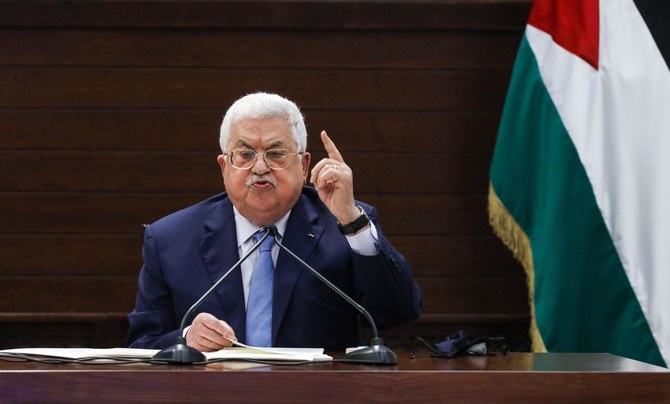
President Mahmoud Abbas speaks in Ramallah on Sep. 3, 2020, as he meets by video conference with representatives of Palestinian factions gathered at the Palestinian embassy in Beirut. (AFP)
Short Url
Updated 04 September 2020
Follow

Abbas forum decries ‘dagger in the back of Palestinians’

  • PLO executive committee member Hanan Ashrawi told Arab News that the meeting offered people hope
  • The meeting ended with Fatah’s secretary-general, reading a communique agreed to by all participants

AMMAN: Palestinian nationalists and Islamic leaders met in response to a call by President Mahmoud Abbas for a show of unity, outlining plans to forge ahead with a “new strategy for resistance and liberation.”
Leaders of Palestinian factions met on Thursday at the Ramallah presidential headquarters along with spokesmen from abroad who joined by video conferencing.
In a lengthy speech, Abbas called for legislative and presidential elections, and outlined the leadership’s rejection of the Trump plan, the Israeli annexation and the UAE’s normalization agreement.
“Our national decision is our exclusive right, and we cannot accept anyone speaking in our name,” he said. “We have not and will not authorize anyone to do so. The Palestinian decision is the right of the Palestinians alone, and we have paid a dear price for it.”
Although Hamas and Islamic Jihad are not yet part of the PLO, Abbas said that “the Palestine Liberation Organization will remain the sole and legitimate representative of the Palestinian people.”
He added: “All national forces and factions must join the PLO in order to protect and reinforce its status as an umbrella of all the Palestinians in the homeland and in the diaspora.”
The five-hour meeting, which was broadcast live on Palestine TV, ended with Jibril Rajoub, Fatah’s secretary-general, reading a communique agreed to by all participants.
“The Palestinian people, with all its components, at the forefront of which is the Palestinian leadership meeting today headed by President Abbas, affirms its absolute rejection of all projects aimed at liquidating our national cause and our legitimate rights,” the statement read.
“The leadership condemns all manifestations of normalization with the occupation and considers this a dagger in the back of the Palestinian people and the Arab and Islamic nations. The Palestinian leadership calls on our (Arab and Muslim) peoples and the free peoples of the world to confront with all the strength they have all of these liquidation plans.”
PLO executive committee member Hanan Ashrawi told Arab News that the meeting offered people hope.
“The decisions taken at this meeting were important, but they need an active political will to translate these decisions on the ground.”
Hamadeh Faraneh, a member of the Palestine National Council, told Arab News that the Palestinian leadership had shown that “it is possible to build on this unprecedented meeting and come back with practical solutions that end the split, accomplish reconciliation and re-establish the PLO with all parties and factions in it.”
Faraneh said that of the 14 speakers at the meeting eight were in Ramallah and six in Beirut. “The key will be the next steps that will include a strategy to deal with the challenges of the US plan and normalization.”
Rifat Kassis, a political activist and general coordinator of Kairos Palestine, described the meeting as a step in the right direction.
“Despite the fears and lack of faith in the PLO, I think that the meeting and attempts to regroup are signs of progress,” he said.
Kassis said that the leaders have to “work hard and be actively involved with the struggle if they want to regain the trust of the people.”


Netanyahu says Israel and Hamas will enter ceasefire’s second phase soon

Updated 08 December 2025
Follow

Netanyahu says Israel and Hamas will enter ceasefire’s second phase soon

  • Says the second phase addresses the disarming of Hamas and withdrawal of Israeli troops from Gaza
  • Second stage also includes the deployment of an international force to secure Gaza and forming a temporary Palestinian government

TEL AVIV, Israel: Israeli Prime Minister Benjamin Netanyahu said Sunday that Israel and Hamas are “very shortly expected to move into the second phase of the ceasefire,” after Hamas returns the remains of the last hostage held in Gaza.
Netanyahu spoke during a news conference with visiting German Chancellor Friedrich Merz and stressed that the second phase, which addresses the disarming of Hamas and the withdrawal of Israeli troops from Gaza, could begin as soon as the end of the month.
Hamas has yet to hand over the remains of Ran Gvili, a 24-year-old police officer who was killed in the Hamas-led Oct. 7, 2023, attack that sparked the war. His body was taken to Gaza.
The ceasefire’s second stage also includes the deployment of an international force to secure Gaza and forming a temporary Palestinian government to run day-to-day affairs under the supervision of an international board led by US President Donald Trump.
A senior Hamas official on Sunday told The Associated Press the group is ready to discuss “freezing or storing or laying down” its weapons as part of the ceasefire in a possible approach to one of the most difficult issues ahead.

Netanyahu says second phase will be challenging
Netanyahu said few people believed the ceasefire’s first stage could be achieved, and the second phase is just as challenging.
“As I mentioned to the chancellor, there’s a third phase, and that is to deradicalize Gaza, something that also people believed was impossible. But it was done in Germany, it was done in Japan, it was done in the Gulf States. It can be done in Gaza, too, but of course Hamas has to be dismantled,” he said.
The return of Gvili’s remains — and Israel’s return of 15 bodies of Palestinians in exchange — would complete the first phase of Trump’s 20-point ceasefire plan.
Hamas says it has not been able to reach all remains because they are buried under rubble left by Israel’s two-year offensive in Gaza. Israel has accused the militants of stalling and threatened to resume military operations or withhold humanitarian aid if all remains are not returned.
A group of families of hostages said in a statement that “we cannot advance to the next phase before Ran Gvili returns home.”
Meanwhile, Israeli military Chief of Staff Lt. Gen. Eyal Zamir on Sunday called the so-called Yellow Line that divides the Israeli-controlled majority of Gaza from the rest of the territory a “new border.”
“We have operational control over extensive parts of the Gaza Strip and we will remain on those defense lines,” Zamir said. “The Yellow Line is a new border line, serving as a forward defensive line for our communities and a line of operational activity.”
Germany says support for Israel is unchanged
Merz said Germany, one of Israel’s closest allies, is assisting with the implementation of the second phase by sending officers and diplomats to a US-led civilian and military coordination center in southern Israel, and by sending humanitarian aid to Gaza.
The chancellor also said Germany still believes that a two-state-solution is the best possible option but that “the German federal government remains of the opinion that recognition of a Palestinian state can only come at the end of such a process, not at the beginning.”
The US-drafted plan for Gaza leaves the door open to Palestinian independence. Netanyahu has long asserted that creating a Palestinian state would reward Hamas and eventually lead to an even larger Hamas-run state on Israel’s borders.
Netanyahu also said that while he would like to visit Germany, he hasn’t planned a diplomatic trip because he is concerned about an arrest warrant issued by the International Criminal Court, the UN’s top war crimes court, last year in connection with the war in Gaza.
Merz said there are currently no plans for a visit but he may invite Netanyahu in the future. He added that he is not aware of future sanctions against Israel from the European Union nor any plans to renew German bans on military exports to Israel.
Germany had a temporary ban on exporting military equipment to Israel, which was lifted after the ceasefire began on Oct. 10.
Israel kills militant in Gaza
The Israeli military said it killed a militant who approached its troops across the Yellow Line.
Gaza’s Health Ministry says Israeli forces have killed more than 370 Palestinians since the start of the ceasefire, and that the bodies of six people killed in attacks had been brought to local hospitals over the past 24 hours.
In the original Hamas-led attack in 2023, the militants killed around 1,200 people and took more than 250 others hostage. Almost all the hostages or their remains have been returned in ceasefires or other deals.
Israel’s offensive in Gaza has killed at least 70,360 Palestinians, according to Gaza’s Health Ministry, which operates under the Hamas-run government. The ministry does not differentiate between civilians and combatants, but says that nearly half the dead have been women and children. The ministry is part of Gaza’s Hamas government and its numbers are considered reliable by the UN and other international bodies.