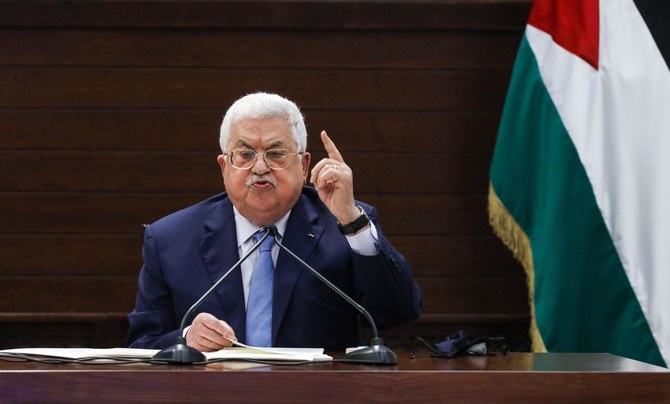
AMMAN: Palestinian nationalists and Islamic leaders met in response to a call by President Mahmoud Abbas for a show of unity, outlining plans to forge ahead with a “new strategy for resistance and liberation.”
Leaders of Palestinian factions met on Thursday at the Ramallah presidential headquarters along with spokesmen from abroad who joined by video conferencing.
In a lengthy speech, Abbas called for legislative and presidential elections, and outlined the leadership’s rejection of the Trump plan, the Israeli annexation and the UAE’s normalization agreement.
“Our national decision is our exclusive right, and we cannot accept anyone speaking in our name,” he said. “We have not and will not authorize anyone to do so. The Palestinian decision is the right of the Palestinians alone, and we have paid a dear price for it.”
Although Hamas and Islamic Jihad are not yet part of the PLO, Abbas said that “the Palestine Liberation Organization will remain the sole and legitimate representative of the Palestinian people.”
He added: “All national forces and factions must join the PLO in order to protect and reinforce its status as an umbrella of all the Palestinians in the homeland and in the diaspora.”
The five-hour meeting, which was broadcast live on Palestine TV, ended with Jibril Rajoub, Fatah’s secretary-general, reading a communique agreed to by all participants.
“The Palestinian people, with all its components, at the forefront of which is the Palestinian leadership meeting today headed by President Abbas, affirms its absolute rejection of all projects aimed at liquidating our national cause and our legitimate rights,” the statement read.
“The leadership condemns all manifestations of normalization with the occupation and considers this a dagger in the back of the Palestinian people and the Arab and Islamic nations. The Palestinian leadership calls on our (Arab and Muslim) peoples and the free peoples of the world to confront with all the strength they have all of these liquidation plans.”
PLO executive committee member Hanan Ashrawi told Arab News that the meeting offered people hope.
“The decisions taken at this meeting were important, but they need an active political will to translate these decisions on the ground.”
Hamadeh Faraneh, a member of the Palestine National Council, told Arab News that the Palestinian leadership had shown that “it is possible to build on this unprecedented meeting and come back with practical solutions that end the split, accomplish reconciliation and re-establish the PLO with all parties and factions in it.”
Faraneh said that of the 14 speakers at the meeting eight were in Ramallah and six in Beirut. “The key will be the next steps that will include a strategy to deal with the challenges of the US plan and normalization.”
Rifat Kassis, a political activist and general coordinator of Kairos Palestine, described the meeting as a step in the right direction.
“Despite the fears and lack of faith in the PLO, I think that the meeting and attempts to regroup are signs of progress,” he said.
Kassis said that the leaders have to “work hard and be actively involved with the struggle if they want to regain the trust of the people.”


![]()

Abbas forum decries ‘dagger in the back of Palestinians’
Short Url
https://arab.news/636z8
Abbas forum decries ‘dagger in the back of Palestinians’
- PLO executive committee member Hanan Ashrawi told Arab News that the meeting offered people hope
- The meeting ended with Fatah’s secretary-general, reading a communique agreed to by all participants


Latest updates




Recommended


© 2026 SAUDI RESEARCH & PUBLISHING COMPANY, All Rights Reserved And subject to Terms of Use Agreement.