


ISLAMABAD: Pakistan is installing glacial monitoring stations and new systems to keep track of watercourses and water levels to prepare against natural disasters, particularly in the country’s northern areas most vulnerable to glacial floods and land sliding, a top official said this week.
The new project is being installed across the northwestern province of Khyber Pakhtunkhwa and Gilgit-Baltistan with $40 million funding from the Green Climate Fund, established within the United Nations framework to help developing countries counter climate change.

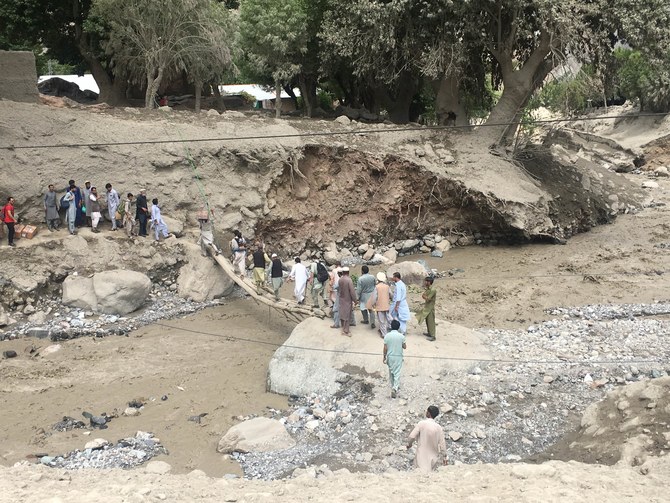
The main mosque in Reshun, Upper Chitral, is seen on Aug. 29, 2020, after flash floods in the northernmost region of Pakistan destroyed its building. (AN photo)
Under the project, around 24 valleys in the northern areas are scheduled to receive warning systems between 2018 and 2022 for glacial lake outburst floods (GLOF), including around 50 glacial monitoring stations and 400 river flow telemetry systems that can monitor different types of watercourses and keep track of water levels to predict flooding.
“The early warning systems have a crucial role to play in adapting to climate change in a country as vulnerable to it as Pakistan,” Malik Amin Aslam, who advises Prime Minister Imran Khan on climate change, told Arab News in an interview.
Pakistan, a South Asian nation of 220 million, is the fifth most vulnerable country to climate change. Its northern areas are home to 7,000 glaciers and 3,044 glacial lakes.
Between 1999 and 2018, 10,000 people have been killed in 152 extreme weather events, with economic losses incurred in the range of $3.8 billion, according to the Global Climate Risk Index annual report for 2020.
GLOFs are sudden events which can release millions of cubic meters of water and debris, leading to potential loss of lives, property and livelihoods in remote and impoverished mountain communities, according to a UNDP report. Over 7.1 million people in Gilgit-Baltistan and Khyber Pakhtunkhwa are vulnerable.
“Any changes in glacial melting rates and river flooding in the north needs to be known as early as possible for an effective response and to save human lives,” the climate change adviser said, adding that the country was enhancing the Pakistan Meteorological Department’s capacity and adding weather stations across the country to deal with the adverse impacts of climate change.
Fahad Bashir Bangash, project-director GLOF at the UNDP, told Arab News the new system would be an “integrated system comprising the necessary equipment, local communities and relevant public departments to timely alert the people in case of any emergency.”
After completion, he said, the project would benefit at least 700,000 people directly, and 29 million indirectly while also boosting food security and reforestation of 35,000 hectares of land.
“Our main focus is to make this project sustainable by making the government allocate funds in its annual budget for maintenance and repair of the systems,” Bangash said.
Climate change experts believe the government should formulate a national adaptation plan at the earliest to mitigate the impact of climate change.
“We need to strengthen our adaptive resilience and we need to plan ahead of time for known actions that will happen as a result of climate change,” Aisha Khan, chief executive of the Civil Society Coalition for Climate Change, told Arab News.
#LISTEN: "#Pakistan is a victim of the climate change", says chief executive of the Civil Society Coalition for #ClimateChange @aisha4climate adding that the govt. must make a national adaptation plan at the earliest
-
Read special by @AamirSaeed_ : https://t.co/6BLCQugb4t pic.twitter.com/kM9BpHDYd4— Arab News Pakistan (@arabnewspk) September 3, 2020
She said that meteorological departments had warned “way ahead of time” that monsoon rains this year would be intense, but no preparations were made to prevent urban flooding.
“The greenhouse gases in the atmosphere will have their impact. Even if we become zero carbon [emitter] today, they will play out their role,” Khan said. “Climate change has begun to happen, and it will get worse with every year. Our preparedness will make the difference in saving lives and livelihoods.”


