

US envoy joins calls for drastic reform in Lebanon

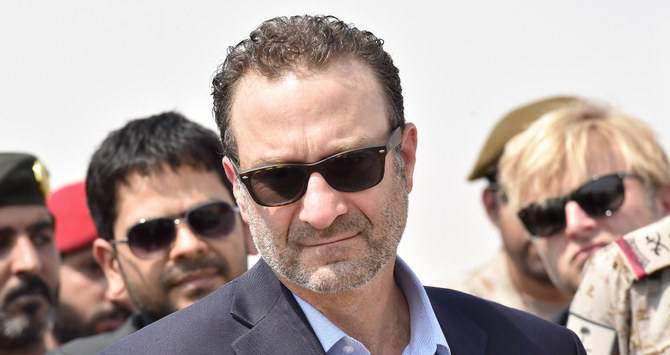
US Assistant Secretary for Near Eastern Affairs David Schenker. (File/AFP)
Short Url
Updated 03 September 2020
Follow

US envoy joins calls for drastic reform in Lebanon

  • Macron warning sparks talks to form crisis Cabinet

BEIRUT: US Assistant Secretary for Near Eastern Affairs David Schenker called on Lebanon’s leaders to implement drastic and wide-ranging reforms as he launched a two-day visit to the crisis-stricken country on Wednesday.

Schenker said that he wants to see reforms that “respond to the Lebanese people’s desire for transparency, accountability and a government free of corruption.”

Diplomatic sources told Arab News that Schenker’s program of meetings is “unusual and unexpected.”

The US official will meet civilian and business leaders for talks related to US aid after the Beirut port explosion on Aug. 4.

Schenker’s arrival follows French President Emmanuel Macron’s second visit to Lebanon during which he made any French bailout conditional on widespread reforms.

Macron gave Lebanese officials “15 days to form the government and eight weeks to implement the promises.”

In a press release, the French leader said: “If you honor your commitments, we will honor ours. Otherwise, there is no blank check and we will not be able to support Lebanon.”

He also said that if the new leadership failed to honor its commitments, “those hindering these efforts will be named.”

Macron managed to bring together rival party officials at the Residence des Pins, the French ambassador’s residence, for a meeting attended by Saad Hariri (Future Movement), Walid Jumblatt and his son Taymour Jumblatt (Progressive Socialist Party), Gebran Bassil (Free Patriotic Movement), Samir Geagea (Lebanese Forces), Mohammed Raad (Hezbollah), Samy Gemayel (Kataeb), Sulaiman Frangieh (Marada) and Ibrahim Azar (Nabih Berri bloc).

Mustapha Adib, Lebanon’s prime minister-designate, said on Wednesday he wants to swiftly form a government of specialists to implement urgent reforms that can regain the trust of the Lebanese and the international community.

Earlier the 48-year-old diplomat held talks with MPs over the formation of a new crisis Cabinet.

During the talks the Future Movement called for “the swift formation of a government of specialists,” while the Hezbollah bloc said it wanted to see a government that is “effective, productive and coherent, and understands the political reality.”

However, Berri’s bloc insisted on keeping the finance portfolio as a “fundamental matter” amid signs of a looming dispute over who will take over the Ministry of Finance.

The Progressive Socialist Party called for “a capable government that makes reforms first, starting with the French initiative which is the last chance.”

The Lebanese Forces’ bloc demanded a government that is “independent, made of specialists and committed to neutrality,” and also announced that the party will not be part of government.

Meanwhile, the Free Patriotic Movement called for “rotating ministries,” with a reassignment of portfolios allocated for other parties.

MP Osama Saad described the events as “the new look of an expired system.”

“The crises and collapses will not stop in Lebanon,” he said.

Following the talks, Adib said that “there is more common ground among the Lebanese than points of disagreement, which can be resolved by dialogue.”

After a meeting with the Maronite Patriarch Bechara Boutros Al-Rai on Wednesday, the Maronite patriarchs called for “a salvation government that does not have any party or political affiliation, with the necessary exceptional powers to be able to make reforms, combat corruption and achieve economic advancement.”

The patriarchs said that “Arab and international concern should be a building block for Lebanon’s salvation.”


Lebanon PM publishes long-awaited banking law draft

Updated 19 December 2025
Follow

Lebanon PM publishes long-awaited banking law draft

  • The law stipulates that each of the state, the central bank, commercial banks and depositors will share the losses accrued as a result of the financial crisis.
  • Depositors with a limit of $100,000, over the course of four years

BEIRUT: Lebanese Prime Minister Nawaf Salam published on Friday a long-awaited banking draft bill, which distributes losses from the 2019 economic crisis between banks and the state.
The draft law is a key demand from the international community, which has conditioned economic aid to Lebanon on financial reforms.
In a televised speech, Salam said “this draft law constitutes a roadmap to getting out of the crisis” that still grips Lebanon.
The draft will be discussed by the Lebanese cabinet on Monday before being sent to parliament, where it could be blocked.
The law stipulates that each of the state, the central bank, commercial banks and depositors will share the losses accrued as a result of the financial crisis.
Depositors, who lost access to their funds after the crisis, will be able to retrieve their money, with a limit of $100,000, over the course of four years.
Salam said that 85 percent of depositors had less than $100,000 in their accounts.
The wealthiest depositors will see the remainder of their money compensated by asset-backed securities.
“I know that many of you are listening today with hearts full of anger, anger at a state that abandoned you,” Salam said.
“This bill may not be perfect... but it is a realistic and fair step toward restoring rights, halting the collapse.”

- ‘Banks are angry’ -

The International Monetary Fund, which closely monitored the drafting of the bill, had previously insisted on the need to “restore the viability of the banking sector consistent with international standards” and protect small depositors.
The Associations of Banks in Lebanon criticized the draft law on Monday, saying in a statement that it contains “serious shortcomings” and harms commercial banks.
“Banks are angry because the law opens the door to them sharing any part of the losses,” said Sami Zougheib, researcher at The Policy Initiative, a Beirut-based think tank.
He told AFP that banks would have preferred that the state bear full responsibility.
The text provides for the recapitalization of failing banks, while the government’s debt to the Central Bank will be converted into bonds.
Salam said that the bill aims to “revive the banking sector” which had collapsed, giving free rein to a parallel economy based on cash transactions, which facilitate money laundering and illicit trade.
According to government estimates, the losses resulting from the financial crisis amounted to about $70 billion, a figure that is expected to have increased over the six years that the crisis was left unaddressed.
Since assuming power, Salam and President Joseph Aoun have pledged to implement the necessary reforms and legislation.
In April, Lebanon’s parliament adopted a bank restructuring law, as the previous legislation was believed to have allowed a flight of capital at the outbreak of the 2019 crisis.
The new bill stipulates that politically exposed persons and major shareholders who transferred significant capital outside the country from 2019 onwards — while ordinary depositors were deprived of their savings — must return them within three months or face fines.
The draft law could still be blocked by parliament even if the cabinet approves it.
“Many lawmakers are directly exposed as large depositors or bank shareholders, politically allied with bank owners, and unwilling to pass a law that either angers banks or angers depositors,” Zougheib said.
Politicians and banking officials have repeatedly obstructed the reforms required by the international community for Lebanon to receive financial support.