Trial begins over Charlie Hebdo terrorist killings that shook France

1 / 3
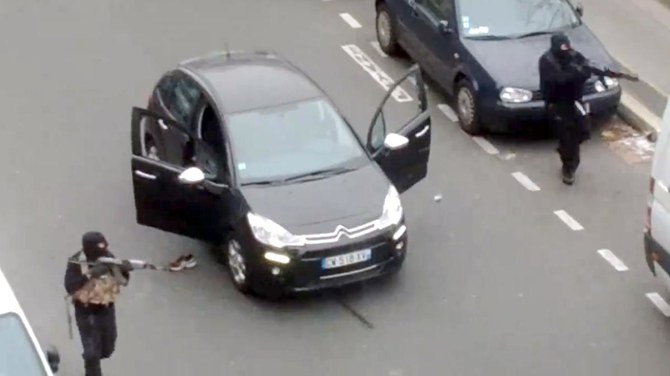
Hooded gunmen Cherif Kouachi and his brother Said Kouachi aiming Kalashnikov rifles toward police officer Ahmed Merabet, before shooting him dead after leaving the office of the satirical weekly newspaper Charlie Hebdo on Jan. 7, 2015. (FILE/AFP/Courtesy of Jordi Mir)
2 / 3
Hooded gunmen Cherif Kouachi and his brother Said Kouachi aiming Kalashnikov rifles toward a police officer, before shooting him dead after leaving the office of the satirical weekly newspaper Charlie Hebdo on Jan. 7, 2015. (FILE/AFP/Courtesy of Jordi Mir)
3 / 3
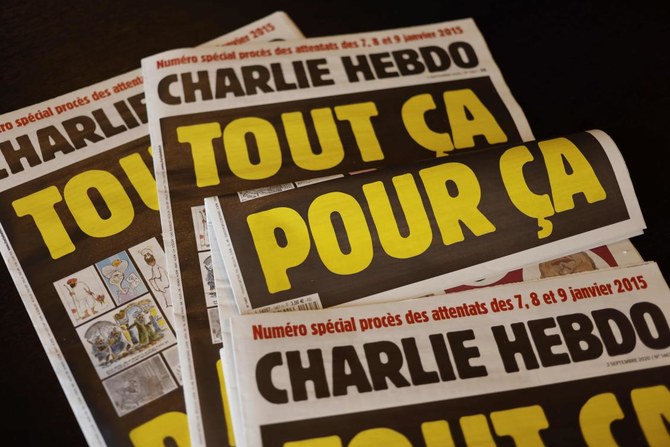
The covers of French satirical weekly Charlie Hebdo reading “All of this, just for that,” to be published on Sept. 2 to mark this week’s start of the trial for 14 accused in Jan. 2015 jihadist attacks in Paris. (AFP)
Short Url
Updated 02 September 2020
Follow

Trial begins over Charlie Hebdo terrorist killings that shook France

  • Evidence will be presented by 150 witnesses and experts
  • The Daesh-claimed France attacks that started on Jan. 7, 2015 saw 250 people killed

PARIS: Fourteen people accused of helping terrorist gunmen attack the French satirical weekly Charlie Hebdo and a Jewish supermarket went on trial Wednesday, over five years after days of terror that sent shockwaves through France.
The attacks that began on Jan. 7, 2015 sparked a series of terrorist attacks on French soil, including “lone wolf” killings by people said to be inspired by the Daesh group that have since claimed more than 250 lives.
The weekly — whose taboo-shattering style makes it for supporters a beacon of free speech — in a typically defiant move in its Wednesday issue republished cartoons of the prophet Mohammed that had angered Muslims around the world.
The trial got underway at a special court in Paris and will over the next two-and-half-months hear from some 150 experts and witnesses in hearings that will again open up one of the most painful chapters in France’s modern history.
Although the three assailants were killed by police, prosecutors have rejected claims that the trial will focus only on “little helpers” suspected of providing weapons or organizational support.
“It is about individuals who are involved in the logistics, the preparation of the events, who provided means of financing, operational material, weapons, a residence,” national anti-terror prosecutor Jean-Francois Ricard told France Info radio on Monday.
“All this is essential to a terrorist operation,” he said, adding that relatives of the 17 victims and others would testify at the trial.

Twelve people, including some of France’s most celebrated cartoonists, were gunned down on Jan. 7, 2015, when brothers Said and Cherif Kouachi stormed the paper’s offices in eastern Paris.
A day later, Amedy Coulibaly, who became close to Cherif Kouachi while they were in prison, killed a 27-year-old police officer, Clarissa Jean-Philippe, during a traffic check in Montrouge, outside Paris.
Then on Jan. 9, Coulibaly killed four men, all Jews, during a hostage-taking at the Hyper Cacher supermarket in Paris. He recorded a video saying the three attacks were coordinated and carried out in the name of the Daesh terror group.
Coulibaly was killed when police stormed the supermarket. The Kouachi brothers were killed when officers carried out a nearly simultaneous operation at the printing shop where they were holed up in Dammartin-en-Goele, northeast of Paris.
“We will never lie down. We will never give up,” Charlie Hebdo director Laurent “Riss” Sourisseau, who was wounded in the attack and will attend the trial, wrote in an editorial published Wednesday.
The publication of the cartoons drew fresh condemnation from Pakistan’s foreign ministry, which said the decision to print them again was “deeply offensive.”
But French President Emmanuel Macron defended the “freedom to blaspheme” and paid tribute to the victims of the attack.
“A president of France should never judge the editorial choice of a journalist or editorial staff because there is freedom of the press which is rightly cherished,” he said on a visit to Beirut.
Christophe Deloire, the head of the Reporters Without Borders (RSF) press freedom group, hailed the decision to republish the cartoons.
“It is a courageous move and a very strong affirmation of their freedom of expression and their refusal to be intimidated,” he said outside the court.

The trial was originally set for last spring but was delayed by the coronavirus crisis that shut down most French courthouses.
Of the 14 suspects, three are being tried in absentia: Hayat Boumedienne, Coulibaly’s girlfriend, and two brothers, Mohamed and Mehdi Belhoucine, all of whom fled for IS-controlled areas in Syria or Iraq just days before the attacks.
The Belhoucine brothers were reportedly killed while fighting alongside IS, while French officials suspect Boumedienne is on the run in Syria. Arrests warrants remain outstanding for all three.
Mohamed Belhoucine and Ali Riza Polat, a French citizen of Turkish origin, face the most serious charges of complicity in a terrorist act, which carried a a maximum sentence of life in jail.
The former is thought to have become the ideological mentor of Coulibaly after meeting him in jail, opening up channels of communication for him to IS.
Polat, seen as close to Coulibaly, is suspected of playing a central role in preparing the attacks, notably by helping to build up the arsenal of weapons used.
Most of the other suspects are on trial for association with a terror group, a crime that comes with a prison sentence of up to 20 years.
Given its historical importance, the trial at the Paris courthouse will be filmed for France’s official archives, a first for a terror trial. It is scheduled to run until Nov. 10.
Uganda’s presidential election experiences hours of delays at some polling stations

Updated 7 sec ago
Follow

Uganda’s presidential election experiences hours of delays at some polling stations

  • Some polling stations remained closed for up to four hours after the scheduled 7 a.m. start time due to “technical challenges“
  • The East African country of roughly 45 million people has 21.6 million registered voters

KAMPALA, Uganda: Uganda’s presidential election was plagued by widespread delays Thursday in addition to a days-long Internet shutdown that has been criticized as an anti-democratic tactic in a country where the president has held office since 1986.
Some polling stations remained closed for up to four hours after the scheduled 7 a.m. start time due to “technical challenges,” according to the nation’s electoral commission, which asked polling officers to use paper registration records to ensure the difficulties did not “disenfranchise any voter.”
President Yoweri Museveni, 81, faces seven other candidates, including Robert Kyagulanyi, a musician-turned-politician best known as Bobi Wine, who is calling for political change.
The East African country of roughly 45 million people has 21.6 million registered voters. Polls are expected to close at 4 p.m. Thursday, according to the electoral commission. Results are constitutionally required to be announced in 48 hours.
Impatient crowds gathered outside polling stations expressing concerns over the delays Thursday morning. Umaru Mutyaba, a polling agent for a parliamentary candidate, said it was “frustrating” to be waiting outside a station in the capital Kampala.
“We can’t be standing here waiting to vote as if we have nothing else to do,” he said.
Wine alleged there was electoral fraud occurring, noting that biometric voter identification machines were not working at polling places and claiming there was “ballot stuffing.”
“Our leaders, including Deputy President for Western Region, arrested. Many of our polling agents and supervisors abducted, and others chased off polling stations,” Wine wrote in a post on social media platform X.
Museveni told journalists he was notfied biometric machines were inoperable at some stations and he supported the electoral body’s decision to revert to paper registration records. He did not comment on the allegation of fraud.
Ssemujju Nganda, a prominent opposition figure and lawmaker seeking reelection in Kira municipality, told The Associated Press he had been waiting in line to vote for three hours.
Nganda also noted biometric machines were malfunctioning, in addition to the late arrival of balloting materials, and predicted the delays likely would lead to apathy and low turnout in urban areas where the opposition has substantial support.
“It’s going to be chaos,” he said Thursday morning.
Nicholas Sengoba, an independent analyst and newspaper columnist, said delays to the start of voting in urban, opposition areas favored the ruling party.
Museveni serving Africa’s third-longest presidential term
Uganda has not witnessed a peaceful transfer of presidential power since independence from British colonial rule six decades ago.
Museveni has served the third-longest term of any African leader and is seeking to extend his rule into a fifth decade. Some critics say removing him through elections remains difficult, but the aging president’s authority has become increasingly dependent on the military led by his son, Muhoozi Kainerugaba.
Museveni and Wine are reprising their rivalry from the previous election in 2021, when Wine appealed to mostly young people in urban areas. With voter turnout of 59 percent, Wine secured 35 percent of the ballots against Museveni’s 58 percent, the president’s smallest vote share since his first electoral campaign three decades ago.
The lead-up to Thursday’s election produced concerns about transparency, the possibility of hereditary rule, military interference and opposition strategies to prevent vote tampering at polling stations.
Uganda’s Internet was shut down Tuesday by the government communications agency, which cited misinformation, electoral fraud and incitement of violence. The shutdown has affected the public and disrupted critical sectors such as banking.
Heavy security deployed
There has been heavy security leading up to voting, including military units deployed on the streets this week.
Amnesty International said security forces are engaging in a “brutal campaign of repression,” citing a Nov. 28 opposition rally in eastern Uganda where the military blocked exits and opened fire on supporters, killing one person.
Museveni urged voters to come out in large numbers during his final rally Tuesday.
“You go and vote, anybody who tries to interfere with your freedom will be crushed. I am telling you this. We are ready to put an end to this indiscipline,” he said.
The national electoral commission chairperson, Simon Byabakama, urged tolerance among Ugandans as they vote.
“Let us keep the peace that we have,” Byabakama said late Wednesday. “Let us be civil. Let us be courteous. Let’s be tolerant. Even if you know that this person does not support (your) candidate, please give him or her room or opportunity to go and exercise his or her constitutional right.”
Authorities also suspended the activities of several civic groups during the campaign season. That Group, a prominent media watchdog, closed its office Wednesday after the interior ministry alleged in a letter that the group was involved in activities “prejudicial to the security and laws of Uganda.”
Veteran opposition figure Kizza Besigye, a four-time presidential candidate, remains in prison after he was charged with treason in February 2025.