Sudan rebels agree to key peace deal with government

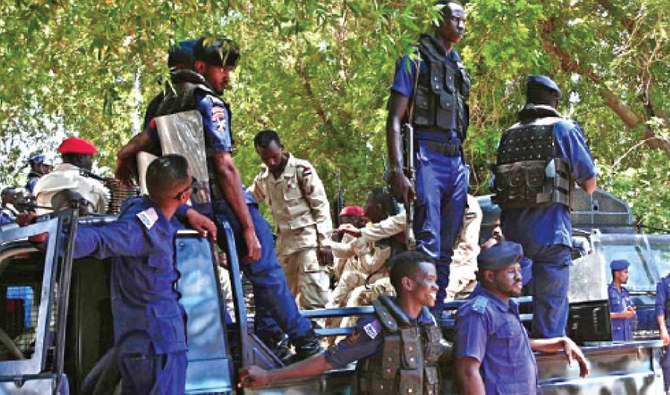
The Sudan Revolutionary Front (SRF), an alliance of rebel groups from the western region of Darfur and the southern states of South Kordofan and Blue Nile, inks a peace deal with the government. (AFP)
Short Url
Updated 31 August 2020
Follow

Sudan rebels agree to key peace deal with government

  • Two movements rejected part of the deal — a faction of the Sudan Liberation Movement, led by Abdelwahid Nour, and a wing of the Sudan People’s Liberation Movement-North (SPLM-N), headed by Abdelaziz Al-Hilu

KHARTOUM: Sudan’s main rebel alliance has agreed to a peace deal with the government aimed at ending 17 years of conflict, official news agency SUNA said on Sunday.
The Sudan Revolutionary Front (SRF), an alliance of rebel groups from the western region of Darfur and the southern states of South Kordofan and Blue Nile, inked a peace agreement with the government late on Saturday.
A formal signing ceremony is set to take place on Monday in Juba, the capital of neighboring South Sudan, which has hosted and helped mediate the long-running talks since late 2019.
Senior government officials and rebel leaders “signed their initials on protocols on security arrangements” and other issues late Saturday, SUNA reported.
However, two key holdout rebel forces have refused to take part in the deal.
The final agreement covers key issues around security, land ownership, transitional justice, power sharing, and the return of people who fled their homes due to war.
It also provides for the dismantling of rebel forces and the integration of their fighters into the national army.
Sudanese Prime Minister Abdalla Hamdok and several ministers flew to Juba on Sunday, the news agency said, where he met with South Sudan President Salva Kiir.

SPEEDREAD

A formal signing ceremony is set to take place on Monday in Juba, the capital of neighboring South Sudan, which has hosted and helped mediate the long-running talks since late 2019.

Hamdok said that finding a deal had taken longer than first hoped after a initial agreement in September 2019.
“At the Juba declaration in September, everyone expected peace to be signed within two or three months, but ...we realized that the questions were of one great complexity,” Hamdok said.
“However, we were able to accomplish this great work, and this is the start of peace building.”
The rebel forces took up arms against what they said was the economic and political marginalization by the government in Khartoum.
They are largely drawn from non-Arab minority groups that long railed against Arab domination of successive governments in Khartoum, including that of toppled ruler Omar Bashir.
About 300,000 people have been killed in Darfur since rebels took up arms there in 2003, according to the United Nations.
Conflict in South Kordofan and Blue Nile erupted in 2011, following unresolved issues from bitter fighting there in Sudan’s 1983-2005 civil war.
Forging peace with rebels has been a cornerstone of Sudan’s transitional government, which came to power in the months after Bashir’s overthrow in April 2019 on the back of mass protests against his rule.
Two movements rejected part of the deal — a faction of the Sudan Liberation Movement, led by Abdelwahid Nour, and a wing of the Sudan People’s Liberation Movement-North (SPLM-N), headed by Abdelaziz Al-Hilu.
Previous peace accords in Sudan, including one signed in Nigeria in 2006 and another signed in Qatar in 2010, have fallen through over the years.


UN, aid groups warn Gaza operations at risk from Israel impediments

Updated 7 sec ago
Follow

UN, aid groups warn Gaza operations at risk from Israel impediments

  • Dozens of international aid groups face de-registration by December 31, which then means they have to close operations within 60 days

UNITED NATIONS: The United Nations and aid groups warned on Wednesday that humanitarian operations in the Palestinian territories, particularly Gaza, were at risk of collapse if Israel does not lift impediments that include a “vague, arbitrary, and highly politicized” registration process.
Dozens of international aid groups face de-registration by December 31, which then means they have to close operations within 60 days, said the UN and more than 200 local and international aid groups in a joint statement.
“The deregistration of INGOs (international aid groups) in Gaza will have a catastrophic impact on access to essential and basic services,” the statement read.
“INGOs run or support the majority of field hospitals, primary health care centers, emergency shelter responses, water and sanitation services, nutrition stabilization centers for children with acute malnutrition, and critical mine action activities,” it said.

SUPPLIES LEFT OUT OF REACH: GROUPS
While some international aid groups have been registered under the system that was introduced in March, “the ongoing re-registration process and other arbitrary hindrances to humanitarian operations have left millions of dollars’ worth of essential supplies — including food, medical items, hygiene materials, and shelter assistance — stuck outside of Gaza and unable to reach people in need,” the statement read.
Israel’s mission to the United Nations in New York did not immediately respond to a request for comment on the statement. Under the first phase of US President Donald Trump’s Gaza plan, a fragile ceasefire in the two-year-old war between Israel and Palestinian militants Hamas began on October 10. Hamas released hostages, Israel freed detained Palestinians and more aid began flowing into the enclave where a global hunger monitor said in August famine had taken hold.
However, Hamas says fewer aid trucks are entering Gaza than was agreed. Aid agencies say there is far less aid than required, and that Israel is blocking many necessary items from coming in. Israel denies that and says it is abiding by its obligations under the truce.
“The UN will not be able to compensate for the collapse of INGOs’ operations if they are de-registered, and the humanitarian response cannot be replaced by alternative actors operating outside established humanitarian principles,” the statement by the UN and aid groups said.
The statement stressed “humanitarian access is not optional, conditional or political,” adding: “Lifesaving assistance must be allowed to reach Palestinians without further delay.”