

Renovation launched for UNESCO heritage site in Yemen

1 / 2
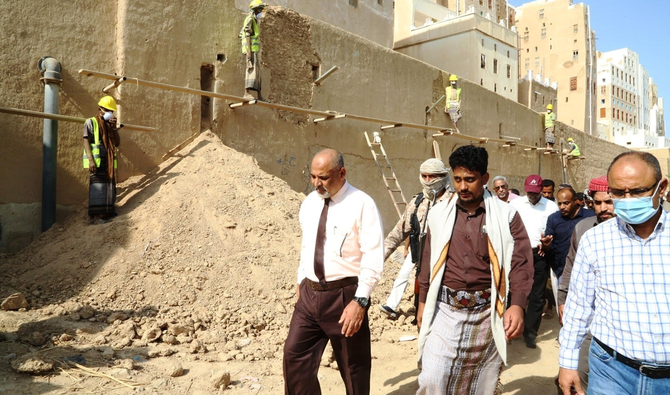
Local government officials in Hadramout inspect renovation of Shibam wall that has been hit hard by rains. (Supplied)
2 / 2
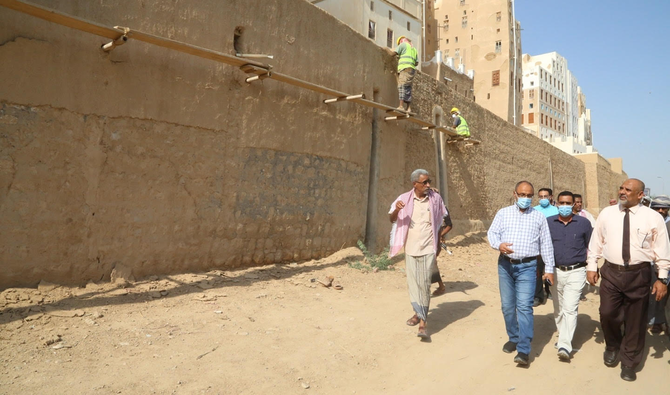
Local government officials in Hadramout inspect renovation of Shibam wall that has been hit hard by rains. (Supplied)
Short Url
Updated 30 August 2020
Follow

Renovation launched for UNESCO heritage site in Yemen

  • UNESCO has been mobilizing resources and expertise to safeguard Yemen’s cultural heritage by implementing a number of projects

AL-MUKALLA, Yemen: Local authorities in Yemen’s southeastern province of Hadramout have announced the start of a program to renovate dozens of decaying houses in the historic city of Shibam, a UNESCO World Heritage site since 1982.

The program is funded by the EU through UNESCO and the Yemeni Social Fund for Development.

The first phase costs $509,000, and targets mud houses that have not undergone renovation for the last five years, said Hasan Ayded, director of Shibam’s office of the General Organization for the Preservation of Historic Cities in Yemen, a government body.

“The priority is for houses that have been hit hard by rains and explosions, and those overlooking the city’s main square,” Ayded told Arab News. 

Known for its ancient towering adobe houses, Shibam has been deprived of vital maintenance since late 2014, when international perseveration experts fled the city following the Houthis’ takeover of Yemen’s capital Sanaa and their subsequent military expansion.

To make things worse, heavy downpours lashed Shibam in July this year, putting dozens of mud houses at risk of collapse.

Ayded said a government committee assigned by local authorities to assess the scale of damage in Shibam found out that almost half its 500 houses are in need of urgent attention.

“If we don’t intervene now, the problem will be bigger and will require more funds,” he said, adding that his office is in urgent need of $100,000 to renovate 40 crumbling houses in the second phase of the program. He urged local authorities, aid organizations and UNESCO to mobilize funds.

“Humanitarian assistance shouldn’t be restricted to food baskets. Saving a house in Shibam and keeping a family inside it is also humanitarian assistance,” he said.

Local officials are also calling for studies on how to help UNESCO World Heritage sites in Yemen adapt to climate change and unprecedented extreme weather.

In Houthi-held Sanaa, houses in the Old City, another UNESCO World Heritage site, have been crumbling since early August due to heavy rains and torrential floods.

UNESCO said in a statement: “Along with its international partners, UNESCO has been mobilizing resources and expertise to safeguard Yemen’s cultural heritage by implementing a number of projects with a focus on urban rehabilitation of private houses and capacity building for the local authorities.”


Algeria inaugurates strategic railway to giant Sahara mine

President Tebboune attended an inauguration ceremony in Bechar. (AFP file photo)
Updated 02 February 2026
Follow

Algeria inaugurates strategic railway to giant Sahara mine

  • The mine is expected to produce 4 million tons per year during the initial phase, with production projected to triple to 12 million tons per year by 2030
  • The project is financed by the Algerian state and partly built by a Chinese consortium

ALGEIRS: Algerian President Abdelmadjid Tebboune on Sunday inaugurated a nearly 1,000-kilometer (621-mile) desert railway to transport iron ore from a giant mine, a project he called one of the biggest in the country’s history.
The line will bring iron ore from the Gara Djebilet deposit in the south to the city of Bechar located 950 kilometers north, to be taken to a steel production plant near Oran further north.
The project is financed by the Algerian state and partly built by a Chinese consortium.
During the inauguration, Tebboune described it as “one of the largest strategic projects in the history of independent Algeria.”
This project aims to increase Algeria’s iron ore extraction capacity, as the country aspires to become one of Africa’s leading steel producers.
The iron ore deposit is also seen as a key driver of Algeria’s economic diversification as it seeks to reduce its reliance on hydrocarbons, according to experts.
President Tebboune attended an inauguration ceremony in Bechar, welcoming the first passenger train from Tindouf in southern Algeria and sending toward the north a first charge of iron ore, according to footage broadcast on national television.
The mine is expected to produce 4 million tons per year during the initial phase, with production projected to triple to 12 million tons per year by 2030, according to estimates by the state-owned Feraal Group, which manages the site.
It is then expected to reach 50 million tons per year in the long term, it said.
The start of operations at the mine will allow Algeria to drastically reduce its iron ore imports and save $1.2 billion per year, according to Algerian media.