LAHORE: A court in Pakistan has sentenced to prison three leaders of Jamat-ud-Dawa, an organization accused by India and the United States of masterminding the 2008 attacks in Mumbai.
The sentencing comes ahead of a September deadline for Pakistan to avoid being blacklisted for failing to curb terror financing by global financial watchdog the Financial Action Task Force (FATF).
Inclusion on the blacklist, alongside Iran and North Korea, would mean being shunned by international financial institutions. The watchdog has called for Pakistan to prosecute those funding terrorism, as well as to enact laws to help track and stop terror financing.
Malik Zafar Iqbal and Abdul Salam were each handed 16-1/2 year total sentences on four charges, to be served concurrently, while a third man, Hafiz Abdul Rehman Makki, got 1-1/2 years on one charge, according to a court judgment seen by Reuters.
The men were associates of Hafiz Saeed, who was sentenced to a total of 11 years in prison in February. All the sentences are concurrent so Saeed, Iqbal and Salam will serve five years.
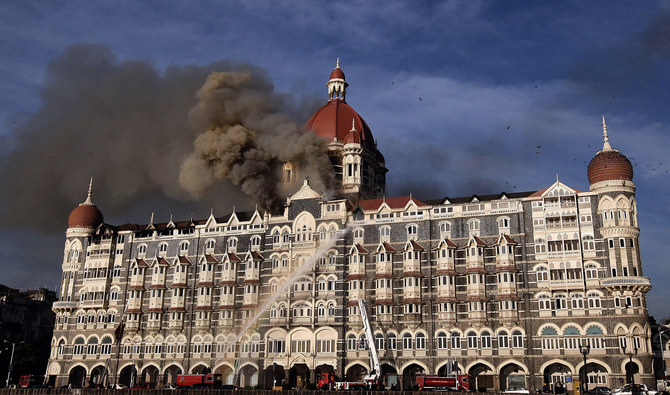
Saeed founded and led Lashkar-e-Taiba (LeT), or the Army of the Pure, a group blamed by India and the United States for the 2008 Mumbai attacks, which killed 160 people, including Americans and other foreigners.
Saeed and his associates also face a further slew of cases for allegedly financing militant activities, while Iqbal and Makki have already been convicted in several cases.
Saeed says his network, which spans 300 seminaries and schools, hospitals, a publishing house and ambulance services, has no ties to militant groups. Jamat-ud-Dawa funds the militant wing LeT.
A 2011 US sanctions designation describes Iqbal as a co-founder of LeT and in charge of its financing activities. Salam is described as the interim leader of the group during the brief periods when Saeed was arrested in the aftermath of the Mumbai attacks, and running its network of seminaries.

Pakistan jails three accused of financing Mumbai attacks
https://arab.news/zyx8p
Pakistan jails three accused of financing Mumbai attacks
- The men were associates of Hafiz Saeed, who was sentenced to a total of 11 years in prison in February
- The sentencing comes ahead of the Financial Action Task Force's September deadline for Pakistan
Islamabad court sentences seven individuals to life imprisonment over ‘digital terrorism’
- The convicts include Wajahat Saeed Khan, Shaheen Sahbahi, Haider Raza Mehdi, Adil Raja, Moeed Peerzada, Akbar Hussain and Sabir Shakir
- The cases against them relate to May 9, 2023 riots over ex-PM Imran Khan’s arrest that saw vandalization of government, military installations
ISLAMABAD: An Islamabad anti-terrorism court (ATC) on Friday awarded two life sentences each to seven individuals, including journalists and YouTubers, over “digital terrorism,” in connection with May 9, 2023 riot cases.
The court sentenced Wajahat Saeed Khan, Shaheen Sahbahi, Haider Raza Mehdi, Adil Raja, Moeed Peerzada, Akbar Hussain and Sabir Shakir under various sections of the Anti-Terrorism Act and the Pakistan Penal Code.
The riots had erupted after former prime minister Imran Khan was briefly arrested in Islamabad on corruption charges on May 9, 2023, with his supporters attacking government buildings and military installations in several cities.
ATC judge Tahir Sipra announced the reserved verdict, following a trial in absentia of the above-mentioned individuals who were accused of “digital terrorism against the state on May 9.”
“The punishment awarded will be subject to the confirmation by Hon’ble Islamabad High Court,” the verdict read, referring to each count of punishment awarded to the convicts.
It also imposed multiple fined on the convicted journalists and YouTubers, who many see as being closed to Khan.
The prosecution presented 24 witnesses, while the court had appointed Gulfam Goraya as the counsel of the accused, most of whom happen to be outside Pakistan.
Pakistan’s anti-terrorism laws allow trials in absentia of the accused persons.
Thousands of supporters of Khan’s Pakistan Tehreek-e-Insaf (PTI) party were detained in the days that followed the May 2023 riots and hundreds were charged under anti-terrorism laws in a sweeping crackdown, with several cases transferred to military courts.
The government of PM Shehbaz Sharif accuses Khan’s party of staging violent protests in a bid to incite mutiny in the armed forces and to derail democracy in the country. The PTI denies inciting supporters to violence and says the government used the May 2023 protests as a pretext to victimize the party, a claim denied by the government.
The May 2023 riots took place a little over a year after Khan fell out with Pakistan’s powerful military, blaming the institution for colluding with his rivals to oust him from office in a parliamentary no-trust vote, a charge denied by the military.
Khan, who has been jailed since Aug. 2023 on a slew of charges, has led a campaign of unprecedented defiance against the country’s powerful military. He also accuses the then generals of rigging the Feb. 8, 2024 election in collusion with the election commission and his political rivals to keep him from returning to power. The military, election commission and Khan’s rivals deny the allegation.


