Bollywood superstar Aamir Khan under fire over Turkey visit

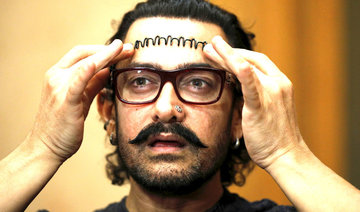
Aamir Khan. (Shutterstock)
Short Url
Updated 28 August 2020
Follow

Bollywood superstar Aamir Khan under fire over Turkey visit

  • While 40 percent of the film has been shot in India in Punjab, the production team decided to film the remainder elsewhere over the coronavirus concerns

PATNA: Bollywood superstar Aamir Khan has aroused controversy in India during a visit to Istanbul by meeting Turkey’s First Lady, Emine Erdogan.
Khan was in Turkey to find shooting locations for “Laal Singh Chaddha,” a remake of classic American comedy “Forrest Gump.” While 40 percent of the film has been shot in India in Punjab, the production team decided to film the remainder elsewhere over the coronavirus concerns.
Right-wing elements aligned with the ruling Bharatiya Janata Party (BJP) expressed anger at his meeting the wife of Turkish President Recep Tayyip Erdogan, while others said the courtesy meeting was blown out of proportions and will have no effect on the well-known actor’s popularity.
“Turkey is among the most intolerant nations in the world. How can Aamir, who speaks out so strongly against intolerance, go to the home of the president of this intolerant nation and have coffee with his wife? This is the reason India is outraged,” filmmaker Vivek Agnihotri, known for his open support of the BJP, told Arab News.
Agnihotri, who is a member of India’s Central Board of Film Certification, said that Aamir should apologize for his “cultural diplomacy.”
“President Erdogan has ordered the arrest and prosecution of thousands of dissenters,” Agnihotri said. “This is President Erdogan, whose wife Aamir went to have tea with? Turkey sponsors terrorism in India. Turkey is an enemy to India. Even an ordinary man in India knows this. How can an enlightened artist like Aamir Khan who addresses so many socio-political issues in India be ignorant?”
Actor-politician Shatrughan Sinha, who used to be affiliated with the BJP but is now a part of the opposition Congress party, disagreed with Khan’s critics.
“Aamir is one of the most intelligent actors of India. He wouldn’t do anything to damage his image as a leading cultural ambassador of the country. So what if he had coffee with the First Lady in Turkey? Aamir had not gone to Turkey as a political representative of India. He was there to shoot a film. What’s wrong in paying a courtesy visit to the country’s president’s wife?
“Let’s not bring politics into cinema. If Aamir made a personal social visit, let’s not make it into a political issue,” he said.
The actor, who shot to fame in 1988 with the epochal love story “Qayamat Se Qayamat Tak,” is known for his game-changing performances in many Bollywood blockbusters.
One of India’s most beloved actors, he has been repeatedly accused of what attackers say is “anti-nationalism” since November 2015, when he admitted in an interview that his wife Kiran Rao was worried about the safety of their son because of India’s atmosphere of growing intolerance.
Film critics Raja Sen and Karan Anshuman played down the incident.
“This will have no effect on Aamir’s career,” Sen said. “Audiences only care about causes from time to time, but their allegiance to their favorite
stars is forever.”
For Anshuman, what should now matter during foreign visits, when all countries are facing the coronavirus pandemic, is that people take necessary precautions be kept when meeting others — in the literal sense: “Last I heard India is still a free country and people shouldn’t project their politics and beliefs onto others. Aamir Khan can do whatever he wants as long as he’s wearing a mask when in public.”
Singer-actor-politician Babul Supriyo, who is a BJP lawmaker and is currently serving as minister of environment, said that the government has not commented on Khan’s visit to Turkey.
“I don’t wish to comment on the rights or wrongs of it,” he said, observing that Bollywood stars are even more in the spotlight now due to social media activity and therefore subject to “immense” scrutiny. “One needs to be very cautious in one’s public conduct.”



Federal agents must limit tear gas for now at protests outside Portland ICE building, judge says

Updated 04 February 2026
Follow

Federal agents must limit tear gas for now at protests outside Portland ICE building, judge says

  • The ruling came in response to a lawsuit filed by the ACLU of Oregon on behalf of protesters and freelance journalists covering demonstrations at the flashpoint US Immigration and Customs Enforcement building

PORTLAND, Oregon: A judge in Oregon on Tuesday temporarily restricted federal officers from using tear gas at protests at the US Immigration and Customs Enforcement building in Portland, just days after agents launched gas at a crowd of demonstrators including young children that local officials described as peaceful.
US District Judge Michael Simon ordered federal officers not to use chemical or projectile munitions on people who pose no imminent threat of physical harm, or who are merely trespassing or refusing to disperse. Simon also limited federal officers from firing munitions at the head, neck or torso “unless the officer is legally justified in using deadly force against that person.”
Simon, whose temporary restraining order is in effect for 14 days, wrote that the nation “is now at a crossroads.”
“In a well-functioning constitutional democratic republic, free speech, courageous newsgathering, and nonviolent protest are all permitted, respected, and even celebrated,” he wrote. “In helping our nation find its constitutional compass, an impartial and independent judiciary operating under the rule of law has a responsibility that it may not shirk.”
Ruling follows a lawsuit filed by the ACLU of Oregon
The ruling came in response to a lawsuit filed by the ACLU of Oregon on behalf of protesters and freelance journalists covering demonstrations at the flashpoint US Immigration and Customs Enforcement building.
The suit names as defendants the Department of Homeland Security and its head Kristi Noem, as well as President Donald Trump. It argues that federal officers’ use of chemical munitions and excessive force is a retaliation against protesters that chills their First Amendment rights.
The Department of Homeland Security said federal officers have “followed their training and used the minimum amount of force necessary to protect themselves, the public, and federal property.”
“DHS is taking appropriate and constitutional measures to uphold the rule of law and protect our officers and the public from dangerous rioters,” spokesperson Tricia McLaughlin said.
Courts consider question of tear gas use
Cities across the country have seen demonstrations against the administration’s immigration enforcement surge.
Last month, a federal appeals court suspended a decision that prohibited federal officers from using tear gas or pepper spray against peaceful protesters in Minnesota who aren’t obstructing law enforcement. An appeals court also halted a ruling from a federal judge in Chicago that restricted federal agents from using certain riot control weapons, such as tear gas and pepper balls, unless necessary to prevent an immediate threat. A similar lawsuit brought by the state is now before the same judge.
The Oregon complaint describes instances in which the plaintiffs — including a protester known for wearing a chicken costume, a married couple in their 80s and two freelance journalists — had chemical or “less-lethal” munitions used against them.
In October, 83-year-old Vietnam War veteran Richard Eckman and his 84-year-old wife Laurie Eckman joined a peaceful march to the ICE building. Federal officers then launched chemical munitions at the crowd, hitting Laurie Eckman in the head with a pepper ball and causing her to bleed, according to the complaint. With bloody clothes and hair, she sought treatment at a hospital, which gave her instructions for caring for a concussion. A munition also hit her husband’s walker, the complaint says.
Jack Dickinson, who frequently attends protests at the ICE building in a chicken suit, has had munitions aimed at him while posing no threat, according to the complaint. Federal officers have shot munitions at his face respirator and at his back, and launched a tear-gas canister that sparked next to his leg and burned a hole in his costume, the complaint says.
Freelance journalists Hugo Rios and Mason Lake have similarly been hit with pepper balls and tear gassed while marked as press, the complaint says.
“Defendants must be enjoined from gassing, shooting, hitting and arresting peaceful Portlanders and journalists willing to document federal abuses as if they are enemy combatants,” the complaint states.
The owner and residents of the affordable housing complex across the street from the ICE building has filed a separate lawsuit, similarly seeking to restrict federal officers’ use of tear gas because its residents have been repeatedly exposed over the past year.
Local officials have also spoken out against use of chemical munitions. Portland Mayor Keith Wilson demanded ICE leave the city after federal officers used such munitions Saturday at what he described as a “peaceful daytime protest where the vast majority of those present violated no laws, made no threat, and posed no danger to federal forces.”
“To those who continue to work for ICE: Resign. To those who control this facility: Leave,” Wilson wrote in a statement Saturday night.
The protest was one of many similar demonstrations nationwide against the immigration crackdown in cities like Minneapolis, where in recent weeks federal agents killed two people, Alex Pretti and Renee Good.