

Polio endemic now only in Pakistan, Afghanistan as Africa declared disease-free

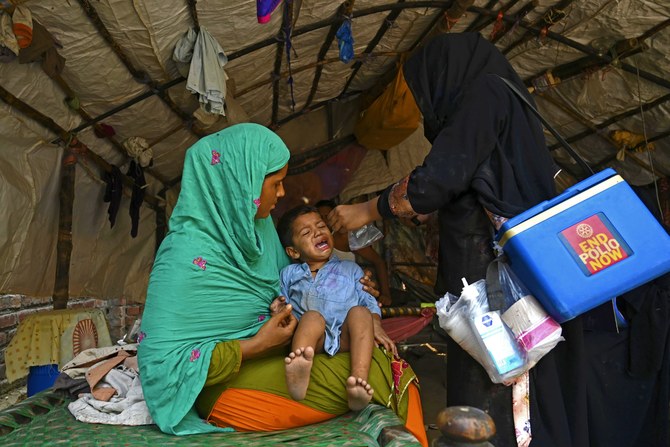
A health worker (R) administers polio vaccine drops to a child during a polio vaccination door-to-door campaign in Lahore on August 16, 2020. (AFP)
Short Url
Updated 26 August 2020
Follow

Polio endemic now only in Pakistan, Afghanistan as Africa declared disease-free

  • The last case in Africa was recorded in 2016 in Nigeria’s northeastern Borno state
  • Last month Pakistan resumed anti-polio drive halted since March due to coronavirus outbreak

LAGOS — Africa was declared free of wild polio on Tuesday by the independent Africa Regional Certification Commission (ARCC) for Polio Eradication, leaving the disease endemic now only in Afghanistan and Pakistan.

Thousands of people across Africa still live with the effects of the disease, but the last polio case was recorded four years ago in Nigeria.

The certification, announced during a World Health Organization (WHO) event, confirmed that all 47 countries in the WHO’s Africa region have eradicated the crippling viral disease that attacks the nervous system and can cause irreversible paralysis within hours.

Children under five are the most vulnerable, but people can be fully protected with preventative vaccines. To keep the virus at bay, population immunization coverage rates must be high and constant surveillance is crucial.

The last case in Africa was recorded in 2016 in Nigeria’s northeastern Borno state, which has been ravaged by the Islamist militant Boko Haram insurgency since 2009.

Tunji Funsho, a Nigerian anti-polio coordinator for Rotary International, said one way the disease was stamped out in Borno was to use the military and a government-approved militia to escort vaccinators in unsafe areas.

Globally, wild polio case numbers have been cut drastically due to national and regional immunization for babies and children.

Nigerian Gbemisola Ijigbamigbe’s right leg was virtually paralyzed after she contracted wild polio aged 11 months. Now the 28-year-old leads an active life as a wheelchair basketball player and also enjoys swimming and kayaking.

“Polio is not a death sentence,” she told Reuters, smiling.

But Michael Galway, a polio expert at the Bill and Melinda Gates Foundation, urged continued vigilance, saying:

“Until wild poliovirus is eradicated everywhere, it’s still a risk everywhere. There’s nothing that prevents the virus from making the route from Pakistan and Afghanistan to Africa.”

Ijigbamigbe, who is based in Nigeria’s commercial capital Lagos, looks back on a childhood that was blighted by the emotional pain of wearing over-sized clothes to hide her difficulty walking.

“I was... trying to mask my emotions so that whatever you say does not get to me. But inside... I would cry,” she recalls, her pronounced limp hinting at her condition.

The WHO estimates that 1.8 million children have been saved from life-long paralysis from wild polio.

Yet despite Tuesday’s announcement, a vaccine-derived strain of the disease — which can infect people where there is only partial vaccination and results in the same symptoms as the wild form — continues to circulate in Africa.

“We must stay vigilant and keep up vaccination rates to avert a resurgence of the wild poliovirus and address the continued threat of the vaccine-derived polio,” said Dr. Matshidiso Moeti, WHO Regional Director for Africa.

Vaccine-derived poliovirus cases can occur when the weakened live virus in the oral polio vaccine passes among under-immunized populations and eventually changes to a form that can cause paralysis.

The 16 countries in Africa affected by circulating vaccine-derived poliovirus outbreaks include Angola, Burkina Faso, Cameroon, Ethiopia, Ghana, Nigeria and Zambia.

Usman Yusuf — a member of Nigeria’s National Association of Polio Survivors who contracted the disease aged 3 — welcomed wild polio’s eradication from Africa.

Speaking after refereeing a soccer game played by polio survivors sitting on wheeled boards and propelled by their arms, Yusuf said he looked forward to an end to all polio one day.

“We are affected. We don’t expect our children and our younger ones to follow the same route.”


Police lodge case over Karachi mall blaze under mischief, negligence and murder clauses

Updated 24 January 2026
Follow

Police lodge case over Karachi mall blaze under mischief, negligence and murder clauses

  • The fire broke out at the densely packed Gul Plaza in the heart of Karachi on Jan. 17 and has so far claimed 71 lives
  • Traders have estimated losses at $53.6 million, while the government has announced $35,720 for family of each victim

ISLAMABAD: Police in Pakistan’s southern port city of Karachi have registered a case over a deadly blaze at Gul Plaza, which has so far claimed 71 lives, under mischief, negligence and murder clauses, a senior police official said on Saturday.

The fire broke out at the densely packed commercial complex in the heart of Karachi on Jan. 17, trapping workers and shoppers inside. It burnt for over 24 hours before being brought under control, leaving the building structurally unsafe.

Authorities have not yet confirmed the cause of the fire. Police said preliminary indications pointed to a possible electrical short circuit, though officials stress conclusions will only be drawn after investigations are completed.

A week after the incident, police have registered the first information report (FIR) of the incident under sections 427, 436, 337-H (i) and 322 of the Pakistan Penal Code, according to Deputy Inspector General (DIG) Karachi South Asad Raza.

“The FIR of the Gul Plaza tragedy has been registered under the government’s prosecution, with case number 08/2026 at Nabi Bux police station,” Raza told Arab News.

Section 427 relates to mischief causing damage, 436 concerns mischief by fire or explosive substance, 337-H (i) details punishment for rash or negligent act, and 322 details punishment for homicide.

Deadly fires are a recurring problem in Karachi, a city of more than 20 million people, where overcrowded markets, aging infrastructure, illegal construction and weak enforcement of safety regulations frequently contribute to disasters. Officials say a blaze of this scale is rare.

Identification has been significantly slowed by the condition of the remains recovered from the site, Syed said, noting that many bodies were found in fragments, complicating DNA analysis and prolonging the process for families waiting for confirmation.

Traders have estimated total losses from the fire at up to Rs15 billion ($53.6 million). The Sindh provincial government this week announced compensation of Rs10 million ($35,720) for the family of each person killed in the blaze and said affected shopkeepers would also receive financial assistance.

Separately on Saturday, the Muttahida Qaumi Movement-Pakistan (MQM-P) party urged Prime Minister Shehbaz Sharif to constitute an inquiry commission to hold those accountable whose negligence led to the Gul Plaza inferno.

“Incapability, mistake, apathy, shamelessness, impudence — these should be exposed,” MQM-P’s Farooq Sattar said, calling for an “independent judicial inquiry” into the Gul Plaza tragedy to ensure the truth comes to light.

LAHORE HOTEL FIRE

Meanwhile, a fire erupted at a hotel in the eastern city of Lahore in Pakistan’s most populous Punjab province, according to Rescue 1122 service.

Six people were injured due to the blaze at the hotel in the city’s Gulberg area who were shifted to hospital.

“All necessary steps be taken to quickly control the fire, instructions,” Deputy Commissioner Muhammad Ali Aijaz directed authorities. “Immediate evacuation of all people from the building be ensured.”