

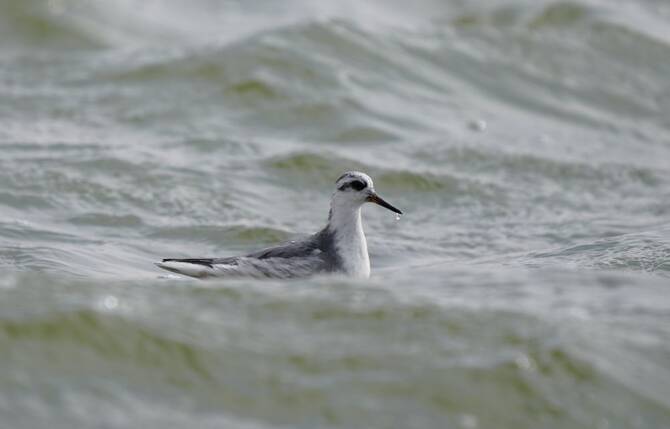


JEDDAH: A tiny seabird that typically spends much of its life in the open ocean has made a rare appearance inland in Saudi Arabia, providing researchers with one of the most unusual bird records ever documented in the Kingdom.
The King Abdulaziz Royal Reserve Development Authority announced the first confirmed sighting of a red phalarope (Phalaropus fulicarius) inside the reserve, a record considered among the rarest bird observations documented in Saudi Arabia and the Arabian Peninsula.
The bird was spotted in February 2026 at the Sudair Artificial Wetland, a permanent water habitat created through the discharge of treated water from Sudair Industrial City, by a joint research team from the authority and King Saud University.
Researchers observed an adult red phalarope in non-breeding winter plumage feeding in a wetland area south of the reserve.
For researchers, the discovery is significant not only because of the species involved, but also because of what it may reveal about migration routes across the Arabian Peninsula.
The red phalarope, also known as the grey phalarope, is a small shorebird measuring no more than 21 centimeters in length.
It breeds in the Arctic regions of North America and Eurasia and is highly migratory by nature.
Abdulaziz Al-Furaih, spokesman for the King Abdulaziz Royal Reserve Development Authority, told Arab News that the sighting was “extraordinary.”
Unlike most shorebirds, the red phalarope’s migration route follows the open oceans rather than coastlines and inland wetlands.
It spends its winters far out at sea in tropical waters, often hundreds of kilometers from land.
“This ocean-going lifestyle is precisely what makes its appearance at an inland site so extraordinary,” said Al-Furaih.
“It is not a swan or a duck that might commonly be found on a lake or oasis. Instead, it is a true bird of the open ocean, one that rarely settles on land except when circumstances force it to do so.
“That is why its presence at the Sudair Artificial Wetland can be considered a remarkable event in the world of ornithology.”
The finding was later published in the peer-reviewed scientific journal Check List, which specializes in biodiversity and ornithological research and serves as an international reference for documenting rare bird movements and migration patterns.
In its winter plumage, the red phalarope displays pale gray upperparts and a white underside, with a distinct dark patch running through the eye like a mask.
Its bill is black and relatively short, but noticeably thicker and heavier than that of its close relative, the red-necked phalarope, making it easier for experienced birdwatchers to identify.
Its most distinctive feature lies in its behavior.
“Phalaropes feed by swimming in tight circles, creating small whirlpools on the water’s surface,” Al-Furaih said.
Scientists believe this spinning motion draws tiny aquatic organisms upward, allowing the birds to pick them off with their slender bills.
This characteristic feeding technique was the first clue that caught the attention of researchers at Sudair before they confirmed the bird’s identity.
“What makes this bird even more fascinating from a behavioral perspective is that the female is more brightly colored and striking than the male, a reversal of the pattern seen in most bird species.
“During the breeding season, it is the female that courts and competes for mates, while the male takes on the responsibility of incubating the eggs and raising the chicks,” he added.
The red phalarope is exceptional among shorebirds. It migrates primarily along oceanic routes far from coastlines and spends the winter on the open seas of tropical regions.
As a result, its annual journey covers thousands of kilometers over water without requiring landfall or coastal habitats.
During winter, it feeds on marine plankton and other tiny organisms gathered from the ocean’s surface. In its Arctic breeding grounds, however, its diet shifts to small insects and aquatic invertebrates.
How, then, did it find its way to an inland wetland in central Saudi Arabia?
“Red phalaropes are occasionally recorded along European coastlines after storms, particularly during autumn and winter, when severe weather systems can drive individual birds away from their normal routes and into large inland lakes,” Al-Furaih said.
“This is considered the most likely scientific explanation for the Sudair sighting: that the bird was displaced from its usual oceanic migration route by a storm or atmospheric disturbance and eventually sought refuge at the nearest suitable body of water, the Sudair Artificial Wetland.”
Another possibility, he said, is that the sighting points to migration corridors that remain undocumented.
Satellite-tracking technology has revealed in recent years that many waterbirds cross the Arabian Peninsula during their journeys between Africa and Central Asia using routes that are still poorly understood.
“In this context, the red phalarope’s arrival at King Abdulaziz Royal Reserve may not have been a navigational error at all, but rather a response to the presence of a suitable wetland habitat that did not exist in the past.”
The sighting also highlights the growing ecological importance of the Sudair Artificial Wetland, which has evolved into a valuable habitat for migratory wildlife despite being located in an arid environment.
“Every documented record of the bird carries significant scientific value and serves as an important reference for future research on migration patterns, distribution and biodiversity in the region,” Al-Furaih said.
“The record will serve as an important reference for future scientific studies. The red phalarope is exceptionally rare even in neighboring Gulf countries such as Kuwait, where it is classified as a very uncommon vagrant during the spring and autumn migration seasons.
“This means that the documentation of the species at King Abdulaziz Royal Reserve is far more than another entry on a bird checklist.
“It represents the first confirmed record for the reserve and places the protected area on the global distribution map of the species.”
The discovery adds to a growing list of scientific records from the reserve, including rare species sightings and first-time breeding confirmations, further strengthening its role as a center for environmental research and biodiversity monitoring in the Kingdom.
The authority said it will continue environmental monitoring and scientific studies in partnership with research and academic institutions to document wildlife, track migration patterns and support biodiversity conservation efforts.


