Nightlife in ruins: Beirut blast pummels industry, destroys businesses

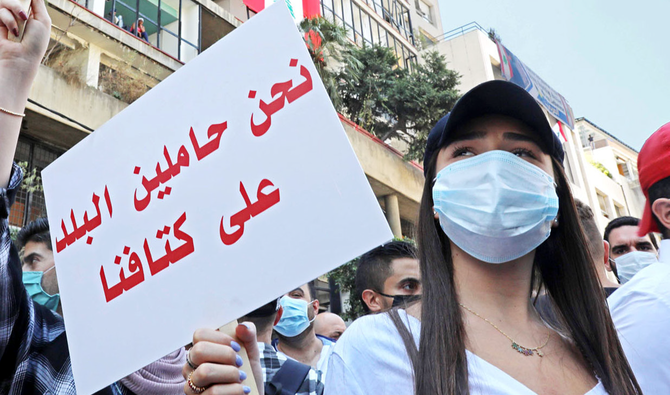
A Beirut rally on Tuesday organized by the Lebanese Federation for Tourism Industries criticized the government’s lack of support for the sector and its workforce. (AFP)
Short Url
Updated 26 August 2020
Follow

Nightlife in ruins: Beirut blast pummels industry, destroys businesses

  • It is a tired cliché that the nightlife in Beirut — billed worldwide as a party destination — stands as proof of the capital’s ability to endure one crisis after another

BEIRUT: A cozy Beirut restaurant, Tenno once hosted a dog’s birthday party, vinyl record nights and stand-up comedians.

Those days are gone. Its doors collapsed and glass shattered in the port blast this month that killed at least 180 people and turned one of Beirut’s most popular pub streets into a disaster zone.

“We plan to rebuild ... we owe it to ourselves to not let things end this way,” said Mohamed Soliman, 28, one of the owners of the cafe which opened around 2 years ago. Money for repairs has poured in through online crowdfunding.

Many others will not rebuild, however, because it no longer makes sense to invest in a country where years of work can vanish in seconds.

“We’ve been saying we’re all on the verge. I don’t know how we made it this far. We’re not going to last,” said Maya Bekhazi of the union of nightclub, cafe and restaurant owners.

It is a tired cliché that the nightlife in Beirut — billed worldwide as a party destination — stands as proof of the capital’s ability to endure one crisis after another.

So much so that Lebanese have made a joke of their fabled resilience which has portrayed them partying through wars and assassinations, when behind the glitz the reality is much grimmer.

The past year, including Lebanon’s financial meltdown and the COVID-19 pandemic, has battered the service industry, a pillar of an economy that produces little. The August warehouse explosion left over 2,000 premises in tatters, putting tens of thousands more jobs at risk in a country with soaring unemployment and poverty.

The restaurant sector alone will cost at least $1 billion to reconstruct, Bekhazi estimates.

Even before the blast, hundreds of venues had shuttered with mass layoffs in an industry that employs a big chunk of Lebanon’s workforce.

In response to a question about what the state has done, Bekhazi laughs. “Nobody cares.” With low-wage workers hit hardest, she said, the union will help provide meals for employees for a month.

Beirut’s nightlife has long attracted investor money and performers from abroad, spawning images of extravagant soirees in ranking lists around the world.

Since last year, a currency crash has eroded the purchasing power of Lebanese, including among the middle class that most of these businesses cater to. Costs skyrocketed and suppliers demanded cash as dollars grew scarce.

The owners of Cafe Em Nazih, who also run a hostel and rooftop bar, do not plan on rebuilding now.

“To start from scratch, without any trust in the state, will be a loss. We could invest again and get hit by another 20 explosions,” said manager Nazih Dirani, who suffered a dislocated shoulder when the blast ripped through the cafe. “This place is my life. I know where every screw is.”

On social media, Lebanese posted videos of bloodied faces emerging from behind bar counters. Some spoke of a sense of loss in a city with few public spaces.

For Jade, founder of the entertainment group Factory People, the focus now is on keeping his 170 employees. The blast reduced one of its clubs to a pile of twisted metal. It cost nearly $2.5 million to launch and will need millions more to fix up.

“We kept investing despite it all,” the DJ said. “But now it’s like we’re in the middle of the battlefield and we ran out of ammunition.”


Palestinians wait at border between Gaza and Egypt as uncertainty clouds reopening of Rafah crossing

Updated 6 sec ago
Follow

Palestinians wait at border between Gaza and Egypt as uncertainty clouds reopening of Rafah crossing

  • At that pace, long waits are facing most of the roughly 20,000 sick and wounded people who Gaza’s Health Ministry has said need treatment abroad
  • Reopening the crossing is considered key as the ceasefire agreement moves into a complicated second phase
  • The bus with about 40 Palestinians that entered Gaza via Rafah on Tuesday arrived at Nasser hospital in Khan Younis early Wednesday morning, where their families welcomed them after spending the entire day waiting

KHAN YOUNIS, Gaza Strip: Palestinians gathered on both sides of Gaza’s border with Egypt on Tuesday hoping to pass through the Rafah crossing, after its reopening the previous day was marred by delays, interrogations and uncertainty over who would be allowed to cross.
On the Egyptian side were Palestinians who fled Gaza earlier in the Israel-Hamas war to seek medical treatment, according to Egypt’s state-run Al-Qahera News television. On the Gaza side, Palestinians in need of medical care that is unavailable in Gaza gathered at a hospital before ambulances moved toward Rafah, hoping for word that they would be allowed to cross the other way.
The office of the North Sinai governor confirmed Tuesday that an unknown number of patients and their companions had crossed from Gaza into Egypt.
The bus with about 40 Palestinians that entered Gaza via Rafah on Tuesday arrived at Nasser hospital in Khan Younis early Wednesday morning, where their families welcomed them after spending the entire day waiting.
Though hailed as a step forward for the fragile ceasefire struck in October, it took more than 10 hours for only about a dozen returnees and a small group of medical evacuees to cross in each direction on the first day Rafah reopened.
Three women who crossed into Gaza on Monday told The Associated Press on Tuesday that Israeli troops blindfolded and handcuffed them, then interrogated and threatened them, holding them for several hours before they were released.
The numbers permitted to cross on Monday fell well short of the 50 people that officials had said would be allowed each way and barely began to address the needs of tens of thousands of Palestinians who are hoping to be evacuated for treatment or to return home.
The import of humanitarian aid or goods through Rafah remains prohibited.
’Not a solution to the crisis’
Evacuation efforts on Tuesday morning converged around a Red Crescent hospital in Khan Younis, where a World Health Organization team arrived and a vehicle carrying patients and their relatives rolled in from another hospital. Then the group of WHO vehicles and Palestinian ambulances headed toward Rafah to await crossing.
As the sick, wounded and displaced waited to cross in both directions, health officials said the small number allowed to exit so far paled beside Gaza’s tremendous needs. Two years of fighting destroyed much of its medical infrastructure and left hospitals struggling to treat trauma injuries, amputations and chronic conditions like cancer.
In Gaza City, Shifa Hospital director Mohamed Abu Selmiya called the pace “crisis management, not a solution to the crisis,” imploring Israel to permit the importing of medical supplies and equipment. He wrote on Facebook: “Denying the evacuation of patients and preventing the entry of medicines is a death sentence for them.”
UN and WHO officials said the trickle of patients allowed out and restrictions on bringing in desperately needed supplies are prolonging a disastrous situation in Gaza.
“Rafah must function as a real humanitarian corridor so we can have a surge in aid deliveries,” said Tom Fletcher, the UN’s top relief official.
Palestinian Red Crescent spokesperson Raed Al-Nims told AP that only 16 patients with chronic conditions or war wounds, accompanied by 40 relatives, were brought from Khan Younis to the Gaza side of Rafah on Tuesday — less than the 45 patients and wounded the Red Crescent was told would be allowed.
After days of anticipation over the reopening, hope lingered that it might mark a meaningful first step. In Khan Younis, Iman Rashwan waited for hours until her mother and sister returned from Egypt, hoping others would soon see their loved ones again.
Waiting on both sides
Officials say the number of crossings could gradually increase if the system works, with Israel and Egypt vetting those allowed in and out. But security concerns and bureaucratic snags quickly tempered expectations raised by officials who for weeks had cast reopening as a major step in the ceasefire deal.
There were delays on Monday over disagreements about luggage allowances. Returnees were carrying more than anticipated with them, requiring additional negotiations, a person familiar with the situation told the AP, speaking on condition of anonymity to discuss the diplomatic matter.
“They didn’t let us cross with anything,” Rotana Al-Regeb said as she returned around midnight Monday to Khan Younis. “They emptied everything before letting us through. We were only allowed to take the clothes on our backs and one bag per person.”
The initial number of Palestinians allowed to cross is mostly symbolic. Israeli and Egyptian officials have said that 50 medical evacuees would depart — along with two caregiver escorts — and 50 Palestinians who left during the war would return.
At that pace, long waits are facing most of the roughly 20,000 sick and wounded people who Gaza’s Health Ministry has said need treatment abroad. About 150 hospitals across Egypt are ready to receive patients, authorities said.
Who and what would be allowed through Rafah was a central concern for both Israel and Egypt.
Israeli Prime Minister Benjamin Netanyahu has said that anyone who wants to leave will eventually be permitted to do so, but Egypt has repeatedly said the Rafah crossing must open in both directions, fearing Israel could use it to push Palestinians out of Gaza.
Reopening the crossing is considered key as the ceasefire agreement moves into a complicated second phase. That calls for installing a new Palestinian committee to govern Gaza, deploying an international security force, disarming Hamas and taking steps to begin rebuilding.
In a meeting Tuesday with US special envoy Steve Witkoff in Jerusalem, Netayanhu repeated Israel’s “uncompromising demand” that Hamas be disarmed before any reconstruction begins, the prime minister’s office said.
A 19-year-old killed in southern Gaza
Nasser Hospital in Khan Younis said Ahmed Abdel-Al, 19, was shot and killed by Israeli troops on Tuesday morning in a part of the southern Gaza City, some distance away from the area under the Israeli military’s control.
Israel’s military said it was not immediately aware of any shootings in the area.
Abdel-Al was the latest of the 529 Palestinians killed by Israeli fire since the Oct. 10 start of the ceasefire, according to Gaza’s Health Ministry. They are among more than 71,800 Palestinians killed since the start of the war, according to the ministry, which does not distinguish between fighters and civilians.
The ministry, part of Gaza’s Hamas-led government, keeps detailed casualty records that are seen as generally reliable by UN agencies and independent experts.