

‘You are nothing’ Christchurch massacre survivors tell ‘loser’ Brenton Tarrant

1 / 4
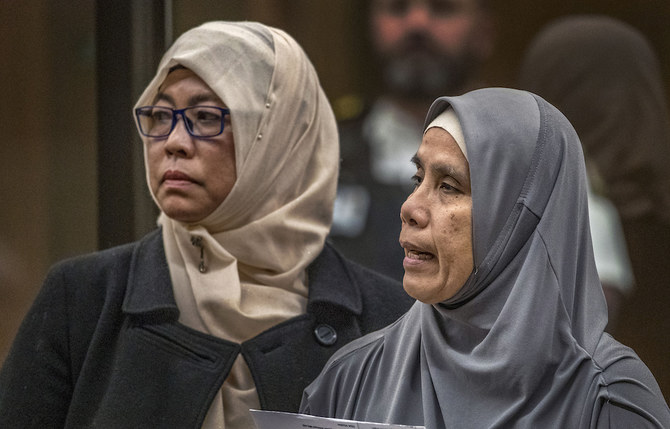
Noraini Abbas Milne, right, mother of 14-year-old mosque shooting victim, Sayyad, makes her victim impact statement during the sentencing hearing for Australian Brenton Harrison Tarrant at the Christchurch High Court. (AP)
2 / 4
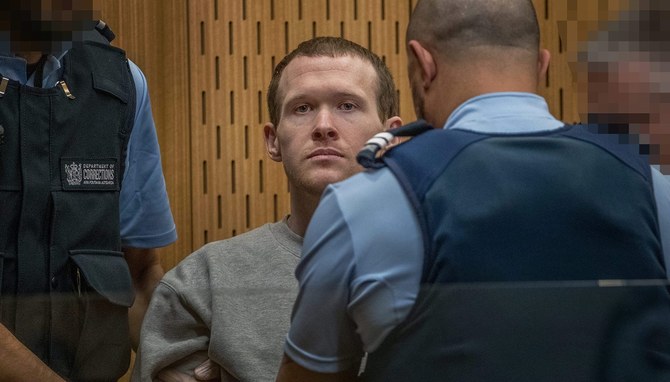
It is thought that Brenton Tarrant might be given the opportunity to address the court on Wednesday. (FILE/AFP)
3 / 4
Hazem Mohammed gives his victim impact statement during the sentencing hearing for Australian Brenton Harrison Tarrant. (AP)
4 / 4
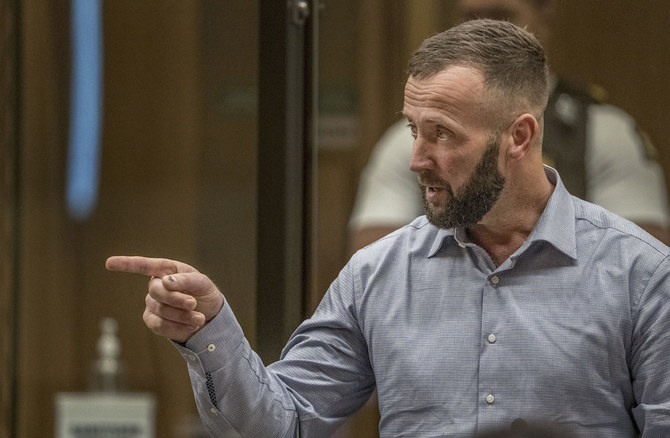
Nathan Smith gestures as he makes a victim impact statement during the sentencing hearing for Australian Brenton Harrison Tarrant at the Christchurch High Court. (AP)
Short Url
Updated 25 August 2020
Follow

‘You are nothing’ Christchurch massacre survivors tell ‘loser’ Brenton Tarrant

  • Shooter could speak ahead of sentencing on Wednesday
  • Survivors of those killed on that fateful day have told the court of the anxiety and sleepless nights they continue to suffer

CHRISTCHURCH, NEW ZEALAND: The irony of a homicidal zealot travelling to new land in order to “remove invaders” from its shores was scornfully highlighted by locally born testifiers at the sentencing hearing of Brenton Harrison Tarrant.

The second full day of victim-impact statements here in New Zealand’s second-largest city started out not unlike the morning of March 15, 2019, all sky-blue skies and a sun hanging like a lemon above the rolling parklands that serve as the visual centrepiece of the Garden City.

Such would have been the decorous scene that greeted the Australian-born Tarrant that Friday morning 17 months ago when he drove into town in a Subaru bristling with the weaponry and high-tech gadgets he had accumulated for the purpose of killing as many Muslims as he could at the Linwood Islamic Centre and Al Noor Mosque.

The 29-year-old has pleaded guilty to 51 charges of murder, 40 of attempted murder and one charge of engaging in a terrorist act in relation to the massacre that he livestreamed on Facebook.

Police officers walk Brenton Tarrant into the Christchurch courtroom (AFP)

According to the summary of facts presented at the High Court in Christchurch the previous day by Crown prosecutor Barnaby Hawes, the self-confessed white supremacist first came to  the country in 2017.

He had arrived determined to reduce New Zealand-bound immigration trends “by intimidating and physically removing” non-Caucasians from the demographic mix.

Survivors and relatives of those killed on that fateful day have told the court of the anxiety and sleepless nights they continue to suffer – others have spoken of the financial hardships imposed through the loss of a main bread winner.

Among those who perished at his hand was Linda Armstrong, 64, a third-generation New Zealander who converted to Islam in 2011.

The late Ms. Armstrong later said her conversion had been spurred by a decade-long friendship she had forged with a Syrian refugee — and an acquired enthusiasm for the Levantine cuisines. 

In a jarring address, the deceased woman’s nephew, Kyron Gosse, described the defendant as a “loser” who brutally betrayed his status as a guest in the country.

Survivors and bereaved give their accounts of their experience and loss at the hands of Tarrant (AFP)

"He entered into our home with ill intentions and hate in his heart only to repay our hospitality by murdering our family and our guests, people we welcome into our country with the promise of a better life," the t-shirt clad Gosse, a seventh-generation New Zealander himself, told the court.

He also spoke of his horror at first learning about the carnage after logging on to Facebook and seeing the live stream of Tarrant slaughtering worshippers.

The late Armstrong’s daughter, Angela, an only child, struck a similar blistering note — and a possibly baffling note for the defendant, too, by prefacing her tearful comments with a lyrical introduction offered in Maori, the native vernacular of New Zealand. 

“You are nothing,” Armstrong added, looking at the defendant seated with hand on chin while surrounded by officers. 

Another local Muslim convert, Rosemary Omar, emphasized her deep family roots in the land here in the South Seas that welcomed the man she also described as a “monster.”

Turkish victim recalls how he and Tarrant looked at each other before he was shot multiple times (AFP)

The court has allowed time for around 70 victim impact statements, including a number not originally scheduled to be delivered. Among the other addresses were ones given by speakers from Britain, Fiji, the Indian subcontinent, South Africa, Syria, and the United States.

Tarrant faces the possibility of life in prison without the chance of parole.

If Tarrant is given an opportunity to address the court, it is expected to happen on Wednesday.

Justice Cameron Mander has said he will not pass judgment until this Thursday morning at the earliest. The hearing continues.


Terror at Friday prayers: Witnesses describe blast rocking Islamabad mosque

Updated 40 min 15 sec ago
Follow

Terror at Friday prayers: Witnesses describe blast rocking Islamabad mosque

  • The Daesh group has claimed responsibility for the attack, according to the SITE Intelligence Group, which monitors jihadist communications

ISLAMABAD: A worshipper at the Shiite mosque in Islamabad where dozens of people were killed in a suicide blast on Friday described an “extremely powerful” explosion ripping through the building just after prayers started.
Muhammad Kazim, 52, told AFP he arrived at the Imam Bargah Qasr-e-Khadijatul Kubra mosque shortly after 1:00 p.m. (0800 GMT) on Friday and took up a place around seven or eight rows from the Imam.
“During the first bow of the Namaz (prayer ritual), we heard gunfire,” he told AFP outside the Pakistan Institute of Medical Sciences (PIMS) hospital, where many of the wounded were brought for treatment.
“And while we were still in the bowing position, an explosion occurred,” he said.
Kazim, who is from Gilgit-Baltistan in northern Pakistan and lives in Islamabad, escaped unharmed, but accompanied his wounded friend to the PIMS hospital for treatment.
“It was unclear whether it was a suicide bombing, but the explosion was extremely powerful and caused numerous casualties,” Kazim said.
“Debris fell from the roof, and windows were shattered,” he added. “When I got outside, many bodies were scattered... Many people lost their lives.”

People mourn the death of their relatives following a suicide bombing at a Shiite mosque, outside a hospital in Islamabad on February 6, 2026. (AFP)

The Daesh group has claimed responsibility for the attack, according to the SITE Intelligence Group, which monitors jihadist communications.
Another worshipper, Imran Mahmood, described a gunfight between the suicide bomber, a possible accomplice and volunteer security personnel at the mosque.
“The suicide attacker was trying to move forward, but one of our injured volunteers fired at him from behind, hitting him in the thigh,” Mahmood, in his fifties, told AFP.
“He fell but got up again. Another man accompanying him opened fire on our volunteers,” he said, adding the attacker “then jumped onto the gate and detonated the explosives.”
As of Saturday morning, the death toll stood at 31, with at least 169 wounded.
The attack was the deadliest in the Pakistani capital since September 2008, when 60 people were killed in a suicide truck bomb blast that destroyed part of the five-star Marriott hotel.

Shiite Muslims demand adequate security from the government during an impromptu protest outside a hospital following a suicide bombing at a Shiite mosque in Islamabad on February 6, 2026. (AFP)

Lax security

Describing the aftermath of the attack, Kazim said unhurt worshippers went to the aid of those wounded.
“People tried to help on their own, carrying two or three bodies in the trunks of their vehicles, while ambulances arrived about 20 to 25 minutes later,” he told AFP.
“No one was allowed near the mosque afterwards.”
Kazim, who has performed Friday prayers at the mosque “for the past three to four weeks,” said security had been lax.
“I have never seen proper security in place,” he told AFP.
“Volunteers manage security on their own, but they lack the necessary equipment to do it effectively,” he said.
“Shiite mosques are always under threat, and the government should take this seriously and provide adequate security,” he added.