

New Zealand mosque attacks survivors describe hiding under corpses

1 / 3
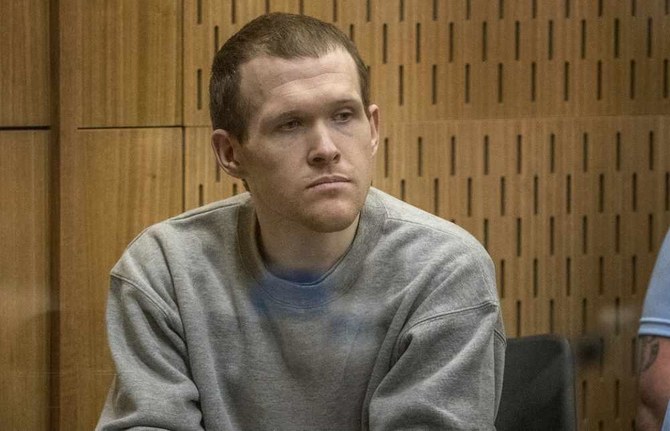
Twenty-nine-year-old Australian Brenton Harrison Tarrant sits in the dock at the Christchurch High Court for sentencing after pleading guilty to 51 counts of murder, 40 counts of attempted murder and one count of terrorism in Christchurch, New Zealand, on Aug. 24, 2020. (John Kirk-Anderson/Pool Photo via AP)
2 / 3
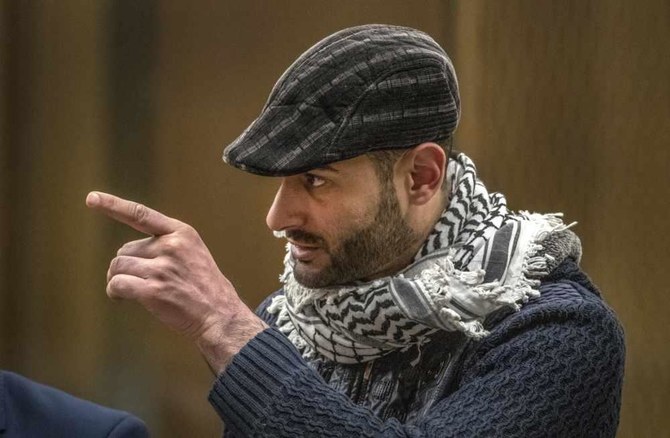
Mosque shooting survivor Khaled Majed Abd'el Rauf Alnobani points at the gunman, 29-year-old Australian Brenton Harrison Tarrant, at the Christchurch High Court for sentencing after pleading guilty to 51 counts of murder, 40 counts of attempted murder and one count of terrorism in Christchurch, New Zealand, on Aug. 24, 2020. (John Kirk-Anderson/Pool Photo via AP)
3 / 3
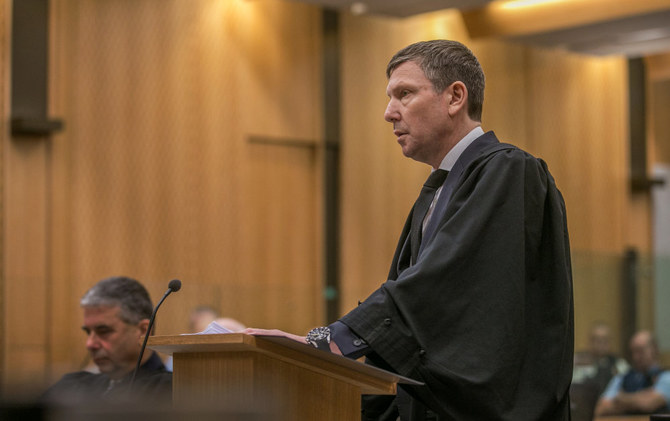
Crown prosecutor Barnaby Hawes reads the summary of facts during the sentencing of Christchurch mosques attacker Brenton Tarrant in Christchurch, New Zealand on August 24, 2020. (John Kirk-Anderson/Pool via REUTERS)
Short Url
Updated 24 August 2020
Follow

New Zealand mosque attacks survivors describe hiding under corpses

  • New details about the March 2019 attacks were outlined during the first day of a four-day sentencing hearing at the Christchurch High Court
  • Australian Brenton Harrison Tarrant, pleaded guilty in March to 51 counts of murder, 40 counts of attempted murder and one count of terrorism

CHRISTCHURCH, NEW ZEALAND: Not only did Brenton Harrison Tarrant murder 51 Muslims on the early afternoon, his sentencing hearing today at the High Court here in New Zealand’s second-largest city heard, he also killed 51 Muslim families.

Almost, at least, but not quite.

Even in a world roiled by terrorist atrocities, the anti-Muslim carnage that took place here in Christchurch on March 15 last year was outsized. But so has been the effort made for survivors to speak on behalf of those who perished in the two meticulously planned attacks against Friday worshippers at the city’s Al Noor Mosque and Linwood Islamic Centre. 

Tarrant, an Australian national and self-confessed white supremacist, has already pleaded guilty to 51 charges of murder as well as 40 further charges of attempted murder and another of engaging in a terrorist act. His sentencing hearing has been set down for at least four days in order to allow for more than 60 victim-impact statements to be heard.
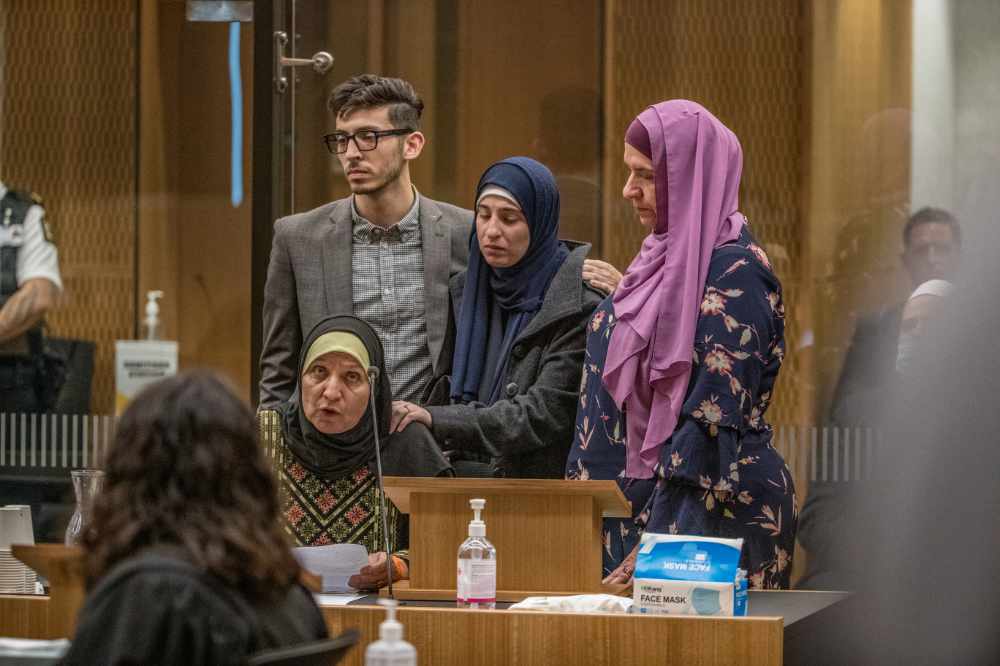


Maysoon Salama, mother of Ata Mohammad Ata Elayyan who was killed in the shooting, gives a victim impact statement about the loss of her son during the sentencing of mosque gunman Brenton Tarrant at the High Court in Christchurch, New Zealand, on August 24, 2020. (John Kirk-Anderson/Pool via REUTERS)

There’s a separate press room where the media watch proceedings via video link. Outside there’s a heavy police presence and a small huddle of broadcast media and photographers.

Justice Cameron Mander said he was “acutely conscious” of the stress of both the event and the practicalities of victims navigating the travel restrictions of a pandemic in order to speak at the sentencing. At least three of the days have been set aside for more than 60 such testimonies.

The number of statements is as unprecedented as the security around the proceedings, with police snipers stationed atop of the courthouse roof, nearby roads shut down and heavily armed cops and bomb-sniffer dogs moving around the main courtroom and its seven overflow rooms.

Some of today’s dozen or so major statements — most of them delivered live, but some given by way of pre-recorded video — spoke wistfully of New Zealand as a land of initial promise, so far removed from troubled homelands such as Afghanistan, Iraq, Pakistan and Somalia.

Details of the early afternoon when that idyllic image vanished were frequently grisly, with accounts of survivors playing dead underneath corpses seeping brain tissue and blood.

One Iraqi woman whose identity was suppressed wept as she explained the grief of receiving her son’s body for burial on what was also Mother’s Day across much of the Middle East. The same date also happened to coincide with her birthday.

Another mother spoke of her helplessness at having to raise a non-verbal autistic child now forever without a devoted father.

“The gunman and I looked into each other’s eyes,” added Temel Atacocugu, recalling his own experience at Al Noor Mosque. “I laid under bodies in the mosque, thinking I was going to die …  I could feel the blood and brains of the person above me running down my face and neck. I couldn’t move or make a sound, as the gunman would have executed me.”

On Monday Atacocugu again looked across at the diminutive gunman now seated in the court — who did not return his gaze.
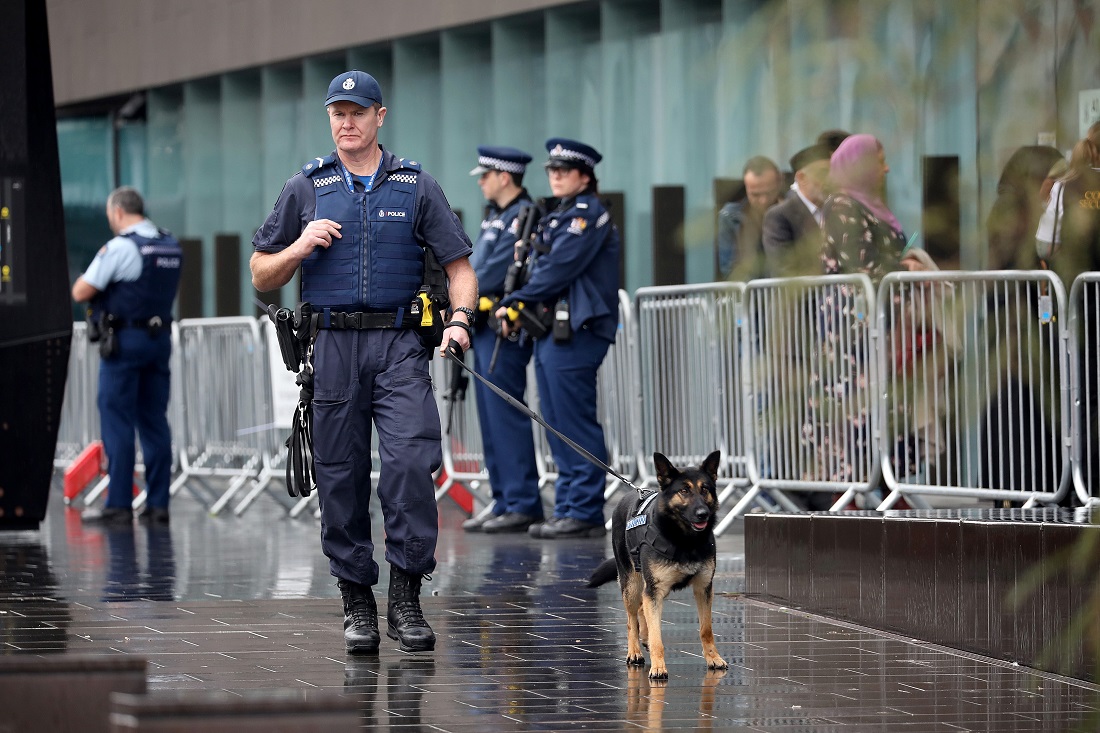


There's a heavy police presence outside the courts, and surrounding roads are closed. (AFP)

The proceedings began with the prosecution airing a summary of the facts, the first time this document had received a public airing.

The court heard of the 29-year-old Australian’s apparently self-financed 15-month spending spree leading up to the March 2019 attack, stockpiling high-powered firearms, military specification sighting systems and telescopic sights.

He purchased more than 7,000 rounds of ammunition, police-style ballistic armour, military-style tactical shirts and a bayonet-style knife. He also bought camouflage clothing and, in particular, the many rifles that he later modified before daubing slogans, obscure European symbols and historical dates on to them. In a methodical touch, he draped a bullet-proof vest across the back of the driver’s seat for ballistic protection.

Tarrant also brought a drone with him to Christchurch and used it to case out Al Noor Mosque, the city’s largest, in particular the exit and entrance doors that immediate survivors would head for.

It was this attention to detail that allowed him, for example, to track 16-year-old Alhaj Mustafa, who had managed to escape the initial bloodletting inside the main prayer room, find him crouched among the parked vehicles outside, and fatally pump another five shots into the boy. 

Also packed in Tarrant’s vehicle had been four modified petrol containers. These he originally planned to use to burn down each of the three mosques he had intended to attack. The court heard that the last planned assault was thwarted before he had an opportunity to make the hour-long drive to what would have been the final mosque in Ashburton.

Other survivors, including the mosque’s imam, Gamal Fouda,

spoke about lost work opportunities, the indignities of widowhood, the pain of busted dreams, the sounds of bereaved children still crying into the night — and the power of forgiveness.


But Tarrant can probably expect little judicial mercy.  There’s no death penalty, New Zealand last executed a convict in 1961, and formally struck the last of its capital crimes, for treason, from its books in the late 1980s. While “life” imprisonment is usually the sentence for murder, it typically means fewer than 17 years in jail and sometimes only 10.

A sentence of life without parole would therefore be unprecedented — like almost everything else about the case — but not out of consideration. The hearing continues.

Justice Department sees no basis for civil rights probe in Minnesota ICE shooting, official says

Updated 5 sec ago
Follow

Justice Department sees no basis for civil rights probe in Minnesota ICE shooting, official says

  • And on Tuesday, Deputy Attorney General Todd Blanche said in a statement that “there is currently no basis for a criminal civil rights investigation”

WASHINGTON: The Justice Department does not believe there is currently any basis to open a criminal civil rights investigation into the killing of a woman by a US Immigration and Customs Enforcement officer in Minneapolis, a top department official said Tuesday.
The decision to keep the Justice Department’s Civil Rights Division out of the investigation into the fatal shooting of Renee Good marks a sharp departure from past administrations, which have moved quickly to probe shootings of civilians by law enforcement officials for potential civil rights offenses.
While an FBI probe is ongoing, lawyers in the Civil Rights Division were informed last week that they would not play a role in the investigation at this time, according to two people familiar with the matter who spoke on the condition of anonymity to discuss internal department deliberations.
And on Tuesday, Deputy Attorney General Todd Blanche said in a statement that “there is currently no basis for a criminal civil rights investigation.” The statement, first reported by CNN, did not elaborate on how the department had reached a conclusion that no investigation was warranted.
Federal officials have said that the officer acted in self-defense and that the driver of the Honda was engaging in “an act of domestic terrorism” when she pulled forward toward him.
The quick pronouncement by administration officials before any meaningful investigation could be completed has raised concerns about the federal government’s determination to conduct a thorough review of the chain of events precipitating the shooting. Minnesota officials have also raised alarm after federal officials blocked state investigators from accessing evidence and declared that Minnesota has no jurisdiction to investigate the killing.
Also this week, roughly half a dozen federal prosecutors in Minnesota resigned and several supervisors in the criminal section of the Civil Rights Division in Washington gave notice of their departures amid turmoil over the federal probe, according to people familiar with the matter.
Among the departures in Minnesota is First Assistant US Attorney Joseph Thompson, who had been leading the sprawling investigation and prosecution of fraud schemes in the state, two other people said. At least four other prosecutors in the Minnesota US attorney’s office joined Thompson in resigning amid a period of tension in the office, the people said. The people spoke on the condition of anonymity to discuss personnel matters.
They are the latest in an exodus of career Justice Department attorneys who have resigned or been forced out over concerns over political pressure or shifting priorities under the Trump administration. Hundreds of Justice Department lawyers have been fired or have left voluntarily over the last year.
Minnesota Democratic lawmakers criticized the departures, with Sen. Amy Klobuchar, a member of the Senate Judiciary Committee, calling the resignations “a loss for our state and for public safety” and warning that prosecutions should not be driven by politics. Gov. Tim Walz said the departures raised concerns about political pressure on career Justice Department officials.
The resignations of the lawyers in the Civil Rights Division’s criminal section, including its chief, were announced to staff on Monday, days after lawyers were told the section would not be involved in the probe. The Justice Department on Tuesday said those prosecutors had requested to participate in an early retirement program “well before the events in Minnesota,” and added that “any suggestion to the contrary is false.”
Founded nearly 70 years ago, the Civil Rights Division has a long history of investigating shootings by law enforcement even though prosecutors typically need to clear a high bar to mount a criminal prosecution.
In prior administrations, the division has moved quickly to open and publicly announce such investigations, not only to reflect federal jurisdiction over potential civil rights violations but also in hopes of soothing community angst that sometimes accompanies shootings involving law enforcement.
“The level of grief, tension and anxiety on the ground in Minnesota is not surprising,” said Kristen Clarke, who led the Civil Rights Division under the Biden administration. “And historically the federal government has played an important role by being a neutral and impartial agency committing its resources to conducting a full and fair investigation, and the public loses out when that doesn’t happen,” she said.
In Minneapolis, for instance, the Justice Department during the first Trump administration opened a civil rights investigation into the 2020 death of George Floyd at the hands of city police officers that resulted in criminal charges. The Minneapolis Police Department was separately scrutinized by the Biden administration for potential systemic civil rights violations through what’s known as a “pattern or practice” investigation, a type of police reform inquiry that is out of favor in the current Trump administration Justice Department.