

Malaysia looks to reboot economy with travel ‘green zones’

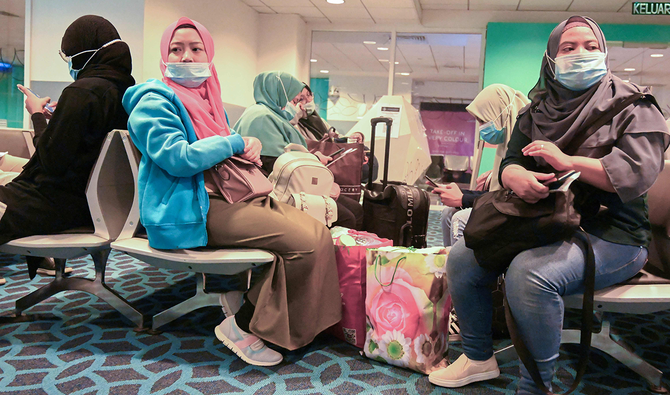
Passengers wearing face masks as a preventive measure against the COVID-19 coronavirus wait before their flight to Jakarta from Kuala Lumpur international airport on August 21, 2020. (AFP)
Short Url
Updated 24 August 2020
Follow

Malaysia looks to reboot economy with travel ‘green zones’

  • Country’s tourism sector severely impacted by coronavirus pandemic

KUALA LUMPUR: With the coronavirus pandemic dealing a severe blow to Malaysia’s tourism sector and domestic travelers unable to revive the industry, the country’s tourism ministry has welcomed the government’s decision to launch travel “green zones” for foreigners. 

“We’ve always been consistent in our approach of asking the government to review international borders,” Tan Kok Liang, president of the Malaysian Association of Tour and Travel Agents (MATTA), told Arab News, adding that the green zones are “most welcome.”

Domestic travel, despite several efforts taken by MATTA, is not enough to “regenerate sustainable revenues streams” for the nation, he said.

Green zones are routes that have been identified as safe for travel, but with strict testing and monitoring during a visit.

Some countries require a travel itinerary for visitors as well as mandatory testing before departure and also upon arrival. Visitors need not undergo 14-day quarantines. 

The proposal to launch the green zones with Australia, Brunei, China, Japan, New Zealand, Singapore, Thailand, Cambodia and Vietnam was mooted by Malaysia’s Tourism Ministry in July, with its implementation subject to bilateral agreements based on health, immigration, data tracking and monitoring by each country. 

To limit economic losses due to the pandemic, Malaysia has allowed interstate travel since May, with strict measures in place, including social distancing and mandatory use of face masks.

Dr. Lim Chee Han, a senior researcher at the Third World Network, an international research and advocacy organization, said 69 percent of foreign arrivals to Malaysia last year were reportedly from fellow member states of the Association of Southeast Asian Nations (ASEAN).

“Many service sectors, especially the tourism sector, are desperate to have a revival of some kind of economic activities,” he told Arab News.

In terms of precautionary measures, he said he foresees the use of rapid test kits for all visitors, who will undergo mandatory health screenings upon arrival. Currently, all foreign arrivals must undergo a 14-day self quarantine after testing at airports. 

Malaysia, a popular Southeast Asian travel destination, welcomed 13.35 million international tourists in the first half of 2019, contributing 41.69 billion ringgits ($9.97 billion) in revenue.

On July 18, Arab News reported that Malaysia saw an estimated 50,000 tourists from the Middle East in the first quarter of 2020.

This coincided with the Visit Malaysia 2020 campaign, which sought to generate $24.26 billion in tourism revenue with a target of 30 million inbound travelers.


Germany says UN rights rapporteur for Palestinian territories should quit

Updated 7 sec ago
Follow

Germany says UN rights rapporteur for Palestinian territories should quit

BERLIN: German Foreign Minister Johann Wadephul on Thursday called for the resignation of the UN special rapporteur for the Palestinian territories, Francesca Albanese, over comments she made allegedly targeting Israel at a conference.
“I respect the UN system of independent rapporteurs. However, Ms Albanese has made numerous inappropriate remarks in the past. I condemn her recent statements about Israel. She is untenable in her position,” Wadephul wrote on X.
Albanese has said that her comments are being falsely portrayed. She denounced what she called “completely false accusations” and “manipulation” of her words in an interview with broadcaster France 24 on Wednesday.
Speaking via videoconference at a forum in Doha on Saturday organized by the Al Jazeera network, Albanese referred to a “common enemy of humanity” after criticizing “most of the world” and much of Western media for enabling the “genocide” in Gaza.
“And this is a challenge — the fact that instead of stopping Israel, most of the world has armed, given Israel political excuses, political sheltering, economic and financial support,” she said.
Albanese said that “international law has been stabbed in the heart” but added that there is an opportunity since “we now see that we as a humanity have a common enemy.”
Wadephul’s French counterpart Jean-Noel Barrot on Wednesday made the same call for Albanese to resign over the comments.
“France unreservedly condemns the outrageous and reprehensible remarks made by Ms Francesca Albanese, which are directed not at the Israeli government, whose policies may be criticized, but at Israel as a people and as a nation, which is absolutely unacceptable,” Barrot told French lawmakers.
Albanese posted video of her comments to X on Monday, writing in the post that “the common enemy of humanity is THE SYSTEM that has enabled the genocide in Palestine, including the financial capital that funds it, the algorithms that obscure it and the weapons that enable it.”
In her interview with France 24, which was recorded before Barrot’s statement, she contended that her comments were being misrepresented.
“I have never, ever, ever said ‘Israel is the common enemy of humanity’,” Albanese told the broadcaster.