

Malaysia looks to reboot economy with travel ‘green zones’

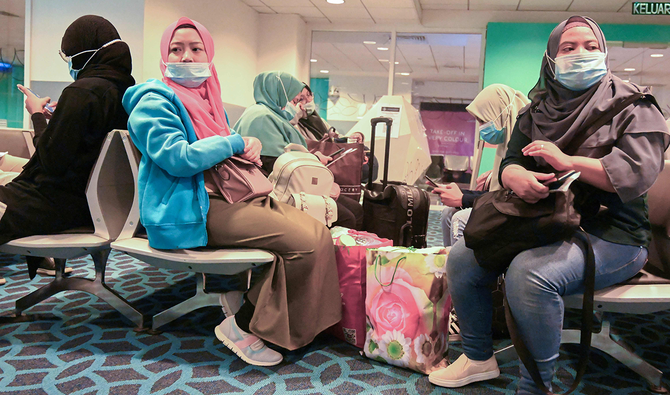
Passengers wearing face masks as a preventive measure against the COVID-19 coronavirus wait before their flight to Jakarta from Kuala Lumpur international airport on August 21, 2020. (AFP)
Short Url
Updated 24 August 2020
Follow

Malaysia looks to reboot economy with travel ‘green zones’

  • Country’s tourism sector severely impacted by coronavirus pandemic

KUALA LUMPUR: With the coronavirus pandemic dealing a severe blow to Malaysia’s tourism sector and domestic travelers unable to revive the industry, the country’s tourism ministry has welcomed the government’s decision to launch travel “green zones” for foreigners. 

“We’ve always been consistent in our approach of asking the government to review international borders,” Tan Kok Liang, president of the Malaysian Association of Tour and Travel Agents (MATTA), told Arab News, adding that the green zones are “most welcome.”

Domestic travel, despite several efforts taken by MATTA, is not enough to “regenerate sustainable revenues streams” for the nation, he said.

Green zones are routes that have been identified as safe for travel, but with strict testing and monitoring during a visit.

Some countries require a travel itinerary for visitors as well as mandatory testing before departure and also upon arrival. Visitors need not undergo 14-day quarantines. 

The proposal to launch the green zones with Australia, Brunei, China, Japan, New Zealand, Singapore, Thailand, Cambodia and Vietnam was mooted by Malaysia’s Tourism Ministry in July, with its implementation subject to bilateral agreements based on health, immigration, data tracking and monitoring by each country. 

To limit economic losses due to the pandemic, Malaysia has allowed interstate travel since May, with strict measures in place, including social distancing and mandatory use of face masks.

Dr. Lim Chee Han, a senior researcher at the Third World Network, an international research and advocacy organization, said 69 percent of foreign arrivals to Malaysia last year were reportedly from fellow member states of the Association of Southeast Asian Nations (ASEAN).

“Many service sectors, especially the tourism sector, are desperate to have a revival of some kind of economic activities,” he told Arab News.

In terms of precautionary measures, he said he foresees the use of rapid test kits for all visitors, who will undergo mandatory health screenings upon arrival. Currently, all foreign arrivals must undergo a 14-day self quarantine after testing at airports. 

Malaysia, a popular Southeast Asian travel destination, welcomed 13.35 million international tourists in the first half of 2019, contributing 41.69 billion ringgits ($9.97 billion) in revenue.

On July 18, Arab News reported that Malaysia saw an estimated 50,000 tourists from the Middle East in the first quarter of 2020.

This coincided with the Visit Malaysia 2020 campaign, which sought to generate $24.26 billion in tourism revenue with a target of 30 million inbound travelers.


Florida braces for frost and possible snow flurries as winter storms hit other parts of the US

Updated 7 sec ago
Follow

Florida braces for frost and possible snow flurries as winter storms hit other parts of the US

  • The worst seems to be heading toward the Carolinas, but the Sunshine State’s humans, animals and even plants are preparing for winter weather
MIAMI: Florida won’t be getting hit with massive blankets of snow and ice like the rest of the US, but even frosty windshields and a few flurries can feel like Antarctica to people with permanent sandal tans.
The Midwest and South have been getting major winter storms for several days, and a giant cyclone forecast in the Atlantic Ocean is expected to pull that cold weather east as a powerful blizzard this weekend. The worst seems to be heading toward the Carolinas, but the Sunshine State’s humans, animals and even plants are preparing for winter weather.
Florida could experience record cold
Ana Torres-Vazquez, a forecaster with the National Weather Service in Miami, said a cold front earlier this week has already caused temperatures to dip some, but the region could experience record-setting cold this weekend.
“It looks like temperatures across South Florida are dipping into the 30s (Fahrenheit) for most of the metro area and maybe into the 20s for areas near Lake Okeechobee,” Torres-Vazquez said. “And then the windchill could make those temperatures feel even cooler.”
Residents of South Florida are less likely to have heavy coats and other winter clothes, so Torres-Vazquez said it’s important to layer up lighter clothing and limit time spent outside.
Moving north, Tony Hurt, a National Weather Service forecaster for the Tampa Bay area, said there’s a 10 to 20 percent chance of snowfall in that region this weekend.
“Most likely if there’s any snow that does actually materialize, it’ll be primarily in the form of flurries, no accumulations,” Hurt said.
The last two times the area got snow was flurries in January 2010 and December 1989. The record for snowfall was in January 1977, with 2 inches (5 centimeters) of snow about 20 miles (32 kilometers) east of Tampa.
Despite the possibility of snow, Tampa will host the annual Gasparilla Pirate Fest on Saturday. And on Sunday, the Tampa Bay Lightning are set to host the Boston Bruins for an outdoor NHL game at the Tampa Bay Buccaneers’ home NFL stadium.
Few tourists visiting Florida will be swimming in the ocean or laying out on sunny beaches this weekend, but many attractions will remain open. Most of Walt Disney World and Universal Orlando will operate normally, though their water parks will be closed. Most of the state’s zoos and animal parks will also remain open while keepers take steps to protect the inhabitants.
Zoo keepers working to keep animals safe and warm
Zoo Miami spokesman Ron Magill said keepers have been setting up heaters and moving reptiles and smaller mammals to indoor enclosures, while primates like chimpanzees and orangutans are given blankets to keep themselves warm. Big cats and large hoofed animals generally do well in colder temperatures and don’t require much assistance from keepers.
“It can be invigorating for animals like the tiger, so they’ll actually become more active,” Magill said.
Outside the safety of the zoo, Florida’s native wildlife has evolved and learned to survive occasional cold snaps, though casualties will still occur, Magill said. Manatees, for example, have spent decades congregating at the warm-water outflows of about a dozen power plants around Florida.
But invasive, nonnative animals like iguanas and other exotic reptiles will suffer the most, Magill said. Iguanas in South Florida famously enter a torpid state during cold periods and even fall out of trees. They usually wake up when the temperature increases, but many will die after more than a day of extreme cold.
“At the end of the day, they don’t belong here, and that might be nature’s way of trying to clean that up a little bit,” Magill said. “That is a part of natural selection.”
Protecting crops is a priority for farmers
Florida’s agriculture industry is also bracing for the cold. Farmers are working to safeguard their crops as winter harvest continues and spring planting begins in some areas, Florida Fruit & Vegetable Association spokeswoman Christina Morton said.
“Preparations vary by crop and include harvesting and planting ahead of the freeze, increasing water levels in ditches, using overhead irrigation, and, in some cases, deploying helicopters to protect sensitive fields,” Morton said.
The Florida deep freeze comes as the arctic blast from Canada also spreads into southern states where thousands of people remain without power to heat their homes, and people in mid-Atlantic states prepare for possible blizzard conditions as a new storm is expected to churn along the East Coast.
Temperatures in hard-hit northern Mississippi will feel as cold as minus 5 degrees Fahrenheit (minus 21 degrees Celsius) when the expected strong winds are factored in, National Weather Service forecasters say. People in a large part of the southeastern US were under a variety of alerts warning of extremely cold weather on the way.
The storm expected to hit the Eastern Seaboard has prompted more warnings in the Carolinas and nearby states. That storm is expected to bring heavy snow and strong winds, which could create “dangerous, near-blizzard conditions,” the weather service warned.