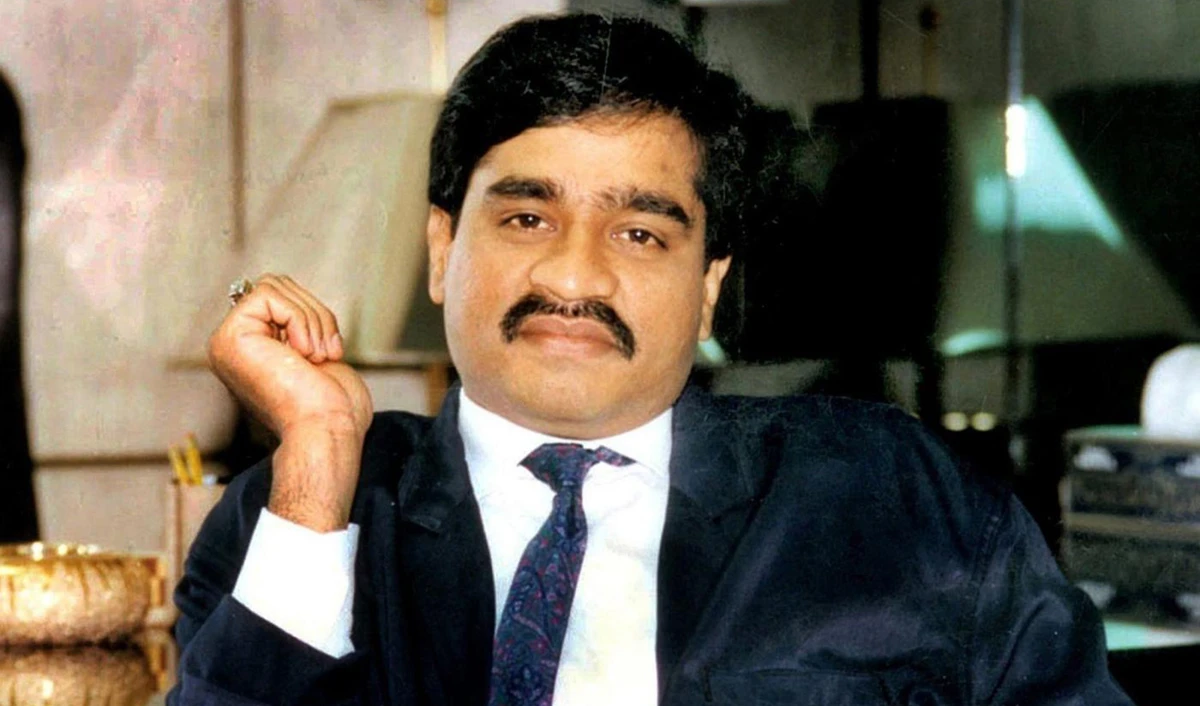
KARACHI: Pakistan has strongly denied the presence on its soil of a notorious Interpol-wanted Indian criminal, Dawood Ibrahim, after the Indian media spotted the gangster’s name on a recent list by the Pakistani Foreign Office of individuals whose assets have been frozen over terrorism links.
Ibrahim has led an organized crime syndicate in Mumbai, India, and is also wanted for ordering a series of bomb explosions that took place in the city in 1993. His name and address in the Pakistani metropolis of Karachi appeared on the statutory notification (SRO) issued by Pakistan on Aug. 18 in a move to avoid the country’s blacklisting by the Financial Action Task Force (FATF), which monitors money laundering and tracks activities of terrorist groups.
“The assertions, made by some sections of the Indian media, as to Pakistan admitting to the presence of certain listed individuals on its territory, based on the information contained in the SRO, are baseless and misleading,” the Foreign Office said in statement on Saturday evening, in response to the Indian press reports.
The statement said the information contained in the SRO was reproduced from the United Nations Security Council’s lists on sanctioned individuals belonging to terrorist groups, which also mention the names of persons who are already dead.
On Sunday, Indian media reported that Pakistan had admitted Ibrahim’s presence on its soil after the SRO mentioned three residential addresses of the gangster in Karachi. The addresses, which could not be independently verified, were first reported in a story by freelance journalist Ghulam Husnain in the Newsline magazine’s September 2001 issue. The same article later became grounds for India to claim that the criminal was living in Pakistan. Interpol issued an arrest warrant for Ibrahim in April 2006.
Ibrahim’s addresses were published on the Pakistani Foreign Office’s website already in November last year.
On June 26, Indian media outlets reported that Ibrahim had died of the coronavirus.
Pakistan denies presence of Interpol-wanted Indian gangster in Karachi
https://arab.news/62msa
Pakistan denies presence of Interpol-wanted Indian gangster in Karachi
- Dawood Ibrahim is wanted for leading an organized crime syndicate and ordering a series of bomb explosions that took place in Mumbai in 1993
- Indian media reported that Pakistan had admitted Ibrahim’s presence on its soil after a statutory notification mentioned his three addresses in Karachi
Pakistan’s top military commander hails Saudi defense pact as ‘historic’ at scholars’ conference
- Asim Munir says Pakistan has a unique bond with the Kingdom, citing the ‘honor’ of helping safeguard the holy sites
- He says only the state can declare jihad, urging religious scholars to counter extremist narratives and promote unity
ISLAMABAD: Chief of Defense Staff Field Marshal Asim Munir on Wednesday described the country’s joint security pact with Saudi Arabia as a “historic” milestone, telling a gathering of religious scholars that Pakistan and the kingdom share a deep strategic relationship.
Signed in September, the Strategic Mutual Defense Agreement has solidified decades of Saudi–Pakistan defense cooperation, covering intelligence-sharing, counterterrorism and regional stability.
The two nations have long coordinated on defense matters, with Pakistani military personnel deployed in the Kingdom.
“The defense agreement [with Saudi Arabia] is historic,” he said in an address to the conference in the federal capital.
The top military commander said Pakistan regarded its connection with the Kingdom as unique.
“Among all Muslim countries, Allah has given Pakistan the honor of helping safeguard the Haramain,” he continued, referring to the two holiest sites of Islam in Makkah and Madinah.
Munir used his speech to warn against extremism, saying that under the Islamic framework, only the state could declare jihad, a pointed reference to groups such as the Tehreek-e-Taliban Pakistan (TTP), which claims to act in the name of religion while carrying out attacks on civilians and security forces.
“When nations abandon knowledge and the pen, disorder takes hold,” he said, urging the religious scholars to help keep society unified and to “broaden the nation’s vision.”
Munir also criticized India, describing “terrorism” as “India’s habit, not Pakistan’s.”
His remarks came months after a four-day military confrontation in May, during which the two nuclear-armed neighbors exchanged artillery and missile fire and deployed drones and fighter jets.
India blamed Pakistan for a militant attack in Indian-administered Kashmir before launching a missile attack. Islamabad denied involvement and called for an international probe.
Pakistan claimed it had shot down six Indian fighter jets before a US-brokered ceasefire took effect.
“We do not hide when confronting the enemy,” Munir said. “We challenge openly.”