Afghan Taliban arrives in Islamabad for peace talks 

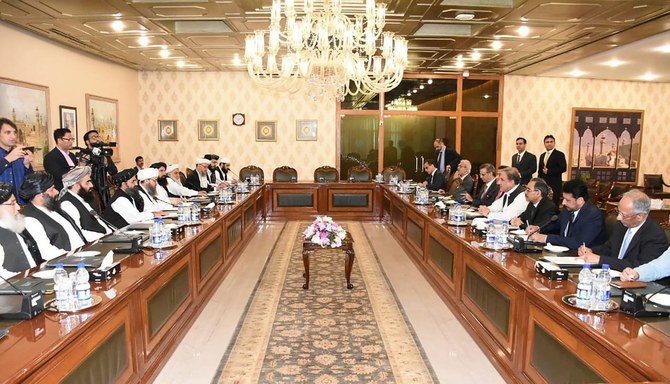
Pakistan's foreign minister Shah Mahmood Qureshi, fourth right, holds a meeting with Afghan Taliban delegation at the Foreign Ministry in Islamabad on Oct. 3, 2019. (Ministry of Foreign Affairs of Pakistan via AN)
Short Url
Updated 24 August 2020
Follow

Afghan Taliban arrives in Islamabad for peace talks 

  • Delegation arrived after the group said Pakistan’s decision to sanction its leadership would affect intra-Afghan talks 
  • Sanction order includes the name of Taliban chief peace negotiator Mullah Abdul Ghani Baradar, who is leading the group’s delegation to Islamabad 

ISLAMABAD: The Afghan Taliban high-level delegation arrived in Islamabad, on Monday, on the invitation of Pakistan’s Foreign Office, days after Pakistani authorities imposed on the group’s leadership sanctions, which include travel restrictions. 

The sanction order issued on Aug. 18 and made public on Friday includes the name of Taliban chief peace negotiator Mullah Abdul Ghani Baradar.

“Officials of the Islamic Emirate routinely pay visits to regional and other countries of the world as part of our political strategy to convey our views about the peace process,” Taliban political spokesman Suhail Shaheen said in a Twitter post on Sunday. 

According Taliban political spokesman Mullah Baradar is leading the delegation, which will hold meetings with senior officials and discuss the peace process in Afghanistan. 
The Foreign Office’s spokesman confirmed to Arab News that Pakistan had invited the Taliban to discuss the peace process. 
A Taliban source in Doha, where the group has its political office, told Arab News that other members of the delegation will be Khairullah Khairkhwa, Mohammad Nabi Omari, Shahbuddin Dilawar and Abdul Latif Mansoor.
The Taliban will land in Pakistan as its sanctions on them are already in place. The sanction order also prevents their entry into or transit through the country.
Earlier on Sunday, the group said the Pakistani government’s decision to sanction its leadership would affect intra-Afghan talks.
“These are not new sanctions, they were slapped on a number of members of the Islamic Emirate previously. But while we are now entering into intra-Afghan negotiations and there is a need for travel, so of course these embargoes or sanctions will hamper the peace process,” Shaheen told Arab News from Doha, Qatar.
The order published by the Foreign Office says the decision was in line with the relevant resolutions of the UN Security Council’s Taliban Sanctions Committee, which direct member countries “to apply travel restrictions, arms embargo and to freeze the funds and other financial resources of certain individuals and entities.”
Shaheen told Arab News that the Taliban have no Pakistani assets or bank accounts, and do not buy weapons from Pakistan.
The Pakistani government’s move has been seen as an attempt to avoid the country’s blacklisting by the Financial Action Task Force (FATF), which monitors money laundering and tracks activities of terrorist groups. FATF put Pakistan on its grey list last year.
However, the development comes at a time when the US, under its agreement with the Taliban that was signed in Doha on Feb. 29, should start consultations with the UN Security Council’s members to lift the sanctions against Taliban leaders.
The Doha agreement says that with the start of intra-Afghan negotiations, the US “will initiate an administrative review of current US sanctions and the rewards list against members of the Islamic Emirate of Afghanistan,” which is known as the Taliban, “with the goal of removing these sanctions by August 27, 2020.”
On Sunday evening, Afghan Foreign Ministry’s spokesman Gran Hewad said in a video post on Twitter that Pakistan’s sanctions on the Taliban leaders were an “important development.”
“The Foreign Ministry has taken note of it and is studying it and will share results with the people after evaluation,” he said. 


Pakistan PM orders accelerated privatization of power sector to tackle losses

Updated 15 December 2025
Follow

Pakistan PM orders accelerated privatization of power sector to tackle losses

  • Tenders to be issued for privatization of three major electricity distribution firms, PMO says
  • Sharif says Pakistan to develop battery energy storage through public-private partnerships

ISLAMABAD: Pakistan’s prime minister on Monday directed the government to speed up privatization of state-owned power companies and improve electricity infrastructure nationwide, as authorities try to address deep-rooted losses and inefficiencies in the energy sector that have weighed on the economy and public finances.

Pakistan’s electricity system has long struggled with financial distress caused by a combination of factors including theft of power, inefficient collection of bills, high costs of generating electricity and a large burden of unpaid obligations known as “circular debt.” In the first quarter of the current financial year, government-owned distribution companies recorded losses of about Rs171 billion ($611 million) due to poor bill recovery and operational inefficiencies, official documents show. Circular debt in the broader power sector stood at around Rs1.66 trillion ($5.9 billion) in mid-2025, a sharp decline from past peaks but still a major fiscal drain. 

Efforts to contain these losses have been a focus of Pakistan’s economic reform program with the International Monetary Fund, which has urged structural changes in the energy sector as part of financing conditions. Previous government initiatives have included signing a $4.5 billion financing facility with local banks to ease power sector debt and reducing retail electricity tariffs to support economic recovery. 

“Electricity sector privatization and market-based competition is the sustainable solution to the country’s energy problems,” Prime Minister Shehbaz Sharif said at a meeting reviewing the roadmap for power sector reforms, according to a statement from the prime minister’s office.

The meeting reviewed progress on privatization and infrastructure projects. Officials said tenders for modernizing one of Pakistan’s oldest operational hubs, Rohri Railway Station, will be issued soon and that the Ghazi Barotha to Faisalabad transmission line, designed to improve long-distance transmission of electricity, is in the initial approval stages. While not all power-sector decisions were detailed publicly, the government emphasized expanding private sector participation and completing priority projects to strengthen the electricity grid.

In another key development, the prime minister endorsed plans to begin work on a battery energy storage system with participation from private investors to help manage fluctuations in supply and demand, particularly as renewable energy sources such as solar and wind take a growing role in generation. Officials said the concept clearance for the storage system has been approved and feasibility studies are underway.

Government briefing documents also outlined steps toward shifting some electricity plants from imported coal to locally mined Thar coal, where a railway line expansion is underway to support transport of fuel, potentially lowering costs and import dependence in the long term.

State authorities also pledged to address safety by converting unmanned railway crossings to staffed ones and to strengthen food safety inspections at stations, underscoring broader infrastructure and service improvements connected to energy and transport priorities.