
Cricket superstar Afridi pledges to bring back to life remote Pakistani town’s sole library

Pakistani cricketer Shahid Afridi speaks during a press conference for the launch of his charity foundation in Karachi on June 27, 2014. (AFP/File)
Short Url
Updated 23 August 2020
Follow

Cricket superstar Afridi pledges to bring back to life remote Pakistani town’s sole library

  • In the 1970s, the public library was the educational center of Tank district, providing the newest books and press
  • Shahid Afridi Foundation is going to rebuild and furnish the building, and supply the library with books

PESHAWAR: Cricket star Shahid Afridi has pledged to rebuild the sole public library of Tank district, an institution which once was a bustling cultural center of the impoverished region in northwestern Pakistan.
The library was established in Tank city, the district’s main town, in the early 1970s. In severely dilapidated condition, it has been closed for the past 15 years as the local administration has no means to maintain it.
“I’ve already talked to the top district administrator to clean up the library’s premises. Though I live far away in Karachi, I often think about the youth of the restive region who have matchless talent and need to be educated,” Afridi, the superstar allrounder, told Arab News on Saturday, after images showing the demolished library made the rounds on social media.
Afridi said he will restore and furnish the building with the help of his Shahid Afridi Foundation, and will supply it with books.
“The people of Tank region and its peripheries had gone through severe hardships and ups and downs during the last few years,” the cricketer said, “The people of that region have great valor and profound love for Pakistan, and deserve quality education.”
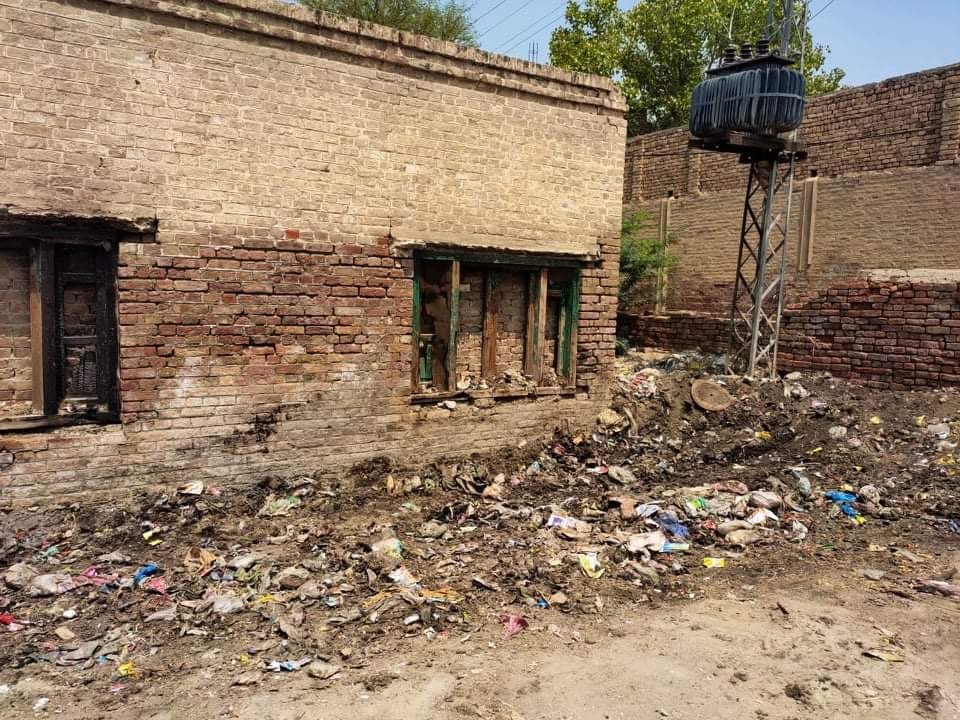


In this photo shared by journalist Ayub Bhittani, the sole library of Tank district in Khyber Pakhtunkhwa is seen in dilapidated condition on Aug. 17, 2020. (Photo courtesy of Ayub Bhittani via AN)

Located in Khyber Pakhtunkhwa province, Tank has a population of nearly 400,000 and is one of the poorest regions of Pakistan. It is part of Dera Ismail Khan division and a gateway to South Waziristan tribal district. The region’s development was affected by years of army operations against militants in South Waziristan in the past decade and an influx of internally displaced persons forced to flee the area.
Muhammad Faizan, municipal officer in Tank, told Arab News that the library’s closure was caused by acute financial problems, but the district administration had ignored it, despite repeated requests for support. The district’s commissioner was not available for comment when Arab News tried to reach him.
Dr. Tahir Javed, former district health officer of Tank, recalled his college years in the 1970s, when he would come with others to the library to study and for the best books and press. The most tragic thing, he said, is that the library’s collections have virtually all “disappeared.”
“The library would be packed with readers because students from the adjacent South Waziristan tribal district used to study there too. In the courtyard of the library, we used to play table tennis and badminton.”
In the morning, Javed said, pensioners would come to the library to read newspapers.
“When I used to study at the library, it was equipped with the latest books, novels, newspapers and magazines. I’m in tears when I see it’s deserted look today.”


Pakistan stocks close at record high over current account surplus, falling bond yields

Updated 9 sec ago
Follow

Pakistan stocks close at record high over current account surplus, falling bond yields

  • KSE-100 index gains 1,646.79 points or 0.97% to close at new high of 171,960.64 points
  • Pakistan’s central bank posted a current account surplus of $100 million in November

KARACHI: Pakistani stocks closed at an all-time high of 171,960.4 points on Thursday, with financial analysts attributing the surge to increasing investor confidence stemming from a current account surplus reported in November and a drop in government bond yields.

The benchmark KSE-100 index gained 1,646.79 points or 0.97% to close at an all-time high of 171,960.64 points on Thursday. The previous day, Pakistani stocks surged to 170,313.85 points at close of business. 

Ahsan Mehanti, chief executive officer at Arif Habib Commodities, said the optimistic mood at the stock exchange was fueled by the $100 million current account surplus reported by the central bank in November.

“Speculations ahead of year-end close and fall in government bond yields up to 70 basis points after the SBP (State Bank of Pakistan) policy easing played the catalyst role in bullish activity at PSX,” Mehanti told Arab News. 

The surplus was a welcome development for Islamabad as Pakistan’s central bank reported a $291 million deficit in October.

Topline Securities, a Pakistani brokerage firm, said in its daily market review that strong buying by local funds followed a drop in Pakistan Investment Bond (PIB) yields, which boosted investor confidence.

PIB yields are the returns on bonds or government-backed securities that pay fixed semi-annual interest, with rates influenced by market demand and SBP auctions.

“Strength in ENGRO (Engro Corporation), FFC (Fauji Fertilizer Company), UBL (United Bank Limited), LUCK (Lucky Cement) and BAHL (Bank AL Habib) underpinned positive momentum, collectively contributing 1,504 points to the index,” the brokerage firm wrote on X. 

“This upside was partly offset by declines in PIOC (Pakistan International Oil Company), DHPL (D.H. Corporation Limited) and MLCF (Millat Tractor Limited), which together subtracted 176 points.”

The sustained rise in equities comes amid improving liquidity conditions and continued investor participation, with market participants focusing on corporate earnings, sector-specific developments and broader macroeconomic signals.

Earlier on Monday, Pakistan’s central bank cut its key policy interest rate by 50 basis points to 10.5%, a move that surprised analysts and followed four consecutive policy meetings where rates were held unchanged.

The cut came despite an International Monetary Fund staff report earlier this month cautioning against premature monetary easing.

Inflation eased to 6.1% in November, remaining within the SBP’s target band, though analysts have warned that price pressures could resurface later in the fiscal year as base effects fade and food and transport costs remain volatile.