Virgin Australia bondholders drop plans to rival Bain Capital deal

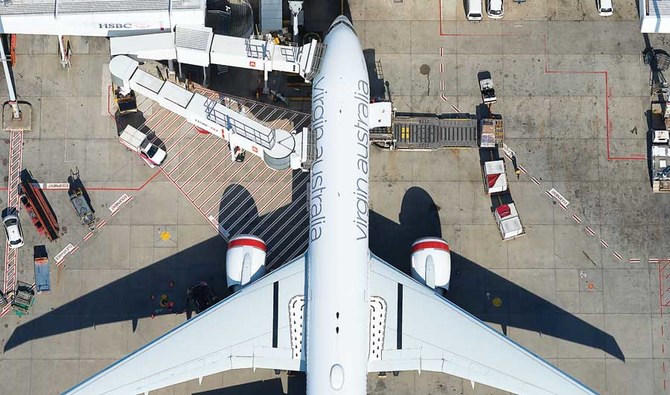
Virgin Australia bondholders will vote on September on the deal offered by Bain Capital to take over the company. (Shutterstock)
Short Url
Updated 22 August 2020
Follow

Virgin Australia bondholders drop plans to rival Bain Capital deal

  • Virgin Australia is in voluntary administration, the closest Australian equivalent to Chapter 11 bankruptcy provisions used to restructure companies in the US

SYDNEY: Virgin Australia Holdings bondholders have withdrawn plans for a proposed recapitalization of the airline that was
meant to rival one from US private equity firm Bain Capital, a spokesman for the bondholders said on Friday.
Singapore’s Broad Peak and Hong Kong’s Tor Investment Management, which had proposed the rival deed of company arrangement (DOCA) to recapitalize the airline, hold around A$300 million ($216 million) of Virgin’s A$2 billion of unsecured bonds, part of nearly A$7 billion owed to creditors.
A court ruling this week makes it impossible to complete due diligence and present a substantially unconditional DOCA proposal to rival Bain’s at a creditors’ meeting on Sept. 4, the spokesman for the bondholders said.
Virgin Australia is in voluntary administration, the closest Australian equivalent to Chapter 11 bankruptcy provisions used to restructure companies in the US.
Administrator Deloitte plans to issue a report to creditors on Aug. 25 outlining the return they should expect under the Bain deal, which has not yet been made public.
“After the release of the administrator’s report, we reserve our rights to take whatever action is necessary to protect our interests as creditors,” the bondholders’ spokesman said.
The bondholders have said their DOCA would allow for the conversion of noteholders’ and certain other unsecured creditors’ debts into equity worth around 69 cents on the dollar, with an option for creditors to sell their shares for cash.
The administrator welcomed the bondholders’ withdrawal as it would allow it to focus on the binding agreement with Bain ahead of the creditors’ meeting, a Deloitte spokesman said.


First EU–Saudi roundtable on critical raw materials reflects shared policy commitment

Updated 16 January 2026
Follow

First EU–Saudi roundtable on critical raw materials reflects shared policy commitment

RIYADH: The EU–Saudi Arabia Business and Investment Dialogue on Advancing Critical Raw Materials Value Chains, held in Riyadh as part of the Future Minerals Forum, brought together senior policymakers, industry leaders, and investors to advance strategic cooperation across critical raw materials value chains.

Organized under a Team Europe approach by the EU–GCC Cooperation on Green Transition Project, in coordination with the EU Delegation to Saudi Arabia, the European Chamber of Commerce in the Kingdom and in close cooperation with FMF, the dialogue provided a high-level platform to explore European actions under the EU Critical Raw Materials Act and ResourceEU alongside the Kingdom’s aspirations for minerals, industrial, and investment priorities.

This is in line with Saudi Vision 2030 and broader regional ambitions across the GCC, MENA, and Africa.

ResourceEU is the EU’s new strategic action plan, launched in late 2025, to secure a reliable supply of critical raw materials like lithium, rare earths, and cobalt, reducing dependency on single suppliers, such as China, by boosting domestic extraction, processing, recycling, stockpiling, and strategic partnerships with resource-rich nations.

The first ever EU–Saudi roundtable on critical raw materials was opened by the bloc’s Ambassador to the Kingdom, Christophe Farnaud, together with Saudi Deputy Minister for Mining Development Turki Al-Babtain, turning policy alignment into concrete cooperation.

Farnaud underlined the central role of international cooperation in the implementation of the EU’s critical raw materials policy framework.

“As the European Union advances the implementation of its Critical Raw Materials policy, international cooperation is indispensable to building secure, diversified, and sustainable value chains. Saudi Arabia is a key partner in this effort. This dialogue reflects our shared commitment to translate policy alignment into concrete business and investment cooperation that supports the green and digital transitions,” said the ambassador.

Discussions focused on strengthening resilient, diversified, and responsible CRM supply chains that are essential to the green and digital transitions.

Participants explored concrete opportunities for EU–Saudi cooperation across the full value chain, including exploration, mining, and processing and refining, as well as recycling, downstream manufacturing, and the mobilization of private investment and sustainable finance, underpinned by high environmental, social, and governance standards.

From the Saudi side, the dialogue was framed as a key contribution to the Kingdom’s industrial transformation and long-term economic diversification agenda under Vision 2030, with a strong focus on responsible resource development and global market integration.

“Developing globally competitive mineral hubs and sustainable value chains is a central pillar of Saudi Vision 2030 and the Kingdom’s industrial transformation. Our engagement with the European Union through this dialogue to strengthen upstream and downstream integration, attract high-quality investment, and advance responsible mining and processing. Enhanced cooperation with the EU, capitalizing on the demand dynamics of the EU Critical Raw Materials Act, will be key to delivering long-term value for both sides,” said Al-Babtain.

Valere Moutarlier, deputy director-general for European industry decarbonization, and directorate-general for the internal market, industry, entrepreneurship and SMEs at European Commission, said the EU Critical Raw Materials Act and ResourceEU provided a clear framework to strengthen Europe’s resilience while deepening its cooperation with international partners.

“Cooperation with Saudi Arabia is essential to advancing secure, sustainable, and diversified critical raw materials value chains. Dialogues such as this play a key role in translating policy ambitions into concrete industrial and investment cooperation,” she added.