


LAHORE: Publishers in Pakistan's most populous province could soon face prison if they fail to win approval from government bureaucrats before printing or importing books, pamphlets and many other written works.
Lawmakers in Punjab, home to about half of the country's 215 million people, unanimously approved the measure last month as part of a sweeping bill targeting "objectionable" printed material.
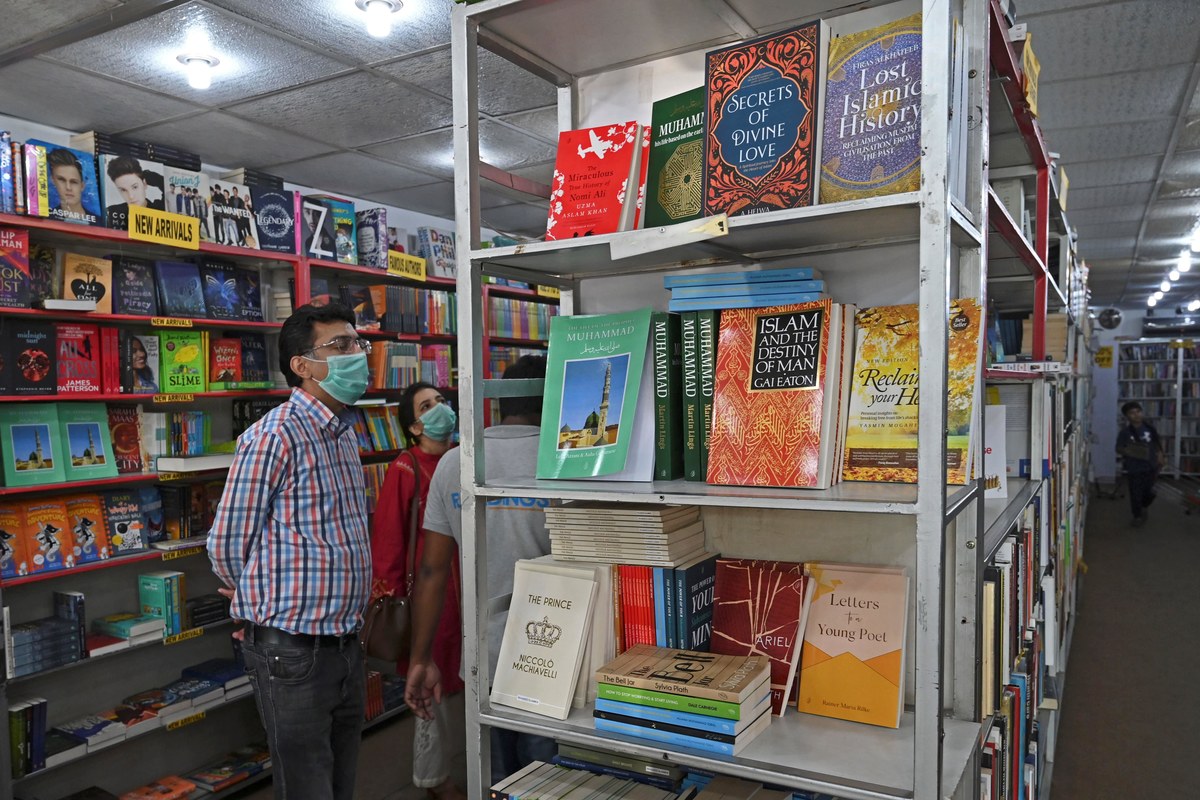
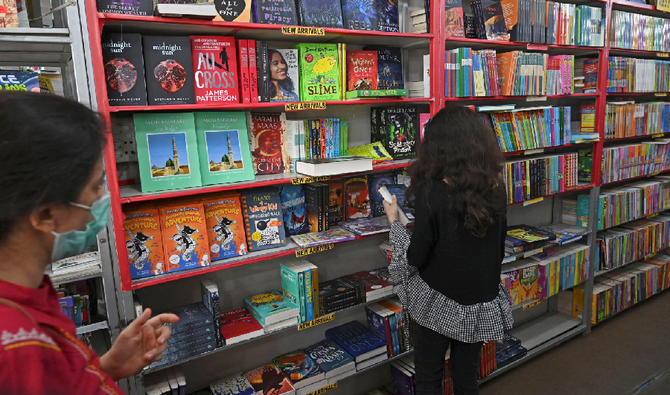
In this photograph taken on August 14, 2020, customers browse books at a bookstore in Lahore. - At the centre of Pakistan's vibrant literary scene, authorities are cracking down on publishers with a new law that has critics fearing for free speech. The parliament of Punjab province, which is home to some of South Asia's best-known writers, unanimously voted through a bill in July that threatens publishing houses and authors with jail for printing content deemed detrimental to Pakistan's national interests. (AFP Photo)
If implemented, the bill could gut the publishing industry in regional capital Lahore and divide Pakistan's literary world, leaving books available in one part of the country but banned in another.
Proponents claim the legislation will root out blasphemous content and enhance national security.
But critics say it is just the latest example of authorities pandering to populist religious pressure, and attempting to stifle debate in a culture of ever-increasing censorship.
The bill has such "loose and vague terms that they can be easily used against progressive publishers like us", Bilal Zahoor, editorial director of a Lahore-based independent publishing house, told AFP.
"Publishers like us will be pushed out of business," he warned.
Punjab's governor has yet to sign the bill into law and has indicated he may seek some amendments before doing so.
In its current form, the legislation would give authorities almost unlimited scope to control, censor and confiscate any texts they deem problematic.
"Any material that is likely to jeopardise or is prejudicial to the ideology of Pakistan or the sovereignty, integrity or security of Pakistan" would be subject to tough new controls, the bill states.
So would any work promoting "vulgarity" and "obscenity".
Publishers would have to submit detailed descriptions of all books to an "authorised officer" with Punjab's office of the Director General of Public Relations (DGPR) -- which would gain broad new powers to inspect any printing press, publication house or bookstore and confiscate books.
Supporters say the bill will boost national security because it will bar writing seen as glorifying "terrorists" and "extremist elements".
It would also require every single printed mention of the Prophet Muhammad (pbuh) to be preceded and followed by wordy honorifics -- something few books currently include.
Publishers would have to inform bureaucrats of works they are producing or translating, and booksellers would need to reveal books they are importing.
Those falling foul of the DGPR could face up to five years in prison.
Nida Kirmani, a Lahore-based academic and social scientist, said the legislation would be used to further stifle Pakistan's already-shrinking space for public debate.
"This is another (step) in a long history of regressive and anti-democratic measures taken by representatives of the state that utilises religion as an excuse to quash free speech and critical thinking," she told AFP.
Pakistan already has powers to ban books after publication.
In January, authorities banned British-American author Lesley Hazleton's non-fiction books about the beginnings of Islam that for years went untouched by censors.
The same month, renowned Pakistani author Mohammed Hanif said all copies of the Urdu version of his award-winning political satire "A Case of Exploding Mangoes" were confiscated after a raid on his publishing house.
In recent years, Pakistani officials have also tried to censor social networks.
More than 200 academics, journalists, historians and other community figures have written an open letter to the Punjab Assembly expressing grave concern about the "immense arbitrary, unfettered and unilateral power" given to authorities to decide a book's fate.
Newspapers and magazines already face intense scrutiny under existing laws and are not subject to the pending legislation.
Neither are textbooks, which are controlled by the Punjab Curriculum and Textbook Board (PCTB).
Soon after lawmakers passed the bill, an emboldened PCTB used existing laws to impose its first mass ban -- censoring 100 textbooks used by private schools due to "anti-Pakistan" and "immoral" content -- and is scrutinising thousands more.
Some of the newly banned books contained quotes from Indian independence icon Mahatma Gandhi and maps that do not include the disputed Kashmir region as part of Pakistan.
A mathematics book, which used three cartoon pigs -- forbidden in Islam -- to illustrate a simple counting exercise, was also banned.
"Publishers should have first sought permission before printing the books," PCTB chief Rai Manzoor Hussain Nasir told AFP, adding that the ban would be lifted if the textbooks were altered.


