

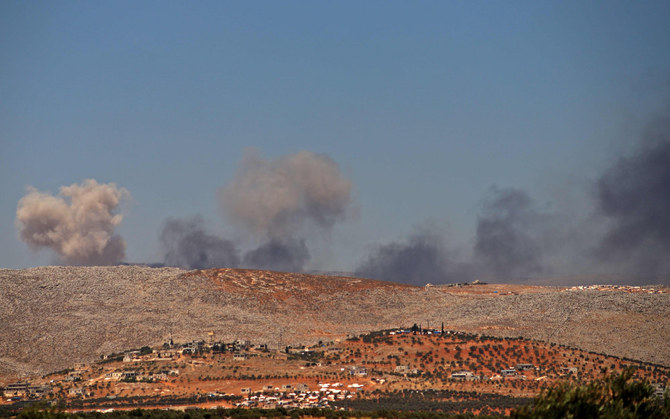

ANKARA: The arrival of hundreds of Turkish military vehicles in Syria’s rebel-held Idlib province has sparked fears that the recent lull in fighting in the area may soon end.
Turkish convoys have reportedly been seen heading toward Turkish observation points in the Idlib countryside days after Russian airstrikes on the area. A Turkish military vehicle on patrol in Idlib was hit by an explosion on Monday, but no casualties were reported.
Russia last week suspended its participation in joint patrols with Turkey along the cross-country M4 highway in Idlib, citing ongoing drone attacks by militants on Russia’s Khmeimim base in the Latakia countryside.
According to Ruwan Al-Rejoleh, an independent analyst in Washington, DC, Turkey is sending reinforcements to Idlib in the hope of deterring a military campaign led by Russia and the Syrian National Army targeting jihadi terrorist groups in Idlib, including Hayat Tahrir Al-Sham (HTS) and Hurras Al-Din.
“Turkey is mobilizing Syrian armed factions like Faylaq al-Sham and others to be on the frontlines facing this potential offensive by Russia and the regime forces,” she told Arab News.
Al-Rejoleh thinks it is likely that Turkey-backed armed factions will be fighting side-by-side with jihadi groups against any such Russian-led offensive, rather than against each other.
Al-Rejoleh added that a recent meeting between Turkish intelligence officers and various opposition factions in the region, including the commander of the military wing of the Al-Nusra Front and Ahrar Al-Sham, had resulted in the formation of a military council whose leaders are based in Idlib city and its surrounding countryside.
“It is likely that Russia aims to control the south of the M4 highway from Jisr Al-Shughoor, in order to secure Latakia,” she said.
However, Al-Rejoleh stressed that Russian President Vladimir Putin and his Turkish counterpart Recep Tayyip Erdogan are more strategic partners than tactical enemies, and suggested that the main aim of Turkey’s military mobilization was to ensure the security of Turkish forces already in Idlib. Turkey has control of around 66 military locations in the de-escalation zone in Idlib.
Navvar Saban, a military analyst at the Omran Center for Strategic Studies in Istanbul, does not believe either Russia or Turkey is attempting to initiate a major confrontation at the moment.
“But still there is a communication gap that is being used by local forces,” he told Arab News. “That’s why we saw regime forces launching attacks. And this gap (adds further) fragility to the situation.”
Saban suggested that the renewed local tensions which have led parties to the latest military maneuvers can be used to hasten political events, such as another round of Astana talks between the leaders of Turkey, Russia and Iran, aimed at launching a political process involving all parties involved in the Syrian conflict. The last round of talks was held online on July 1.


