

ADNOC chief sees robust return of oil demand

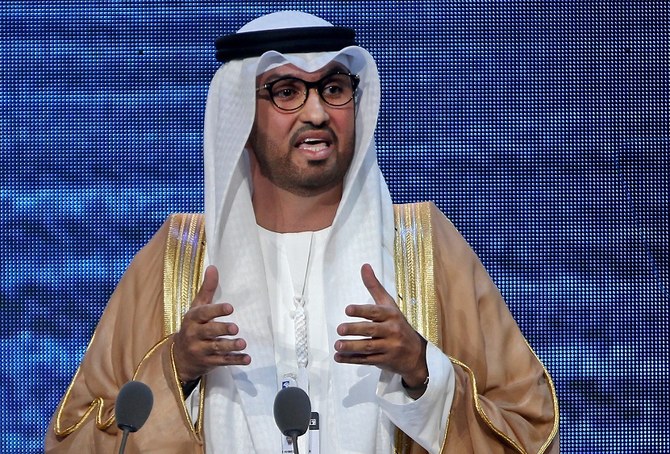
ADNOC CEO Sultan Al-Jaber. (File/AFP)
Short Url
Updated 18 August 2020
Follow

ADNOC chief sees robust return of oil demand

  • The industry will need to remain cautious and focused on its cost base amid continued volatility, said ADNOC CEO
  • Oil producers within OPEC and others outside the group including Russia have agreed to slash production in an effort to stabilize the market

LONDON: The CEO of Abu Dhabi National Oil Company (ADNOC) expects to see a robust recovery in oil demand driven by consumption in China.
But the industry will need to remain cautious and focused on its cost base amid continued volatility, said ADNOC CEO Sultan Al-Jaber in an interview with IHS Markit Vice Chairman Daniel Yergin.
"No one is in a position to predict what the shape of economic recovery will look like in the long term. There are multiple macroeconomic variables but on the positive side, the market has clearly tightened in the last two months, and this happened because economies began to reopen," he said. "The approach of OPEC and its leadership also helped build confidence in the market and as a result we are seeing the robust return of oil demand and this is mainly coming from China."

China has ramped up oil purchased in recent months with its  imports for May, June and July together representing the highest three months on record.

The positive outlook for oil was echoed in the results of Australian mining and oil production group BHP on Tuesday.
"We believe that the most significant risks to the physical (oil) market have now passed," the company said.

Oil producers within OPEC and others outside the group including Russia have agreed to slash production in an effort to stabilize the market as global oil demand was devastated by the collapse of demand associated with pandemic lockdowns.
The group, known as OPEC+, eased their cuts this month to about 7.7 million barrels per day (bpd) from 9.7 million bpd previously.


Saudi minister at Davos urges collaboration on minerals

Global collaboration on minerals essential to ease geopolitical tensions and secure supply, WEF hears. (Supplied)
Updated 1 min 38 sec ago
Follow

Saudi minister at Davos urges collaboration on minerals

  • The reason of the tension of geopolitics is actually the criticality of the minerals

LONDON: Countries need to collaborate on mining and resources to help avoid geopolitical tensions, Saudi Arabia’s minister of industry and mineral resources told the World Economic Forum on Tuesday.

“The reason of the tension of geopolitics is actually the criticality of the minerals, the concentration in different areas of the world,” Bandar Alkhorayef told a panel discussion on the geopolitics of materials.

“The rational thing to do is to collaborate, and that’s what we are doing,” he added. “We are creating a platform of collaboration in Saudi Arabia.”

Bandar Alkhorayef, Saudi Minister of Industry and Mineral Resources 

The Kingdom last week hosted the Future Minerals Forum in Riyadh. Alkhorayef said the platform was launched by the government in 2022 as a contribution to the global community. “It’s very important to have a global movement, and that’s why we launched the Future Minerals Forum,” he said. “It is the most important platform of global mining leaders.”

The Kingdom has made mining one of the key pillars of its economy, rapidly expanding the sector under the Vision 2030 reform program with an eye on diversification. Saudi Arabia has an estimated $2.5 trillion in mineral wealth and the ramping up of extraction comes at a time of intense global competition for resources to drive technological development in areas like AI and renewables.

“We realized that unlocking the value that we have in our natural resources, of the different minerals that we have, will definitely help our economy to grow to diversify,” Alkhorayef said. The Kingdom has worked to reduce the timelines required to set up mines while also protecting local communities, he added. Obtaining mining permits in Saudi Arabia has been reduced to just 30 to 90 days compared to the many years required in other countries, Alkhorayef said.

“We learned very, very early that permitting is a bottleneck in the system,” he added. “We all know, and we have to be very, very frank about this, that mining doesn’t have a good reputation globally.

“We are trying to change this and cutting down the licensing process doesn’t only solve it. You need also to show the communities the impact of the mining on their lives.”

Saudi Arabia’s new mining investment laws have placed great emphasis on the development of society and local communities, along with protecting the environment and incorporating new technologies, Alkhorayef said. “We want to build the future mines; we don’t want to build old mines.”