Iraq pledges full compliance with OPEC+ oil cuts

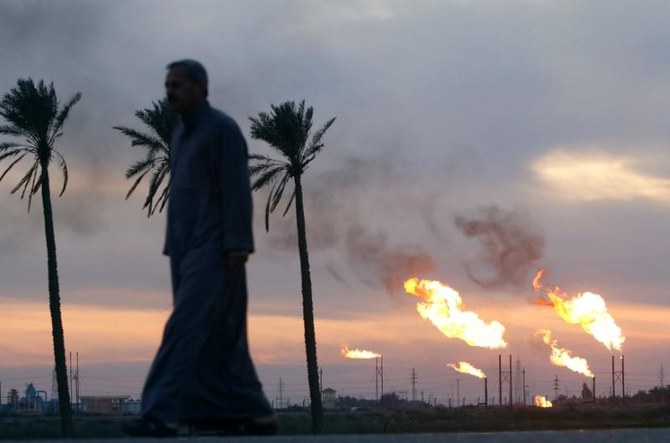
Flames emerge from flare stacks at the oil fields in Basra, Iraq, January 17, 2017. (Reuters)
Short Url
Updated 08 August 2020
Follow

Iraq pledges full compliance with OPEC+ oil cuts

  • Prince Abdulaziz bin Salman Al-Saud, the Saudi Arabian energy minister, and his Iraqi counterpart, Ihsan Ismail, reaffirmed their commitment to the cuts
  • Under tough economic pressure, Iraq had struggled to meet the full cuts, but Ismail promised to reach 100 percent this month

DUBAI: Iraq has pledged to meet in full its obligations under the OPEC+ oil production cuts that have been credited with rebalancing global crude markets after the mayhem of April’s “Black Monday” when prices crashed around the world.

In a telephone call between Prince Abdulaziz bin Salman Al-Saud, Saudi Arabian energy minister, and his Iraqi counterpart, Ihsan Ismail, the two men reaffirmed their commitment to the cuts, which have helped to pull the oil price back from historic lows.

Brent crude, the global benchmark, has more than doubled in the past three months.

Under tough economic pressure, Iraq had struggled to meet the full cuts, but Ismail promised to reach 100 percent this month. Iraq has now committed itself to an ambitious program of compensation to make up for past overproduction.

Iraq will further reduce production by 400,000 barrels per day this month and next, Ismail said, bringing its total cut to 1.25 million barrels daily. That level of cuts could be adjusted when final estimates of compliance are assessed by the six “secondary sources” that monitor OPEC+ output.

“The two ministers stressed that efforts by OPEC+ countries toward meeting production cuts, and the extra cuts under the compensation regime, will enhance oil market stability, help accelerate the rebalancing of global oil markets, and send a constructive signal to the market,” a joint statement added.

Prince Abdulaziz thanked Ismail for his efforts to improve Iraq’s compliance with the agreement.

Iraq had been the biggest laggard in the move toward 100 percent compliance by the 23 members of the OPEC+ alliance.

Officials in Riyadh told Arab News that Iraqi compliance had reached about 90 percent, a high level by the country’s previous standards but still short of the new targets.

Saudi Arabia has been forcefully advocating full compliance with the targets in an effort to remove oil from the global market as demand is still badly affected by the economic fallout from the COVID-19 pandemic.

The oil market will be under the spotlight later this month when the joint ministerial monitoring committee of OPEC+ energy ministers convenes virtually in the most recent of the monthly meetings set up to oversee the state of the global industry.

Oil had another strong week on global markets, breaking through the $45 barrier for the first time since early March on signs that the glut in US oil stocks was easing, as well as reductions in the amount of “floating crude” stored in tankers on the world’s oceans.

The price spiked on news of the Beirut explosion, which some analysts believed could herald a deterioration in regional security and a threat to oil exports.

Brent crude was trading at $44.70 on international markets.


Saudi Aramco, ExxonMobil, Samref ink deal to study Yanbu refinery upgrade

Updated 08 December 2025
Follow

Saudi Aramco, ExxonMobil, Samref ink deal to study Yanbu refinery upgrade

RIYADH: Energy giants Saudi Aramco, ExxonMobil, and Samref have signed a venture framework agreement to upgrade the Yanbu refinery and expand it into an integrated petrochemical complex.

As a part of the deal, the companies will explore capital investments to upgrade and diversify production, including high-quality distillates that result in lower emissions and high-performance chemicals, according to a joint press statement.

The agreement will also see the parties explore opportunities to improve the refinery’s energy efficiency and reduce environmental impacts from operations through an integrated emissions-reduction strategy.

Samref is an equally owned joint venture between Aramco and Mobil Yanbu Refining Co. Inc., a wholly owned subsidiary of Exxon Mobil Corp.

The refinery currently has the capacity to process more than 400,000 barrels of crude oil per day, producing a diverse range of energy products, including propane, automotive diesel oil, marine heavy fuel oil, and sulfur.

“This next phase of Samref marks a step in our long-term strategic collaboration with ExxonMobil. Designed to increase the conversion of crude oil and petroleum liquids into high-value chemicals, this project reinforces our commitment to advancing Downstream value creation and our liquids-to-chemicals strategy,” said Aramco Downstream President, Mohammed Y. Al Qahtani.

He added that the deal will help position Samref as a key driver of the Kingdom’s petrochemical sector’s growth.

The press statement further said that companies will commence a preliminary front-end engineering and design phase for the proposed project, which would aim to maximize operational advantages, enhance Samref’s competitiveness, and help to meet growing demand for high-quality petrochemical products in Saudi Arabia.

The firms added that these plans are subject to market conditions, regulatory approvals, and final investment decisions by Aramco and ExxonMobil.

“We value our partnership with Aramco and our long history in Saudi Arabia. We look forward to evaluating this project, which aligns with our strategy to focus on investments that allow us to grow high-value products that meet society’s evolving energy needs and contribute to a lower-emission future,” said Jack Williams, senior vice president of Exxon Mobil Corp.