Lebanon president hedges over eventual peace with Israel in interview

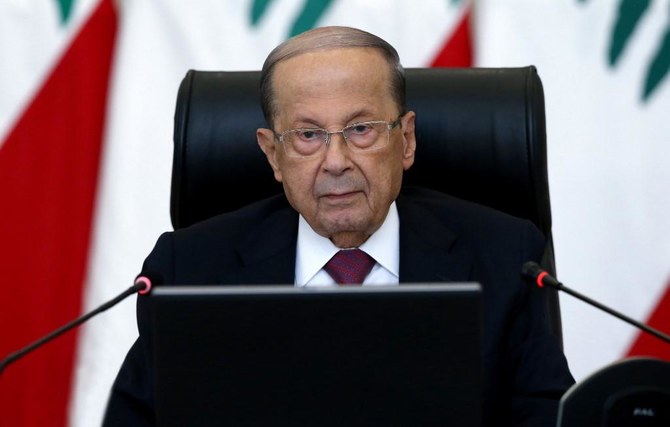
Aoun’s Christian Free Patriotic Movement has for years been politically allied with Hezbollah, enabling them to dominate parliament and the government. (File/AFP)
Short Url
Updated 17 August 2020
Follow

Lebanon president hedges over eventual peace with Israel in interview

  • Lebanon has technically been at war with neighboring Israel for decades
  • Aoun’s Christian Free Patriotic Movement has for years been politically allied with Hezbollah

PARIS: Lebanese President Michel Aoun, ally of Israel’s arch-foe Hezbollah, seemed to leave the door open to eventual peace with the Jewish state, in an interview with French news channel BFMTV.
Lebanon has technically been at war with neighboring Israel for decades, with tensions sporadically flaring in the border area in Lebanon’s south, stronghold of the Shiite Muslim Hezbollah movement.
Asked in an interview on BFMTV on Saturday whether Lebanon would be prepared to make peace with Israel, Aoun responded: “That depends. We have problems with Israel, we have to resolve them first.”
His statement came in the wake of an announcement Thursday that Israel would normalize relations with the United Arab Emirates, only the third Arab state to establish full diplomatic ties with Israel since its creation in 1948.
“It’s an independent country,” Aoun said of the UAE.
Aoun’s Christian Free Patriotic Movement has for years been politically allied with Hezbollah, enabling them to dominate parliament and the government, which resigned on Monday amid outrage over negligence that led to the deadly explosion at Beirut’s port that devastated the capital.
Hezbollah chief Hassan Nasrallah said on Friday of the Israel-UAE agreement that “it’s a betrayal of Jerusalem and the Palestinian people. It’s a knife in the back.”
A key point of contention between Lebanon and Israel concerns oil and gas resources in the eastern Mediterranean, where both countries have sought bids for exploration in their exclusive economic zones.
The maritime border between the countries is disputed.
Aoun’s interview was aired in the aftermath of the Beirut blast on August 4 that killed 177 people and wounded at least 6,500 more, with many blaming systemic corruption and negligence of the entrenched political class for the disaster.
Many Lebanese have demanded the ouster of the entire ruling class, dominated by ex-warlords from the country’s 1975-1990 civil war, including of Aoun.
Asked by the BFMTV journalist if he had thought of stepping down, Aoun said, “it’s impossible, there would be a vacuum.”


Fledgling radio station aims to be ‘voice of the people’ in Gaza

Updated 15 February 2026
Follow

Fledgling radio station aims to be ‘voice of the people’ in Gaza

  • The electricity crisis is one of the most serious and difficult problems in the Gaza Strip, says Shereen Khalifa Broadcaster

DEIR EL-BALAH: From a small studio in the central city of Deir El-Balah, Sylvia Hassan’s voice echoes across the Gaza Strip, broadcast on one of the Palestinian territory’s first radio stations to hit the airwaves after two years of war.

Hassan, a radio host on fledgling station “Here Gaza,” delivers her broadcast from a well-lit room, as members of the technical team check levels and mix backing tracks on a sound deck. “This radio station was a dream we worked to achieve for many long months and sometimes without sleep,” Hassan said.

“It was a challenge for us, and a story of resilience.”

Hassan said the station would focus on social issues and the humanitarian situation in Gaza, which remains grave in the territory despite a US-brokered ceasefire between Israel and Hamas since October.

“The radio station’s goal is to be the voice of the people in the Gaza Strip and to express their problems and suffering, especially after the war,” said Shereen Khalifa, part of the broadcasting team.

“There are many issues that people need to voice.” Most of Gaza’s population of more than 2 million people were displaced at least once during the gruelling war.

Many still live in tents with little or no sanitation.

The war also decimated Gaza’s telecommunications and electricity infrastructure, compounding the challenges in reviving the territory’s local media landscape. “The electricity problem is one of the most serious and difficult problems in the Gaza Strip,” said Khalifa.

“We have solar power, but sometimes it doesn’t work well, so we have to rely on an external generator,” she added.

The station’s launch is funded by the EU and overseen by Filastiniyat, an organization that supports Palestinian women journalists, and the media center at the An-Najah National University in Nablus, in the occupied West Bank.

The station plans to broadcast for two hours per day from Gaza and for longer from Nablus. It is available on FM and online.

Khalifa said that stable internet access had been one of the biggest obstacles in setting up the station, but that it was now broadcasting uninterrupted audio.

The Gaza Strip, a tiny territory surrounded by Israel, Egypt, and the Mediterranean Sea, has been under Israeli blockade even before the attack on Oct. 7, 2023, which sparked the war. Despite the ceasefire, Israel continues to strictly control the entry of all goods and people to the territory.

“Under the siege, it is natural that modern equipment necessary for radio broadcasting cannot enter, so we have made the most of what is available,” she said.