Lebanon president hedges over eventual peace with Israel in interview

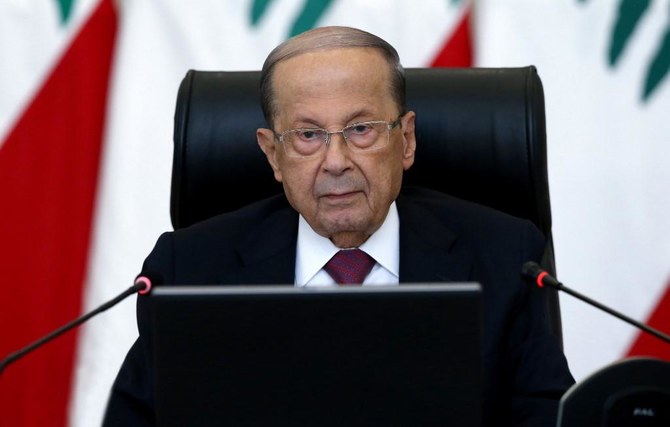
Aoun’s Christian Free Patriotic Movement has for years been politically allied with Hezbollah, enabling them to dominate parliament and the government. (File/AFP)
Short Url
Updated 17 August 2020
Follow

Lebanon president hedges over eventual peace with Israel in interview

  • Lebanon has technically been at war with neighboring Israel for decades
  • Aoun’s Christian Free Patriotic Movement has for years been politically allied with Hezbollah

PARIS: Lebanese President Michel Aoun, ally of Israel’s arch-foe Hezbollah, seemed to leave the door open to eventual peace with the Jewish state, in an interview with French news channel BFMTV.
Lebanon has technically been at war with neighboring Israel for decades, with tensions sporadically flaring in the border area in Lebanon’s south, stronghold of the Shiite Muslim Hezbollah movement.
Asked in an interview on BFMTV on Saturday whether Lebanon would be prepared to make peace with Israel, Aoun responded: “That depends. We have problems with Israel, we have to resolve them first.”
His statement came in the wake of an announcement Thursday that Israel would normalize relations with the United Arab Emirates, only the third Arab state to establish full diplomatic ties with Israel since its creation in 1948.
“It’s an independent country,” Aoun said of the UAE.
Aoun’s Christian Free Patriotic Movement has for years been politically allied with Hezbollah, enabling them to dominate parliament and the government, which resigned on Monday amid outrage over negligence that led to the deadly explosion at Beirut’s port that devastated the capital.
Hezbollah chief Hassan Nasrallah said on Friday of the Israel-UAE agreement that “it’s a betrayal of Jerusalem and the Palestinian people. It’s a knife in the back.”
A key point of contention between Lebanon and Israel concerns oil and gas resources in the eastern Mediterranean, where both countries have sought bids for exploration in their exclusive economic zones.
The maritime border between the countries is disputed.
Aoun’s interview was aired in the aftermath of the Beirut blast on August 4 that killed 177 people and wounded at least 6,500 more, with many blaming systemic corruption and negligence of the entrenched political class for the disaster.
Many Lebanese have demanded the ouster of the entire ruling class, dominated by ex-warlords from the country’s 1975-1990 civil war, including of Aoun.
Asked by the BFMTV journalist if he had thought of stepping down, Aoun said, “it’s impossible, there would be a vacuum.”


Sudan drone attack on Darfur market kills 10: rescuers

Updated 11 sec ago
Follow

Sudan drone attack on Darfur market kills 10: rescuers

  • According to the UN’s International Organization for Migration, more than 50,000 civilians have fled the region since the end of October

PORT SUDAN, Sudan: A drone attack on a busy market in Sudan’s North Darfur state killed 10 people over the weekend, first responders said on Sunday, without saying who was responsible.
The attack comes as fighting intensified elsewhere in the country, leading aid workers to be evacuated on Sunday from Kadugli, a besieged, famine-hit city in the south.
Since April 2023, Sudan’s army and the paramilitary Rapid Support Forces have been locked in a conflict which has killed tens of thousands of people, displaced nearly 12 million and created the world’s largest displacement and hunger crisis.
The North Darfur Emergency Rooms Council, one of hundreds of volunteer groups coordinating aid across Sudan, said a drone strike hit Al-Harra market in the RSF-controlled town of Malha on Saturday.
The attack killed 10 people, it said.
The council did not identify who carried out the attack, which it said had also sparked “fire in shops and caused extensive material damage.”
There was no immediate comment from either the Sudanese army or the RSF.
The war’s current focal point is now South Kordofan and clashes have escalated in Kadugli, the state capital, where a drone attack last week killed eight people as they attempted to flee the army-controlled city.
A source from a humanitarian organization operating in Kadugli told AFP on Sunday that humanitarian groups had “evacuated all their workers” from the city because of the security conditions.
The evacuation followed the United Nations’ decision to relocate its logistics hub from Kadugli, the source said on condition of anonymity, without specifying where the staff had gone.

- Measles outbreak -

Kadugli and nearby Dilling have been besieged by paramilitary forces since the war erupted.
Last week, the RSF claimed control of the Brno area, a key defensive line on the road between Kadugli and Dilling.
After dislodging the army in October from the western city of El-Fasher — its last stronghold in the Darfur region — the RSF has shifted its focus to resource-rich Kordofan, a strategic crossroads linking army-held northern and eastern territories with RSF-held Darfur in the west.
Like Darfur, Kordofan is home to numerous non-Sudanese Arab ethnic groups. Much of the violence that followed the fall of El-Fasher was reportedly ethnically targeted.
Communications in Kordofan have been cut, and the United Nations declared a famine in Kadugli last month.
According to the UN’s International Organization for Migration, more than 50,000 civilians have fled the region since the end of October.
Residents have been forced to forage for food in nearby forests, according to accounts gathered by AFP.
The conflict has effectively split Sudan in two, with the army controlling the north, east and center while the RSF dominates all five state capitals in Darfur and, with its allies, parts of the south.
Doctors without Borders (MSF) said on Sunday that measles was spreading in three of the four states in Darfur, a vast region covering much of western Sudan.
“A preventable measles outbreak is spreading across Central, South and West Darfur,” the organization said in a statement.
“Since September 2025, MSF teams have treated more than 1,300 cases. Delays in vaccine transport, approvals and coordination, by authorities and key partners are leaving children unprotected.”