

Focus: Stock splits, drilling down on the S&P 500, and the MSCI Emerging Markets Index

Short Url
Updated 14 August 2020
Follow

Focus: Stock splits, drilling down on the S&P 500, and the MSCI Emerging Markets Index

The week that was:

On Thursday the S&P 500 came into 13 points range of its February all-time high.

US first-time jobless numbers came in at 963,000 for the week of August 7 - below one million for the first time since mid-March. According to the US Department of Labor, more than 28 million (slightly below 20 percent of the US workforce) were collecting unemployment insurance during the week ending July 25.

Democrats and Republicans could not reach an agreement on a follow-up stimulus package before the Senate went into recess. On Aug. 8, US President Donald Trump stepped into the breach by signing executive orders on $400 unemployment benefit, a payroll tax holiday, student loan relief and an eviction moratorium.

Q2 Japanese gross domestic product (GDP) came in at an annualised minus 27 percent, the worst since records began. It was the third consecutive quarterly decline because, even before the pandemic, Japan had been hit by an increase in sales tax as well as the US-China trade war.  

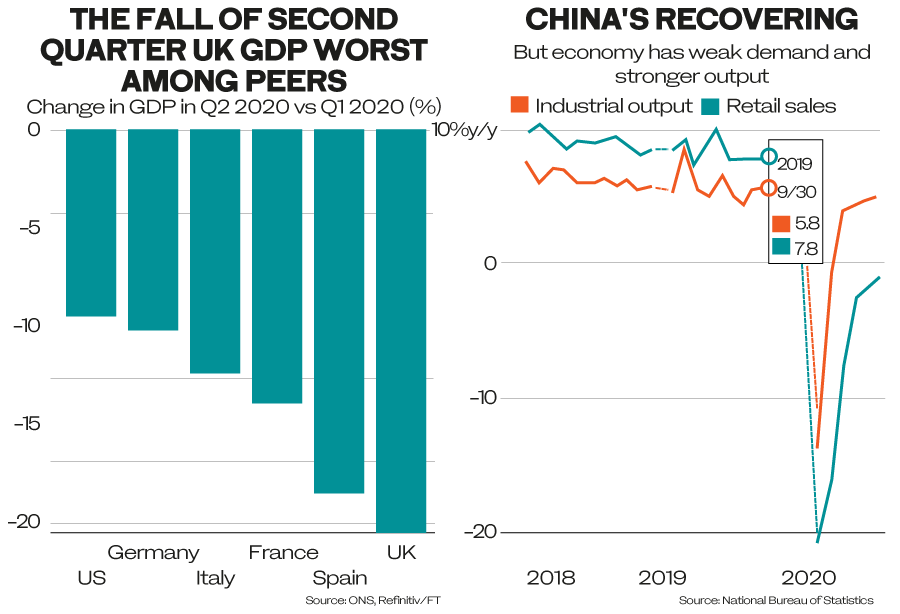
The UK’s Q2 GDP came in at the bottom compared to its European peers with a decline of 20.4 percent - the worst performance since 1955. The economy grew 8.7 percent in June but is still 17.3 percent lower than February.

China’s recovery was led by industrial output outperforming retail sales. July industrial output was up 4.8 percent on an annualised basis and retail sales fell - 1.1 percent during the same period with fixed asset investment down – 1.6 percent.
The UK added France, the Netherlands and Malta to its quarantine list, which affected the share price of airlines (particularly low-cost carriers) and leisure stocks.

Highlights from the earnings season:

On Sunday, Saudi Aramco reported a Q2 net income of $6.6 billion. While this represented a 73 percent annualised quarterly decline and 50 percent for the first half, the company compares well to its peer group with positive net income and free cash flow during the worst quarter in the history of oil. Aramco will maintain its $75 billion dividend ($18.75 billion for Q2), which it had pledged during the IPO. Gearing was up at 20.1 percent reflecting the acquisition of a 70 percent share of SABIC. Capital expenditure will come in at the lower end of its $25-20 billion range, if not slightly below. All major oil companies slashed capital expenditure considerably due to the grim oil price and demand environment. Aramco’s considerable debt capacity, combined with lower expenditure, means it can afford its dividend. Aramco results, combined with the company’s positive demand outlook, lifted both oil company stocks and the oil price. The latter made gains for two consecutive weeks, despite marginal demand downgrades by the International Energy Agency.

Maersk Drilling reported H1 earnings before interest, taxes, depreciation, and amortization (EBITDA) of $168 million before special items and a non-cash impairment charge of $1.5 billion, reflecting the difficult environment in the sector. The company has an optimistic outlook for 2021 and leaves its full-year guidance as revised in May unchanged. This compares well to Schlumberger and Haliburton, which operate in a bigger segment but both reported losses for Q2.

German power company RWE generated a H1 EBITDA of $2.1 billion, representing an increase of 10 percent over the same period last year. The company expects to benefit from energy transition-related funding. The company intends to “vigorously” expand RWE’s core business and increase the dividend.

Focus:

This week saw stock splits of Tesla 5:1 and Apple 4:1. Tesla’s stock price has quadrupled since March and Apple’s has doubled meaning that the companies, valued at $1,441 and $452 respectively, became too expensive for many retail investors. The split opens a new segment of investors. CNBC’s Jim Kramer called on 10 more companies to split their stock. All of them benefitted from the pandemic and most of them are in the technology sector. They include Alphabet, Microsoft, Netflix, Facebook and Home Depot.

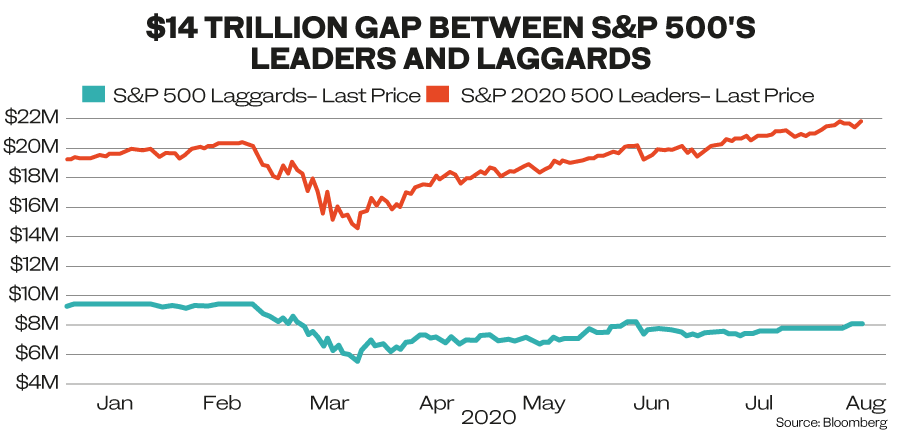
In the same vein the S&P 500 was driven by a few stocks since its March low. The differential between leaders and laggards amounts to $14 trillion. Earlier in the week, value stocks caught up with their growth counterpart of the technology space. The trend was reversed toward the end of the week. However, the question remains how long the spread between growth and value stocks can be maintained and when we will see a more permanent adjustment.
When investing in index-related instruments like exchange-traded funds it makes sense to drill down into the underlying components of the index. The S&P 500 is just one example, the MSCI Emerging Markets Index is another. While Brazil made up more than 16 percent of the latter in 2010 and Mexico 13.2 percent in 1997, they now stand at 5.1 and 1.9 percent respectively. South Africa has also lost much ground, with a current 3.8 percent in the index. This stands in stark contrast to Asian stocks, which account for 78.3 percent of the index – China, Taiwan and Korea coming in at 63.5 percent. China gained 29.1 percentage points between 2006 and 2020.
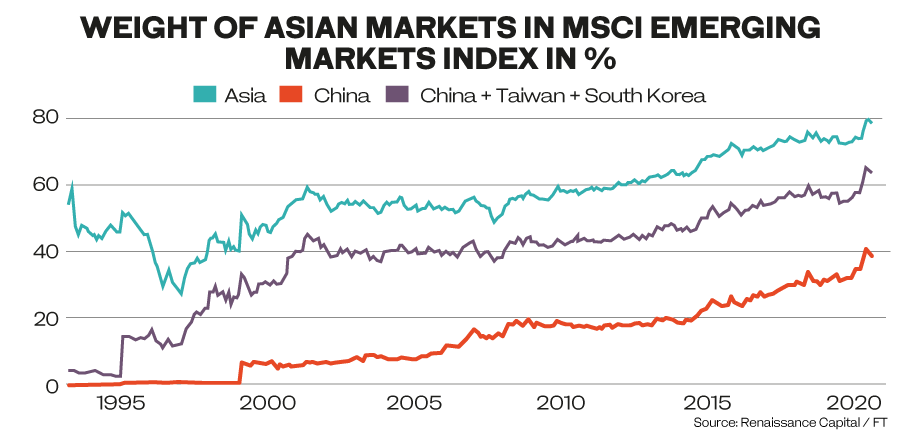
If diversification is the aim, it is worthwhile to understand the composition of the underlying index or asset classes.

Where we go from here:

US and Chinese officials will meet on Aug. 15 to review the US-China trade deal.

Implications for investors of the new UAE-Is.


— Cornelia Meyer is a Ph.D.-level economist with 30 years of experience in investment banking and industry. She is chairperson and CEO of business consultancy Meyer Resources.
Twitter: @MeyerResources


What Prince William’s first solo visit to Riyadh signals for UK-Saudi ties

Updated 7 sec ago
Follow

What Prince William’s first solo visit to Riyadh signals for UK-Saudi ties

  • Heir to the British throne arrives in Riyadh as historic royal links underpin deepening trade and defense cooperation
  • The Prince of Wales’ official visit follows decades of close ties between the House of Saud and Britain’s royal family

LONDON: Prince William’s arrival in Riyadh on Monday will be a reaffirmation of the special bond between the monarchies of Britain and Saudi Arabia that was forged in the early days of the reign of his grandmother, Queen Elizabeth II, and which has flourished ever since.

But for the 43-year-old prince, heir apparent to the British throne, his first official visit to the Kingdom will also be imbued with an element of personal poignancy.

William will be following in the footsteps of his mother, the late Diana, Princess of Wales, who visited Saudi Arabia 40 years ago during a nine-day tour of the Middle East in 1986 with her then husband, Prince Charles.

The couple had married in 1981, and Diana was just 25 years old during their first tour of the Middle East. Prince William, their first child, was three years old at the time and did not accompany his mother on the visit, although as a nine-month-old baby he had travelled with his parents to Australia and New Zealand in 1983.

Prince William (left) was present when King Charles III (right) met with Crown Prince Mohammed bin Salman at Clarence House in London in March 2018. (AFP file)

William was 15 when his mother died in a car crash in Paris in August 1997.

The prince has visited the region before. His first trip was freighted with personal meaning. In June 2018 he paid a three-day visit to Israel and Palestine, meeting both Israeli Prime Minister Benjamin Netanyahu and Mahmoud Abbas, president of the Palestinian Authority.

It was the first official visit by a senior member of Britain’s royal family to Israel and the Palestinian Territories.

Although the visit was described by Britain as strictly non-political, and William visited holy places important to all three Abrahamic faiths, to the annoyance of some Israeli politicians he made a point of publicly assuring Palestinians that they had not been forgotten by Britain, which had ruled the area from 1917 until the creation of Israel in 1948.

But there was also an element of personal pilgrimage to the trip for William. While in Jerusalem he visited the tomb of Princess Alice of Battenberg and Greece, his great-grandmother, a devout Christian who had helped Jews to evade Nazi capture during the Second World War.

After her death in 1969, Israel honored her request to be buried in Jerusalem, and William visited her burial place in a crypt in the Russian Orthodox Church of Mary Magdalene on the Mount of Olives outside Jerusalem’s Old City.

Kensington Palace describes the purpose of Prince William’s first solo visit to Saudi Arabia as “a celebration of trade, energy and investment ties.”

It is no coincidence that the visit of the prince, who served for several years as a pilot in the British Royal Air Force, coincides with the World Defense Show in Riyadh, and amid British hopes of Saudi Arabia becoming the fourth national partner in the next-generation Tempest fighter aircraft program.

Queen Elizabeth meeting with King Salman and Crown Prince Mohammed bin Salman. (AFP/File Photos)

In May 2025, Saudi Defense Minister Prince Khalid bin Salman travelled to London to discuss closer cooperation with UK Defense Secretary John Healey, who described the Kingdom as “a vital partner for the UK in ensuring security and stability in the Gulf.”

However, royal watchers in the UK have attached another significance to Prince William’s visit. For Tatler, the house journal of Britain’s upper classes, for the man it describes as “one of Britain’s greatest diplomats” the visit is being seen as “another step in his preparation for the throne.”

The visit comes at a pivotal moment for the British royal family.

Queen Elizabeth II, who became queen at the age of 25 upon the death of her father, King George VI, on Feb. 6, 1952, reigned for 70 years. When she passed on Sept. 8, 2022, at the age of 96, she was succeeded by her eldest son, Prince Charles.

Upon the accession of King Charles III, Prince William, known formerly as the Duke of Cambridge, inherited his father’s previous titles as Prince of Wales and Duke of Cornwall.

But in February 2024, barely nine months after the coronation of the king, Buckingham Palace announced that Charles III had been diagnosed with an undisclosed form of cancer.

Fears about his health have persisted ever since, although in December 2025, the 77-year-old monarch revealed that “thanks to early diagnosis, effective intervention and adherence to doctors’ orders, my own schedule of cancer treatment can be reduced in the new year.”

Nevertheless, as heir apparent, all of Prince William’s duties are now designed with his future responsibilities very much in mind.

His visit this week reflects the importance placed by Britain not only on its relationship with Saudi Arabia as an important trading partner, but also on a personal connection between the two royal families that stretches back for more than a century.

Opinion

This section contains relevant reference points, placed in (Opinion field)

The friendship between the British and Saudi royal families dates back to 1919, when Prince Faisal, the 13-year-old third son of Abdulaziz bin Abdulrahman, the future founder and king of Saudi Arabia, became the first member of the Saudi royal family to visit Britain.

The invitation had been sent to his father, the king of Najd, who was known in the West as Ibn Saud and was recognized by the British government following the defeat of the Ottoman Empire in the First World War as the rising political force in the Arabian Peninsula.

Still grappling with the impact on his territories of the influenza epidemic of 1919, which would claim more lives globally than the First World War that had preceded it, the king chose his eldest son, Prince Turki, to represent him in England.

Tragedy, however, intervened. Turki fell victim to the epidemic and, at the last minute, Prince Faisal was appointed in his place as the symbolic head of the Saudi delegation to London.

It proved a wise choice. Although young, the Prince won over his hosts during a cordial visit that set the tone for a relationship between the two royal families that has endured ever since.

While in London, Prince Faisal visited Buckingham Palace, where he met King George V, toured the House of Commons and the House of Lords, and was taken on what must have been a somber tour of the battlefields of northern France, where more than 3.5 million Allied and German soldiers had been killed in the war that had ended only one year previously.

In June 1953, Prince Fahd, another of King Abdulaziz’s sons, represented his 78-year-old father at the coronation of Queen Elizabeth II. King Abdulaziz had only five months left to live, and on Nov. 9, 1953, would be succeeded by Crown Prince Saud, his second son.

During the reign of Queen Elizabeth II, there were no fewer than four state visits to Britain by kings of Saudi Arabia, a number matched by the heads of state of only four other countries, including the UK’s near-neighbors, France and Germany.

The first to visit was King Faisal, who as a young prince had visited England in 1919 and had succeeded King Saud in 1964. In May 1967 he arrived in London for a momentous eight-day visit, at the start of which he was honored with a full state welcome, riding through the streets of London in a horse-drawn carriage alongside Queen Elizabeth II.

King Faisal would be followed on state visits to Britain by King Khaled in 1981, King Fahd in 1987 and King Abdullah in 2007.

The royal traffic between the two kingdoms has always been two-way.

In February 1979, arriving on board the supersonic jet Concorde, Queen Elizabeth II visited Riyadh and Dhahran during a Gulf tour that also took her to Kuwait, Bahrain, Qatar, the UAE and Oman.

In Saudi Arabia, she was hosted by King Khaled and enjoyed a series of events, including a desert picnic and a state dinner at Maathar Palace in Riyadh. In return, she and her husband hosted a dinner for the Saudi royal family on board Her Majesty’s Yacht Britannia.

The relationship between the two royal families has not been limited to the great occasions of state.

The Court Circular published by Buckingham Palace reveals that between 2011 and 2021 alone various members of Britain’s royal family met with Gulf monarchs more than 200 times — equivalent to once a fortnight — and that 40 of these informal meetings were with members of the House of Saud.

In January 2015, Prince William’s father, the then Prince Charles, flew to Riyadh to pay his respects following the death of King Abdullah, while flags over royal and government buildings in London were lowered to half-mast.

In March 2018, Crown Prince Mohammed bin Salman had a private audience and lunch with Queen Elizabeth II at Buckingham Palace during an official visit to the UK. During that visit he also dined with the Prince of Wales — now King Charles III — and his son, Prince William.

This week, with William’s arrival in Saudi Arabia as the Prince of Wales, the two men will resume their acquaintance, this time both as heirs apparent.

Prince William is famously unstuffy and down to earth, and very much at ease meeting members of the public, both at home and when he travels overseas.

His precise itinerary while in Saudi Arabia is unclear. For anyone who might encounter him during his visit, Buckingham Palace insists “there are no obligatory codes of behavior” when meeting a member of the royal family.

However, its advice for those who “wish to observe the traditional forms” is to address Prince William first as “Your Royal Highness” and thereafter as “Sir.”