

Kashmiris reject India’s militant rehab plan

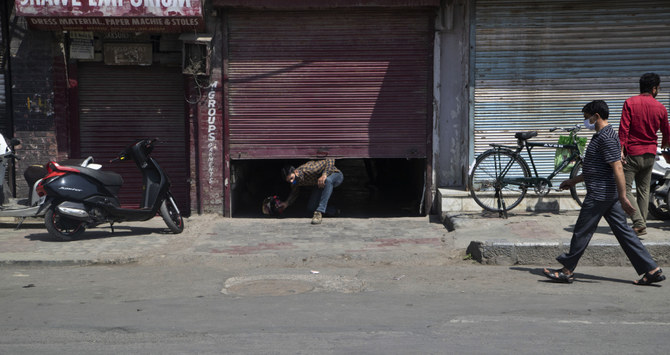
India has tried similar rehabilitation programs in the past. (AP)
Short Url
Updated 14 August 2020
Follow

Kashmiris reject India’s militant rehab plan

  • India’s rehabilitation policy will be “futile” unless it addresses the source of the problem: expert

NEW DELHI: An Indian military plan to end militancy in the region by resettling young Kashmiri fighters has been described as “meaningless” by both analysts and former fighters.
The rehabiliation program will fail unless the roots of unrest in the region — violence, alienation and betrayal — are addressed by New Delhi, they say.
India’s military commander in the Kashmir Valley, Lt. Gen. B.S. Raju, announced the rehabilitation program on Wednesday, saying advanced plans had been submitted to Indian Prime Minister Narendra Modi.
Referring to the Kashmiri fighters as “young boys who need to be taken care of,” Raju said the policy “will help and give confidence to those who are opting to surrender.”
India has tried similar rehabilitation programs in the past, but some who took part have told Arab News they now regret their experience.
“They offered us jobs, some money, rehabilitation and training, but in the last 6 years I have received nothing,” former fighter Sanullah Dar, 44, said.
Dar  returned to Indian-administered Kashmir from Pakistan in 2014 when he was offered a place in rehabilitation scheme by the-then Kashmiri government. His Pakistani wife accompanied him.
“Even after 6 years my wife doesn’t have an Indian passport. My children are also denied passports. I was leading a peaceful life in Lahore, earning a living, doing some work. But here we are without hope.”
Dar left Kashmir in 1990 at the height of militant uprising in the valley, settled down in Lahore and married a Pakistani woman. After 24 years he decided to return to his homeland after the rehabilitation policy was announced.
Javed Ahmed, who returned from Karachi in 2007, also regrets his decision to respond to the Kashmir government’s call.
“There is no empathy or sympathy for us. No promise has been honored. My wife and I somehow survive eking out a living, but there are more that 400 families who are struggling to feed themselves,” Ahmed, who now works as bus driver, told Arab News.

FASTFACT

Former fighters say previous amnesty ‘left us with nothing.’

“My wife is still treated as a foreigner, she cannot have an Indian passport. Legally, a foreign wife should become a legal citizen of the husband’s country within four or five years, but my wife and several women are living like stateless persons.”
Ahmed’s wife, Saira, said she is unable to return to Pakistan because she has no documents.
“My father is sick, but I cannot visit him because I don’t have a passport.”
Ahmed is worried about the future of his four children.
“My younger children get angry when they see our humiliation, and it is because of this humiliation that many in Kashmir pick up guns,”
he said.
“I am worried that they might become rebels when they grow up. Can you stop them?“
A Kashmir expert, retired Air Vice Marshal Kapil Kak, told Arab News that India’s rehabilitation policy will be “futile” unless it addresses the source of the problem, which is “alienation, anger, hatred and a sense of betrayal.”
The issue was exacerbated by the decision to revoke Kashmir’s autonomy, he said.
On Aug. 5 last year, New Delhi annulled Article 370 of India’s constitution, which had guaranteed Kashmir’s autonomy. Amid a military lockdown thousands of local political leaders and activists were detained, some of whom remain under arrest.
“These militants are not criminals. They are coming out to express dissent and protest at the way they have been treated by India for the past 30 years,” Kak said.
In the past seven months at least 135 fighters have been killed in the region. The Indian military says that about 200 militants are still active in the Kashmir Valley.
“There is a monetary reward for killing militants, which is an incentive for extrajudicial killings, and also leads to fake encounters in which civilians are killed and branded as militants,” said Khurram Parvez, a Kashmiri human
rights activist.
“If the government really wants to show change of approach, it must stop financial rewards for killing militants. The rehabilitation policies have been a disaster.” 
Zaffar Choudhary, a Srinagar-based political analyst and editor of online news magazine The Dispatch, told Arab News: “Militancy is never a mechanical process where the isolation of a few elements can change the course of a project.
“Militancy is in the mind,” he said. “A few become more visible as militants when they pick guns. So you have to deal not just with the militants but also wider society. It is the society that needs rehabilitation through political outreach.”
Despite repeated attempts by Arab News, Lt. Gen. B.S. Raju, who announced the rehabilitation policy, was unavailable for comment.


Trump downplays importance of Russia reportedly sharing intel with Iran to help it hit US targets

Updated 52 min 5 sec ago
Follow

Trump downplays importance of Russia reportedly sharing intel with Iran to help it hit US targets

  • Critics charge that Trump was giving Russia a break that will provide Moscow with badly needed revenue as it looks to keep funding its war machine
  • Ukraine, in the four years since it was invaded by Russia, has received US intelligence to help defend against incoming missiles from Russia as well as to help Kyiv hit certain Russian targets

DORAL, Florida: President Donald Trump said Saturday that it was inconsequential if Russia has provided Iran with information to help Tehran target US military personnel and assets in the Middle East as the week-old war rages.
The president dismissed the import of such information-sharing after he attended the dignified transfer for six Army reservists who were killed in a drone strike in Kuwait the day after the US and Israel launched a war on Iran that has unsettled the global economy.
Trump stopped short of confirming reports by The Associated Press and other news outlets that US intelligence officials believe Russia has provided Iran with such targeting information. But if Moscow is passing on such details, he said Iran was getting little out of it.
“If you take a look at what’s happened to Iran in the last week, if they’re getting information, it’s not helping them much,” Trump told reporters on Air Force One as he flew to Miami, where he’s spending the rest of the weekend.
The president also waved off a question about how Russia assisting Iran in such a way might affect his view of the US-Russia relationship.
“They’d say we do it against them,” Trump responded. “Wouldn’t they say that we do it against them?”
Ukraine, in the four years since it was invaded by Russia, has received US intelligence to help defend against incoming missiles from Russia as well as to help Kyiv hit certain Russian targets.
Downplaying the significance of Russia handing off battlespace intelligence to Iran came after the US Treasury Department announced earlier this week that it was temporarily allowing India to keep buying crude oil and petroleum products from Russia for a month, until April 4.
The administration decision to grant the world’s most populous country a temporary exemption faced bipartisan blowback. Critics charge that Trump was giving Russia a break that will provide Moscow with badly needed revenue as it looks to keep funding its war machine.
Rep. Don Bacon, R-Nebraska, condemned the move, saying in a post on X that “weakness toward Russia is appalling.”
Rep. Ted Lieu, D-Calif., in his own X post directed at Treasury Secretary Scott Bessent, also decried the administration’s decision.
“Reverse your decision to lift oil sanctions on Russia. It is traitorous conduct for you to help Russia,” Lieu said. “Meanwhile, Russia is assisting Iran in targeting American troops.”
Trump has decided to give India leeway on oil purchases from Russia as global oil prices surge and investors across sectors worry about how long the Iran war will last.
The waiver for Prime Minister Narendra Modi’s government followed Trump announcing weeks ago that he was cutting tariffs on India after their officials agreed to reduce its reliance on cheap Russian crude.
India has taken advantage of reduced Russian oil prices as much of the world has sought to isolate Moscow for its February 2022 invasion of Ukraine.
The price of oil has surged higher and shows no signs of halting a week into a war that the US and Israel launched and has widened through the Middle East as Tehran strikes back. Ships that carry roughly 20 million barrels of oil a day are unable to safely pass through the Strait of Hormuz, the narrow mouth of the Arabian Gulf that is bordered on its north side by Iran.
The shipping disruption and damage to key Middle East oil and gas facilities has interrupted supplies from some of the world’s largest oil producers.
Asked whether he was willing to take other steps to ease oil prices, Trump said that “if there were some, I would do it, just to take a little of the pressure off.”
He appeared Saturday to wave off, at least for now, the possibility of tapping the nation’s Strategic Petroleum Reserve, saying the US has a “lot of oil.”
The reserve — a supply of oil that the US government can tap in case of emergencies — held more than 415 million barrels as of the end of last month, up from about 395 million barrels at this time in 2025. In total, when full, the SPR can hold more than 700 million barrels.
“We’ve got a lot of oil. Our country has a tremendous amount,” Trump said. “There’s a lot of oil out there. That’ll get healed very quickly.”