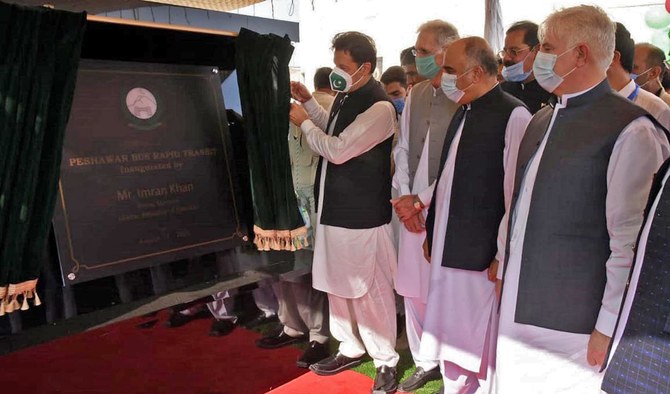
PESHAWAR: Prime Minister Imran Khan on Thursday inaugurated Peshawar’s long-awaited Bus Rapid Transit (BRT) project, calling it the best metro bus service available in Pakistan.
“I had serious reservations about the project initially,” he said, “but it is one of the best models of transportation system in the country. I congratulate you all and [former chief minister of Khyber Pakhtunkhwa province] Pervez Khattak who used to say we would realize the significance of the project after its completion.”
Launched in October 2017 at an estimated cost of Rs. 49 billion, the 27-kilometer-long BRT corridor had to be completed within a span of six months. However, the project got delayed and missed at least four deadlines in 2018 and 2019.
Addressing the media in Peshawar on Wednesday, Chief Minister Mahmood Khan acknowledged that the earlier inauguration dates announced by his predecessor were mistakes.
However, Alamgir Bangash, who works with the government-owned TransPeshawar Company, told Arab News that the project got delayed since its design had to undergo some changes which also increased its cost to a staggering Rs. 66 billion.
Praising the project, the prime minister said that it connected the city’s main arteries and went as far away as the Torkham border that separates the Afghan and Pakistani territories.
The introduction of hybrid diesel buses, he continued, would effectively tackle the traffic congestion and reduce air pollution in Peshawar.
The TransPeshawar Company has already acquired a fleet of 200 hybrid air-conditioned buses to cover the BRT corridor, Bangash informed.
“We are still doing some infrastructure and beautification work on three stations,” he said. “But this will not hamper the service that has started today.”
The political rivals of the ruling party criticized the BRT, however, and claimed that it was not a viable project for Peshawar.
“The BRT project was flawed from the outset and it was also surrounded by corruption allegations,” said Sardar Hussain Babak, a senior leader of the Awami National Party, while talking to Arab News. “Even now we don’t know if the project has been completed or it is a premature inauguration.”
“I suggest the PTI must probe the corruption allegations related to this if it is truly striving to uproot financial irregularities from the country,” he added.


Pakistani PM inaugurates BRT rapid bus service in Peshawar
https://arab.news/46wa2
Pakistani PM inaugurates BRT rapid bus service in Peshawar

- Launched in 2017, the project had to be completed in six months but missed several deadlines
- Opposition figures say all corruption allegations surrounding the project must be probed

Pakistan Air Force conducts ‘Exercise Golden Eagle’ to test combat readiness, agility
- The exercise follows an intense, four-day Pakistan-India military conflict in May 2025
- It focused on AI-enabled operations integrating disruptive technologies, military says
ISLAMABAD: The Pakistan Air Force (PAF) has conducted “Exercise Golden Eagle” that successfully validated its combat readiness and operational agility through synchronized employment of the PAF’s complete combat potential, the Pakistani military said on Tuesday.
It comes months after Pakistan’s four-day military conflict with India in May, with Islamabad claiming victory in the standoff after the PAF claimed to have shot down at least six Indian fighter aircraft, including the French-made Rafale. New Delhi acknowledged some losses but did not specify a number.
The exercise was conducted on a Two-Force construct, focusing on AI-enabled, net-centric operations while integrating indigenous niche, disruptive and smart technologies in line with evolving regional security dynamics, according to the Inter-Services Public Relations (ISPR), the Pakistani military’s media wing.
Operating within a robust Integrated Air Defense System, friendly forces shaped the battlespace through seamless fusion of kinetic operations with cyber, space and electro-magnetic spectrum operations.
“The kinetic phase featured First-Shoot, First-Kill swing-role combat aircraft equipped with long-range BVR air-to-air missiles, extended-range stand-off weapons and precision strike capabilities, supported by Airborne Early Warning & Control platforms and Air-to-Air Refuelers,” the ISPR said in a statement.
“A key highlight of the exercise was Manned–Unmanned Teaming, with deep-reach killer drones and loitering munitions operating in a highly contested, congested and degraded environment, validating PAF’s capability to conduct high-tempo operations in modern warfare.”
In recent months, many countries have stepped up defense engagement with Pakistan, while delegations from multiple nations have proposed learning from the PAF’s multi-domain air warfare capabilities that officials say were successfully employed during the May conflict.
“The successful conduct of Exercise Golden Eagle reaffirms Pakistan Air Force’s unwavering commitment to maintaining a high state of operational preparedness, leveraging indigenous innovation and effectively countering emerging and future security challenges,” the ISPR added.


