Pakistan denies 'illegal' fencing on Durand Line as Kabul protests

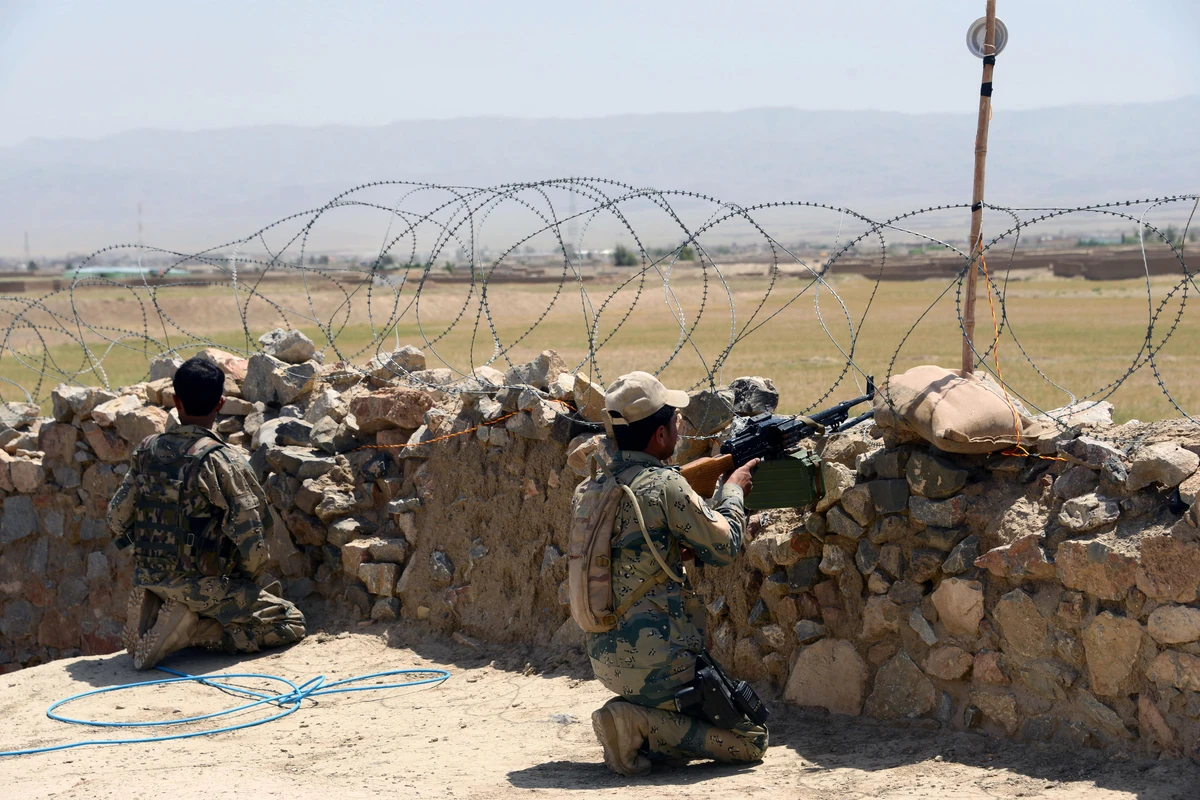
Afghan Border Police personnel keep watch during an ongoing battle between Pakistani and Afghan Border forces near the Durand line at Spin Boldak, in southern Kandahar province on May 5, 2017. (AFP)
Short Url
Updated 13 August 2020
Follow

Pakistan denies 'illegal' fencing on Durand Line as Kabul protests

  • Pakistan considers the Durand Line its border, which neigboring Afghanistan does not recognise
  • Pakistan plans to fence up most of the 2,500 km disputed frontier this year

ISLAMABAD: Pakistan on Thursday rejected reports in Afghan media and a statement by the Afghan Ministry of Foreign Affairs that Islamabad was conducting “illegal” border fencing on the Durand Line, which Pakistan considers today as its border and which neighboring Afghanistan refuses to recognise.

Pakistan is betting that a pair of nine-foot chain-link fences topped with barbed wire will stop incursions by militants from neighbouring Afghanistan, which opposes Islamabad’s plans for a barrier along the disputed frontier.

Pakistan plans to fence up most of the 2,500 km (1,500 mile) frontier despite Kabul’s protests that the barrier would divide families and friends along the Pashtun tribal belt straddling the colonial-era Durand Line drawn up by the British in 1893.

Pakistan expects to finish building the fence this year.

“The [foreign office] Spokesperson rejected the insinuation that Pakistan military was conducting “illegal” fencing of the Pakistan-Afghanistan border,” the foreign office said in a statement. “The Spokesperson made clear that the fencing along the Pakistan-Afghanistan border was being done to address Pakistan’s serious security concerns and was fully in accordance with the established norms of international law, without encroaching into Afghan territory.”

The Afghan side should engage on border matters through "relevant institutional mechanisms," the statement added, saying Pakistan’s suggestion to conduct joint topographic surveys had not been “positively” received by the Afghan side.

“The Spokesperson reaffirmed that Pakistan respects the territorial integrity of Afghanistan and conducts its relations with the brotherly country in accordance with the principles of UN Charter and expects reciprocity from the Afghan side,” the statement concluded.
 
Quoting Gran Hewad, a spokesman for the Afghan Ministry of Foreign Affairs, Afghan media reported that the ministry had protested the “illegal” border fencing with Pakistani officials.
 
Pakistan has long blamed Pakistani Taliban militants it says are based on Afghan soil for a spate of attacks at home, urging Kabul to eradicate “sanctuaries” for militants.

Afghanistan, in turn, accuses Islamabad of sheltering the leadership of the Afghan Taliban militants who have been battling the Western-backed government in Kabul.

Both countries deny aiding militants, but relations between the two have soured in recent years.

Eight killed as protesters storm US Consulate in Karachi after Iran confirms Khamenei killed

Updated 6 sec ago
Follow

Eight killed as protesters storm US Consulate in Karachi after Iran confirms Khamenei killed

  • Protesters smashed doors, set fire to property as police used tear gas to disperse crowds
  • Protests spread to Shiite-majority areas of Gilgit-Baltistan, UN office torched, curfew imposed

ISLAMABAD: At least eight people were killed in clashes near the US Consulate in Karachi on Sunday, the Edhi Foundation said, as protests erupted across parts of Pakistan following Iran’s confirmation that Supreme Leader Ayatollah Ali Khamenei was killed in joint US–Israeli strikes.

Hundreds of protesters gathered outside the consulate on Sunday afternoon, with some attempting to storm the compound and vandalizing property, according to footage circulating on social media and international news reports.

Videos showed protesters armed with sticks smashing doors and windows. Separate footage appeared to show property inside the consulate premises set on fire. International media outlets reported that police used tear gas and baton charges to disperse the crowd.

“The number of people killed during the firing and unrest near the American Consulate on Mai Kolachi Road has risen to eight,” the Edhi Foundation, a major charity and rescue organization, said in a statement.

Sindh Home Minister Zia-ul-Hassan Lanjar directed authorities to strengthen security around sensitive installations as unrest intensified.

“No one will be allowed to take the law into their own hands,” Lanjar said in a statement issued by his office.

He added that law enforcement agencies were fully alert and monitoring the situation, and vowed that action would be taken in accordance with the law against those disturbing public order.

The violence came hours after Iranian authorities confirmed Khamenei was killed in coordinated strikes carried out by the United States and Israel, dramatically escalating tensions in the Middle East and triggering protests in several countries.

PROTESTS SPREAD

Demonstrations were also reported in Skardu, in Pakistan’s northern Gilgit-Baltistan region, where hundreds of people staged a sit-in on a main road to protest Khamenei’s killing.

Shabbir Mir, spokesperson for the Gilgit-Baltistan chief minister, told Arab News that a United Nations office in the district had been set on fire.

“The protesters have torched an UN office in Skardu,” Mir confirmed.

Gilgit-Baltistan Police announced on its official Facebook page that a curfew had been imposed in the predominantly Shiite district.

The unrest in Pakistan follows a sharp escalation in the Middle East after the United States and Israel launched coordinated strikes in Iran on Saturday.

According to US officials, the operation targeted Revolutionary Guard command facilities, air defense systems, missile and drone launch sites, and military airfields. The US military said it suffered no casualties and reported minimal damage to its bases despite what it described as “hundreds of Iranian missile and drone attacks.”

Iran retaliated by launching missiles and drones toward Israel and targeting US military installations in Bahrain, Kuwait and Qatar. Israeli ally UAE said its air defense systems intercepted dozens of Iranian missiles and drones, but debris from the interceptions caused material damage in Abu Dhabi and Dubai, and at least one civilian, including a Pakistani national, was killed.

The UAE government condemned the strikes as a “blatant violation of national sovereignty and international law,” and issued rare emergency alerts urging residents to seek shelter, underscoring how the conflict has rippled far beyond Iran’s borders. 

The Israeli military said dozens of Iranian missiles were fired toward Israeli territory, many of which were intercepted. Israel’s Magen David Adom rescue service said a woman in the Tel Aviv area died after being wounded in a missile strike.