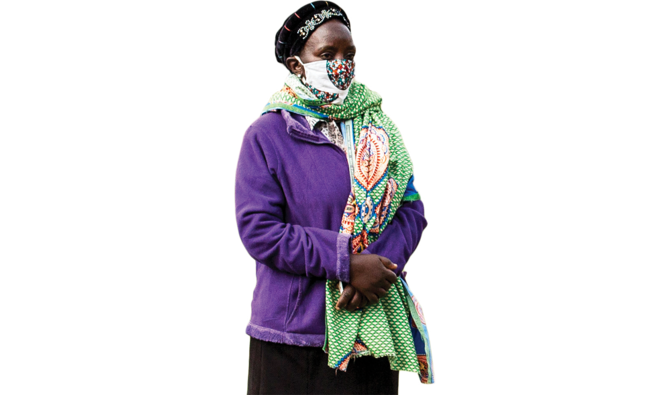

NAIROBI: In the last three months, teacher Faith Njeri has been a regular customer at a courier service office in Nairobi, collecting parcels sent from her village three hours drive north of the capital.
When the coronavirus pandemic closed the private school where she taught, “I was left jobless,” she said. Efforts to feed her family by washing clothes failed “as people avoided any intrusions in their homes for fear of getting infected with the virus.”
With three hungry children and no alternatives, she called her parents in her home village, asking them to send food to keep the family afloat.
“We did not have any money, and we needed to survive,” she said. “When it became apparent that hunger would kill us instead of the virus, we turned to our people back in the village.”
As coronavirus-related restrictions and economic downturns make bringing in an income harder, many urban families in Kenya — and in other countries around the world — are looking to their rural families for help.
In some cases, the calls for help represent an abrupt turnaround in relations, as city dwellers with jobs, who once sent regular cash to support their families at home, now find themselves the ones in need of help.
The added burden on rural families — some of them struggling to feed themselves as more extreme weather linked to climate change hurts harvests — has been substantial, they and farm experts say.
“Most (rural) families have been constrained as the little they had was sent to Nairobi to sustain their relatives,” said Phillip Oketch, a dairy expert with the Kenya Climate Smart Agriculture Project.
Njeri’s mother, who farms in Gathuthi, in Nyeri county, said 30 percent or more of her earnings have gone to sustain her jobless children and grandchildren in Nairobi through the pandemic.
Previously, her four children sent home about $500 each year, she said — but this year they have instead sent four of her grandchildren to live with her in the village, to try to ease costs in the city.
Joseph Kimathi, another farmer from the village of Katheri in Meru county who has sent food to his children in Nairobi, said the pandemic had created a substantial financial burden for farmers.
“I had to forego profits and ensure the survival of my three children in the city, whose forms of livelihoods were suddenly cut by the pandemic,” he said.
Kenya’s lockdown eased in early July but an economic downturn linked to the COVID-19 pandemic means many urban residents are still receiving a reduced paycheck or struggling to find work, Oketch said.
Doreen Akinyi, who lost her job as a hotel waitress, said she continues to rely on a weekly pack of fish and maize flour sent by her aging mother in Mambo Leo, a village in Kisumu County.
Pressure on harvests
Zaverio Chabari, executive director of the nonprofit Strategies for Agro-Pastoralists’ Development Kenya, said the need for rural families to send food to city relatives has been particularly difficult as the country grapples with harvest losses to flooding and locust swarms this year.
“By the time the COVID pandemic struck, much of the food at the farms was already ruined,” Chabari said.
Transportation also for a period was a challenge thanks to coronavirus-linked movement restrictions and road flooding — though Kenya’s Ministry of Agriculture quickly classified food transport as an essential service.