

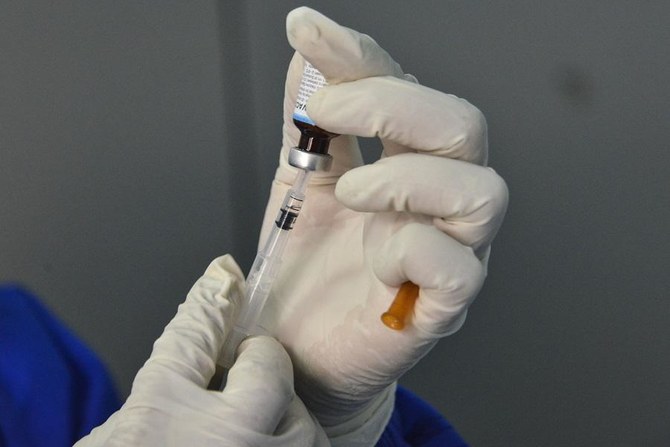

JAKARTA: Indonesia is stepping up efforts to find a COVID-19 vaccine by launching human trials of a potentially effective drug amid criticism of its lacklustre handling of the pandemic and concerns about its plummeting economy.
The third phase of the clinical trials of the vaccine — which is manufactured by China’s Sinovac Biotech in collaboration with its Indonesian pharma counterpart, Bio Farma — began on Tuesday and is being conducted by the Padjadjaran University School of Medicine at six locations in Bandung, West Java province, where the university and the state-owned pharma company are based.
“The first day of the trial went well, with 20 volunteers in each of the six locations injected with the potential vaccine. We have no complaints so far, and we are preparing the second injection batch on Aug 14,” Iwan Setiawan, a spokesman for Bio Farma, told Arab News on Wednesday.
He added that the six-month trial would require the participation of 1,620 volunteers who were “in good health and had not tested positive” for the disease.
Ridwan Kamil, governor of West Java, Indonesia’s most populated province, is among the volunteers who have signed up for the trial.
The third phase is a must before the vaccine, known as CoronaVac, goes into the production stage and is a prerequisite for all pharmaceutical products, including medicines and vaccines.
“The potential vaccine had gone through three trials; the pre-clinical, the clinical trial first phase and the second phase in China,” Bio Farma CEO Honesti Basyir said in a statement.
According to Basyir, Sinovac is one of the few institutions that have progressed to the third phase of the clinical trial from among hundreds of research institutions around the world that are developing the COVID-19 vaccine.
According to Oxford Business Group’s COVID-10 Economic Impact Assessment, there are more than 150 different vaccines that international researchers are working on. However, only 26 have reached the human trial stage so far.
Once the trials are concluded, Bio Farma will register the vaccine with the Food and Drug Supervisory Agency so that it can begin mass-production of the drug.
“We have prepared a production facility for the COVID-19 vaccine with a maximum capacity of 100 million dosages, and by the end of December this year we will have an increased production capacity to produce an additional 150 million dosages,” Basyir said.
President Joko Widodo oversaw the first injections to the batch of volunteers in one of the six locations and also toured Bio Farma’s production facility.
“We hope this clinical trial would conclude in six months and so we can start producing the vaccine in January and vaccinate our people soon,” Widodo said.
State-Owned Enterprise Minister Erick Thohir, who is also the head of the COVID-19 mitigation and national economic recovery committee, said that Bio Farma was a well-established vaccine producer whose products were halal-compliant and used in 150 countries, including in the Middle East.
The collaboration with Sinovac is one of three vaccine-development projects that Indonesia is engaging in with foreign parties as it grapples with a surge in infections. At the same time, social restrictions and economic activities were eased. The other two projects are with South Korea’s Genexine and Norway’s Coalition for Epidemic, Preparedness and Innovation.
As of Wednesday, Indonesia had reported 130,718 infections with 1,942 new cases, 85,798 recoveries and 5,903 deaths, although experts suggest that the numbers could be higher due to the country’s low testing capacity.
Cases also surged in the capital Jakarta with workplaces emerging as the new infection clusters after thousands of employees returned to work recently.


