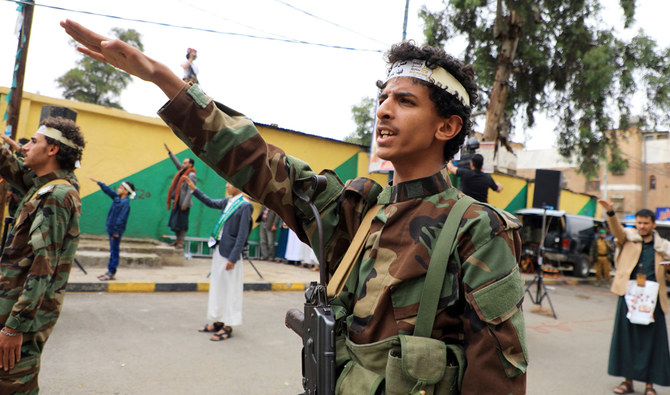

AL-MUKALLA: The internationally recognized government of Yemen has demanded the UN to extend the arms embargo on Iran, saying that Iranian arms have fueled the conflict in the country.
Yemen’s Information Minister Muammar Al-Aryani said war-torn Yemen and other Arab countries have borne the brunt of Iranian expansionism through proxy conflicts.
“Yemen and Arab countries like Iraq, Lebanon and Syria have paid heavy prices for hostile policies adopted by the Iranian regime and the Revolutionary Guards,” he said.
Iran’s supply of weapons to Houthis in Yemen and other militias in the region had fueled the war, he added.
“Selling and supplying arms to Iran inflames conflicts in the region through the smuggling of weapons to sectarian militias and terrorist organizations like the Houthis, Hezbollah, Al-Qaeda and Daesh.”
His appeal came as the Gulf Cooperation Council (GCC) called for an extension to the embargo, just two months before it is set to expire.
The GCC sent a letter to the UN Security Council urging an extension to the deal that has prevented Iran from buying foreign-made weapons, including jets, tanks and warships.
The GCC said Iran had “failed to cease or desist from armed interventions in neighboring countries, directly, and through organizations and movements armed and trained by the country.”
Even before the Houthi takeover of Sanaa in late 2014, consecutive Yemeni governments accused Iran of fueling the conflict by providing rebels with advanced weapons, military training and financial support.
The government and Arab coalition have intensified attacks on Iran in recent years after intercepting arms shipments to Yemen.
Al-Aryani warned that lifting the embargo could give the Iranians free rein to cause chaos in the region.
“We warn against lifting the embargo, which would be a free gift to spread chaos and terrorism in the region, and would provide Iran with financial resources to expand its activities, and threaten the security and stability of the region and the world,” the minister said.
In a recent speech during Eid Al-Adha, Yemeni President Abed Rabbo Mansour Hadi renewed his commitment to challenging Iran’s designs in Yemen by defeating the Houthis, and liberating the capital and other areas under their control.
He accused the rebel group of “turning Yemen into a den of Iranian extremism and terrorism.”
When the US killed Qassem Soleimani in January, the Yemeni government praised the strike, accusing the Al-Quds Force commander of spearheading Iranian military activities in Yemen.
Yemeni military and political analysts said that advanced weaponry supplied by Iran has shored up the Houthis on the battlefield, encouraging them to reject calls for peace.
“The Iran-backed Houthis are the main engine of the war. They expanded across Yemen. Stopping the flow of Iranian weapons to them is the most important step for stopping the war in Yemen,” Yasser Al-Yafae, an Aden-based political analyst, told Arab News.
He added that the Houthis would likely accept peace deals if their arsenal of weapons is depleted.
Fighting has raged in recent days on the front line in several contested provinces across Yemen.
Yemen’s Defense Ministry said army troops and allied tribesmen pushed back Houthi attempts to gain ground in the provinces of Marib and Al-Bayda.
Fighting intensified despite repeated appeals from the UN and local health workers for a humanitarian truce to help deal with the coronavirus pandemic.
The Aden-based national coronavirus committee reported seven new cases, three deaths and three recoveries in the provinces of Hadramout and Taiz on Sunday, bringing the total number of cases to 1808, including 515 deaths and 913 recoveries.