‘It’s our duty’: Saudi donors reach out to help hard-hit Lebanese

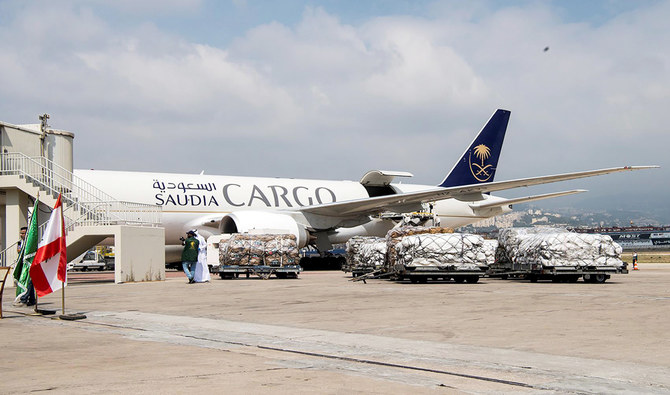
A staff member of King Salman Humanitarian Aid and Relief Center is seen next to humanitarian aid which has been unloaded at Beirut International airport to provide support following Tuesday's blast, Lebanon, August 7, 2020. (SPA via REUTERS)
Short Url
Updated 11 August 2020
Follow

‘It’s our duty’: Saudi donors reach out to help hard-hit Lebanese

  • KSRelief ‘helping hand’ program raises $490,000 for Beirut blast victims

JEDDAH: For years, residents of the Kingdom have raised funds, donated goods and helped charities provide emergency aid to countries and people facing wars, famine and disaster.

This time, it is no different. Shocked by the devastating events in Beirut, Saudis are once more displaying their generosity by offering donations to help the Lebanese people find comfort and peace, as well as rebuild their shattered capital.

When news of the deadly Beirut port explosion broke last Tuesday, thousands of Saudis voiced their shock on social media, standing in solidarity with their Lebanese brothers and sisters, and promising to offer donations to help thousands of Lebanese left homeless by the blast.

In less than week, private businesses and donors, including foundations and philanthropic organizations, have donated more than SR1.8 million ($490,000) to the “Giving a helping hand to the brothers in Lebanon” program organized by the King Salman Humanitarian Aid and Relief Center (KSRelief).

KSRelief, the only body authorized to receive charitable or humanitarian donations from within the Kingdom, was at the forefront of international aid efforts to Beirut.

Businesses have also offered part of their proceeds to help KSRelief’s assistance program.

Tarek, Farah & Haneen Khaled Naaman, owners of Siblings Brunch and Coffee in Jeddah, dedicated the proceeds from one day’s work to help hard-hit Lebanese — even though their business has been in operation for only eight months.

We’re a small business and yet my siblings and I couldn’t turn away from this devastating situation. One day’s proceeds is the minimum we could do; that’s what we can do for now.

Tarek Naaman

“My family is originally Lebanese, but we were born and raised here, so Lebanon has always been a second home to us,” Tarek told Arab News.

“To give is a human act of kindness and they (the Lebanese) have gone through so much for so long. It is our duty to help. I’m blessed and I’d like to share these blessings, especially now. If I can do more, I won’t hesitate,” he said.

“We’re a small business and yet my siblings and I couldn’t turn away from this devastating situation. One day’s proceeds is the minimum we could do; that’s what we can do for now.”

Naaman also called on other firms to help in any way possible, urging them to “do the math, focus on keeping their business afloat, but also finding the means to give back.”

He said: “If God is giving to you, you should give to those less fortunate. God will triple your earnings.”

Saudi people have also shown their generosity, with many voicing the same reason for making donations.

“These are our Arab brothers and sisters, we stand with them and we’ll help in any way we can,” said Amani A.A., a businesswoman.

“No matter how big or small a donation is, I know it’s going to a good cause and it’s only fair we do our part.

“Lebanon, Palestine, Yemen, Iraq, Syria — it doesn’t matter who they are or where they’re from,” she said.

“You wouldn’t want to stand alone while you suffer.”


Economic growth and resilience at heart of 2nd AlUla Emerging Market Economies Conference

Updated 03 February 2026
Follow

Economic growth and resilience at heart of 2nd AlUla Emerging Market Economies Conference

  • Event on Feb. 8 and 9 will bring together ministers, governors of central banks, policymakers, economic experts and international financial institutions
  • Emerging-market economies a ‘pivotal element’ in global economic system due to effect they have on growth and stability, says Saudi Finance Minister Mohammed Al-Jadaan

RIYADH: The second annual AlUla Conference for Emerging Market Economies, which Saudi Arabia will host next week, offers a platform to exchange views on global developments and discuss policies and reforms that support inclusive growth and strengthen economic resilience, the Kingdom’s finance minister said.

The event on Feb. 8 and 9 will bring together finance ministers, governors of central banks and policymakers, alongside economic experts and representatives of international financial institutions.

Organized by the Saudi Ministry of Finance in partnership with the International Monetary Fund, it takes place as emerging-market economies face mounting challenges amid rapid global economic change.

Finance Minister Mohammed Al-Jadaan said the decision to host the conference reflects Saudi Arabia’s ongoing commitment to efforts that support global financial and economic stability, and highlights the growing influence of emerging economies on worldwide growth.

Emerging-market economies represent a “pivotal element” in the global economic system due to the direct impact they have on economic growth and stability, he added.

“The AlUla Conference for Emerging Market Economies provides a unique platform for exchanging views on global economic developments, and discussing policies and reforms that will support inclusive growth and enhance economic resilience, in light of broader international cooperation that contributes to confronting common challenges,” Al-Jadaan said.

Kristalina Georgieva, managing director of the IMF, said the event would help emerging economies deal with growing uncertainty driven by technological change, demographic shifts and geopolitical tensions.

“The AlUla conference provides a vital platform for emerging economies to discuss how they can navigate the risks and embrace the opportunities ahead,” she said.

“In these times of sweeping transformations in the global economy, policymakers face a more challenging and uncertain environment. Countries should work together to strengthen resilience through sound macroeconomic and financial policies.”