

Director of groundbreaking new women-led Pakistani series hopes men will watch too

A poster of 'Churails', a new groundbreaking Pakistani TV show directed by London-based Asim Abbasi and to be premiered on August 11, 2020. (Courtesy: Social Media)
Short Url
Updated 11 August 2020
Follow

Director of groundbreaking new women-led Pakistani series hopes men will watch too

  • Asim Abbasi says his “job is done” if the series 'Churail' helps men become empathetic toward women’s issues
  • Says he titled the series Churail to subvert the meaning of a word that was long been used to label women negatively

KARACHI: The British-Pakistani director of a new groundbreaking Pakistani TV show that aims to put the spotlight on stereotypes about Pakistani women said he hopes men too will watch the show and develop a more empathetic attitude towards women’s problems.



Actress Sarwat Gilani feeding a horse during filming of the new TV series 'Churails' in Karachi in 2019. (Photo courtesy: Zee5 Global)

The ten-episode 'Churails', which is the Urdu word for witches, releases on Tuesday on the Zee5 app. It stars top actresses Sarwat Gilani, Yasra Rizvi, Nimra Bucha and Mehr Bano as four women who start a detective agency to expose cheating husbands behind the facade of a burqa boutique.
“After watching it, even on a marginal rate, [if] they [men] become empathetic towards what a woman goes through and understands them better, I think my job is done,” London-based Asim Abbasi said in an interview with Arab News. 
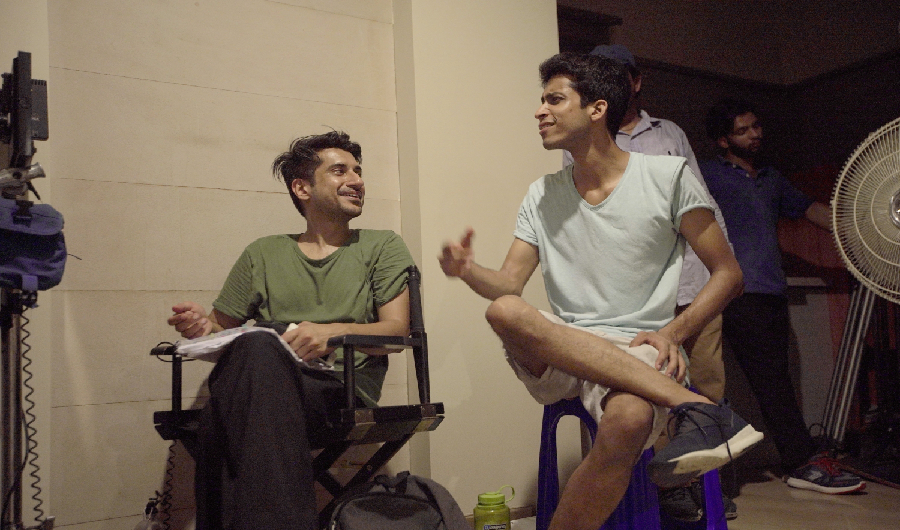


Director Asim Abbasi seen behind the scenes of the TV series 'Churails' in Karachi in 2019. (Photo courtesy: Zee5 Global)

Abbasi said he had titled the series Churail to subvert the meaning of a word that has long been used to label women 'negatively'. In his show, Churail is a woman who opposes oppression and is liberated emotionally, physically and sexually, he said. 
“I have put forward the issue of the status of a woman in a patriarchal society without giving moral judgement on it,” he said. “Churails is not just about how a woman should stand up for her rights but also how she is downplayed in our society through acts of child marriages, domestic violence, abusive attitude, and judgement on her physical appearances.”



Actress Sarwat Gilani during filming of the new TV series 'Churails' in Karachi in 2019. (Photo courtesy: Zee5 Global)

“Mainstream media all over the world generally portrays a woman in a very suppressive and deprived state, who needs a man as her savior and a guiding force,” said leading lady Gilani, who plays the role of family woman Sarah who finds out her husband is cheating on her, which leads her to meeting the three other women with whom she sets up the detective agency. 
“But in Churails all these women uplifting and supporting each other in fighting their battle," she added. 



Sarwat Gilani poses during a cut scene of the new TV seres 'Churails' shot in Karachi in 2019. (Photo courtesy: Zee5 Global)

Yasra Rizvi, who portrays the role of event planner Jugnu Chaudhry, said her character was “breaking all the stereotypical portrayals of women in our media.”
Mehar Bano, who portrays Zubaida, a young girl from a poor family who wants to be a boxer, said she took boxing training to play the role. In the play, her father beats her after he learns that she wants to box. 
“At that point, the Churails squad rescued her and then inspired by their mission, she also became their part,” Bano said.
Nimra Bucha, who plays a self-determined woman from a middle class background, described her character as such: “Batool has had enough to bear from men and the society and now leads her own life on her terms and conditions.”


Macroeconomic instability, inconsistent policies hinder FDI in Pakistan— economists, OICCI

Updated 4 sec ago
Follow

Macroeconomic instability, inconsistent policies hinder FDI in Pakistan— economists, OICCI

  • Pakistan’s foreign direct investment fell 26 percent to $748 million from $1.01 billion a year earlier — data
  • Foreign investors also avoid Pakistan due to its repeated reliance on loans from the IMF, say economists

KARACHI: Despite being the fifth-largest consumer market in the world, Pakistan has failed to attract its “due share” of foreign direct investment (FDI) due to inconsistent policies, regional conflicts and macroeconomic stability, economists and a senior official of the Overseas Investors Chamber of Commerce and Industry (OICCI) said this week. 

Prime Minister Shehbaz Sharif has pursued economic diplomacy recently, traveling frequently to the China, Saudi Arabia, the UAE and other countries. However, these efforts have yet to translate into sustained inflows, as Pakistan has attracted a mere $3 billion in annual FDI over the past two decades, according to the SBP’s data.

Pakistan’s FDI fell 26 percent to $748 million from $1.01 billion a year earlier, extending the downward trend from $2.5 billion recorded in FY25 and $2.3 billion in FY24.

“Pakistan has not been able to attract its due share of the foreign direct investment,” OICCI Secretary General Abdul Aleem said on Friday.
 
The OICCI represents over 200 multinational companies operating in Pakistan, which have collectively reinvested $23 billion over the decade to 2023, according to the group’s website.

“One of the reasons that Pakistan has not been able to attract as much FDI as it should is also a situation in a region where there are conflicts.”

Aleem was referring to Pakistan’s recent border skirmishes with Afghanistan and its four-day military conflict with India in May this year. 

Portfolio investment has also been far from impressive, rising to $160 million in July–Oct in FY26 from $97.2 million a year earlier. Portfolio investment reflects how much money foreigners invest in or withdraw from a country’s stock market.

Last month, Karachi-based market research firm Topline Securities reported that Pakistan had lost around $4 billion in portfolio investments over the past decade.

Arab News reached out to Pakistan’s finance adviser Khurram Schehzad and Jamil Ahmad Qureshi, the secretary-general of the Special Investment Facilitation Council but they were not immediately available for comment. 

Finance Minister Muhammad Aurangzeb told Arab News last month that Pakistan was now better positioned to seek foreign investment due to early signs of macroeconomic stabilization after a prolonged crisis.

‘GREATER CLARITY, CONTINUITY’

Sana Tawfik, head of research at Arif Habib Limited, said Pakistan could see more sustained foreign investment flows through consistent reforms and “clear policies.”

“But foreign investors look for greater clarity and continuity before committing large and long-term capital,” she noted. 

Pakistan’s former finance adviser, Khaqan Najeeb, agreed. He said macroeconomic instability and policy shifts complicate business planning.

“Infrastructure gaps and regulatory hurdles further soften investor confidence,” Najeeb said, noting that Pakistan’s net FDI was hovering around the $1.5-2 billion mark, far below the country’s potential. 

Najeeb pointed out that Islamabad’s repeated reliance on bailouts from the International Monetary Fund (IMF) is also a major reason why foreign investors avoid Pakistan’s debt-burdened yet resilient economy.

Pakistan has secured at least 26 loans from the IMF since joining the organization in 1950, according to the Fund’s website. Pakistan secured a $7 billion bailout program from the global lender last year and is expecting a $1.2 billion tranche after the Executive Board’s meeting next week.

“I think chronic macroeconomic instability, currency volatility, reserves positions going down, going back to the IMF so many times have played a role in this,” he said. 

He said Pakistan’s FDI inflows had remained “modest” due to its recurring balance of payments pressures, noting that periodic IMF programs create “uncertainty for long-term investors.”

Aleem said he was working with the government to streamline Pakistan’s tax structure and ease of doing business, noting that foreign investors often had concerns about the South Asian country’s “slow” legal system.

“It is not enough to say improvements have been made internally,” he said. 

“You have to stand up internationally and at the right forums, share transparently what is good and what is not good in the country.”