

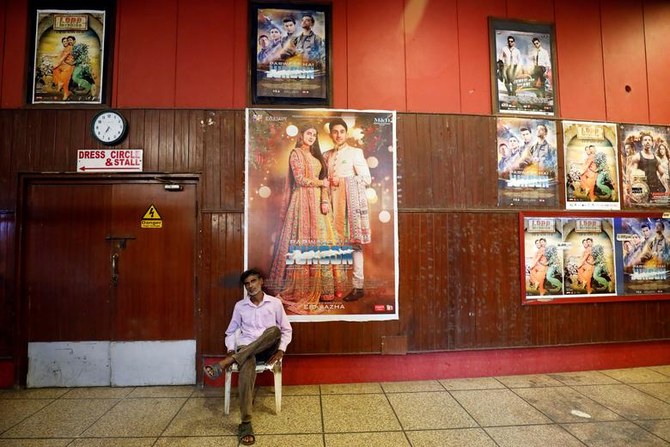
As Pakistani cinemas reopen, owners unsure theaters can implement coronavirus restrictions

Ticket checker Mukesh, 40, sits by a wall decorated with film posters at the hall of the Bambino Cinema in Karachi, Pakistan August 30, 2018. (Reuters)
Short Url
Updated 10 August 2020
Follow

As Pakistani cinemas reopen, owners unsure theaters can implement coronavirus restrictions

  • Distributors, producers and cinema owners say the reopening for many may end up being unprofitable
  • They say it could take seven months to adjust to the ‘new normal’ also because production had been put on hold due to coronavirus lockdowns

KARACHI: Starting Monday, theaters and cinema halls across Pakistan will be allowed to reopen, but theater owners are not sure if they will be able to implement the government’s antivirus procedures.

As the government lifts antivirus restrictions on the hospitality and recreation sectors, business owners must adhere to strict standard operating procedures (SOPs) to prevent the spread of the coronavirus.

“Many cinema houses may not be able to cope with the new SOPs, which includes ensuring a limited seating capacity, and would rather wait for conditions to normalize completely,” Nadeem Mandviwalla, owner of Atrium Cinemas in Karachi and Centaurus Cineplex in Islamabad, told Arab News.

Even if the plan worked, he said, the reopening for many may be unprofitable.

“It would be difficult to meet the costs if we sell tickets at the same price. It would take three to four weeks to work on how to implement the SOPs and which films with minimum duration can be screened.” 

Mandviwalla added it could take six to seven months for cinema industry stakeholders to adjust to the “new normal” also because film production work had been put on hold due to coronavirus lockdowns imposed in March.

“At the moment, expecting something fresh on the screens is impossible as all producers are waiting for things to get normal. So, till then, we would have to rely on to re-runs of Pakistani and Hollywood movies,” he said, adding that he’s not expecting for it to be a win-win situation since audiences have access to ample content on Over The Top (OTT) platforms such as Netflix and Amazon Prime.

With nearly 160 cinemas across the country, with an average seating capacity of 150 persons each, watching movies is a popular pass time in Pakistan.

Satish Anand, a renowned film distributor who owns the franchise, said that while watching content on OTT platforms might be the latest trend, it was too early to rule out the importance of watching movies through the traditional practice of going to a cinema.

“We have to gain the trust of cinema-goers by ensuring their safety and selling tickets on discounted or reduced prices,” he said, “The outcome of the decision will be visible in early September, but I believe all stakeholders of the cinema industry such as producers, distributors and exhibitors should sit together and set new goals of profit and loss,” he said. 

Due to the coronavirus outbreak, Anand himself had to postpone the release of four films.

Out of the 54 films released last year, 23 were locally made, six were from across the border in India, while the rest were from the US.

According to Anand, Pakistan’s film industry could currently either take Hollywood’s route — which has moved its releases to next year — or settle for reruns of old films.

Mandviwalla says he would prefer to do that instead of “incurring more losses.”

“In France, reopened cinemas had to close down after going into losses. I would prefer to keep it closed and not get anything instead of going into loss by restating my business in unviable conditions.”


Pakistan, global crypto exchange discuss modernizing digital payments, creating job prospects 

Updated 05 December 2025
Follow

Pakistan, global crypto exchange discuss modernizing digital payments, creating job prospects 

  • Pakistani officials, Binance team discuss coordination between Islamabad, local banks and global exchanges
  • Pakistan has attempted to tap into growing crypto market to curb illicit transactions, improve oversight

ISLAMABAD: Pakistan’s finance officials and the team of a global cryptocurrency exchange on Friday held discussions aimed at modernizing the country’s digital payments system and building local talent pipelines to meet rising demand for blockchain and Web3 skills, the finance ministry said.

The development took place during a high-level meeting between Finance Minister Muhammad Aurangzeb, Pakistan Virtual Assets Regulatory Authority (PVARA) Chairman Bilal bin Saqib, domestic bank presidents and a Binance team led by Global CEO Richard Teng. The meeting was held to advance work on Pakistan’s National Digital Asset Framework, a regulatory setup to govern Pakistan’s digital assets.

Pakistan has been moving to regulate its fast-growing crypto and digital assets market by bringing virtual asset service providers (VASPs) under a formal licensing regime. Officials say the push is aimed at curbing illicit transactions, improving oversight, and encouraging innovation in blockchain-based financial services.

“Participants reviewed opportunities to modernize Pakistan’s digital payments landscape, noting that blockchain-based systems could significantly reduce costs from the country’s $38 billion annual remittance flows,” the finance ministry said in a statement. 

“Discussions also emphasized building local talent pipelines to meet rising global demand for blockchain and Web3 skills, creating high-value employment prospects for Pakistani youth.”

Blockchain is a type of digital database that is shared, transparent and tamper-resistant. Instead of being stored on one computer, the data is kept on a distributed network of computers, making it very hard to alter or hack.

Web3 refers to the next generation of the Internet built using blockchain, focusing on giving users more control over their data, identity and digital assets rather than big tech companies controlling it.

Participants of the meeting also discussed sovereign debt tokenization, which is the process of converting a country’s debt such as government bonds, into digital tokens on a blockchain, the ministry said. 

Aurangzeb called for close coordination between the government, domestic banks and global exchanges to modernize Pakistan’s payment landscape.

Participants of the meeting also discussed considering a “time-bound amnesty” to encourage users to move assets onto regulated platforms, stressing the need for stronger verifications and a risk-mitigation system.

Pakistan has attempted in recent months to tap into the country’s growing crypto market, crack down on money laundering and terror financing, and promote responsible innovation — a move analysts say could bring an estimated $25 billion in virtual assets into the tax net.

In September, Islamabad invited international crypto exchanges and other VASPs to apply for licenses to operate in the country, a step aimed at formalizing and regulating its fast-growing digital market.