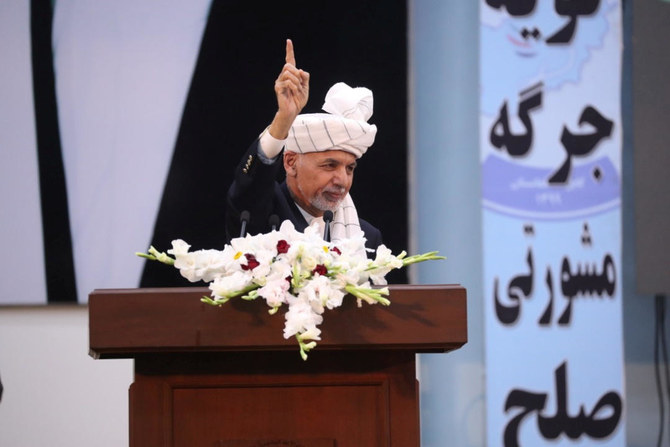
KABUL: President Ashraf Ghani on Friday inaugurated a traditional grand assembly, the Loya Jirga, to help decide whether the last 400 Taliban prisoners held by Kabul should be freed as part of a historic peace deal between the US and the militants.
The 400 inmates still in government custody have been at the center of a dispute that is delaying peace in the war-torn country.
A prisoner swap between the Taliban and Kabul was a major part of the February agreement signed by the US and the militants in Qatar.
The exchange should have taken place in early March and be immediately followed by talks to decide the future of Afghanistan’s political system, including the creation of an interim government.
“Today, we have gathered here to discuss what is our interest in the talks and the ultimate price of peace. Now is the time for making a major decision,” Ghani told the assembly of over 3,200 delegates in Kabul.
“The Taliban have committed that after the freedom of their 400 prisoners, they will begin official talks with our delegation,” he said. “But at the same time, they have also warned that if the prisoners are not freed, they will not only continue the violence, but also increase it.”
The Qatar agreement stipulated that the Afghan government would first release up to 5,000 Taliban prisoners and the militants would free about 1,000 national security personnel. Ghani’s government, which was not part of the Qatar accord, initially refused to free the militants.
However, under pressure from Washington, Kabul has freed more than 4,600 Taliban inmates. But it is refusing to free the remaining 400 who, it said, had been behind major crimes and attacks.
After Eid Al-Adha prayers last week, Ghani announced he would summon the Loya Jirga, a traditional council to reach consensus among Afghanistan’s rival tribes, factions and ethnic groups.
Delegates are expected to announce their decision in three days.
As Ghani spoke, a woman delegate stood and voiced her opposition to the release of the remaining Taliban inmates, saying that it would be “national treason.”
The meeting has been held under tight security and parts of Kabul are under lockdown.
Many of Afghanistan’s political and tribal leaders, including former President Hamid Karzai, were absent from the assembly.
Meanwhile, the Taliban accused Ghani of blocking the start of negotiations.
The US special envoy for Afghanistan, Zalmay Khalilzad, said the Kabul assembly was a historic “opportunity for peace” and “must be seized by all sides.”


![]()
![]()
![]()

Kabul assembly to decide fate of last Taliban inmates


Short Url
https://arab.news/6r4r4
Kabul assembly to decide fate of last Taliban inmates
- The 400 inmates still in government custody have been at the center of a dispute that is delaying peace
- A prisoner swap between the Taliban and Kabul was a major part of the February agreement signed by the US and the militants in Qatar


Latest updates


© 2026 SAUDI RESEARCH & PUBLISHING COMPANY, All Rights Reserved And subject to Terms of Use Agreement.