

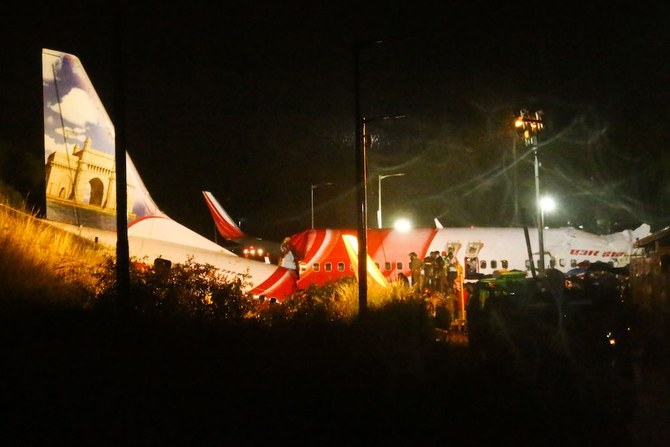
Death toll from Air India Express aircraft crash rises to 18

1 / 3
Officials inspect the wreckage of an Air India Express aircraft that crashed on landing at Calicut International Airport in Kerala on August 8, 2020. (AFP)
2 / 3
First responders inspect the wreckage of an Air India Express jet, which was carrying more than 190 passengers and crew from Dubai, after it crashed by overshooting the runway at Calicut International Airport in Karipur, Kerala, on August 7, 2020. (AFP)
3 / 3
Rows of ambulances are seen outside the Calicut International Airport where a passenger plane crashed after it overshot the runway in Karipur, in the southern state of Kerala, India, August 7, 2020. (Reuters)
Short Url
Updated 08 August 2020
Follow

Death toll from Air India Express aircraft crash rises to 18

  • The Air India Express plane from Dubai had 191 passengers and crew on board when it overshot the runway
  • There were 10 infants on board

KOZHIKODE, India: The death toll from an Indian passenger aircraft accident has risen to 18, while 16 people have been seriously injured, a senior government official said on Saturday.

The Air India Express plane, which was repatriating Indians stranded in Dubai due to the coronavirus pandemic, overshot the runway of the Calicut International Airport in heavy rain near the southern city of Kozhikode on Friday. It was India’s worst passenger aircraft accident since 2010.

The flight was carrying 190 passengers and crew.

The plane’s pilot and the co-pilot were killed in the accident, K Gopalakrishnan, chief of the Malappuram district in the southern state of Kerala, told Reuters.

All survivors were admitted to various hospitals and were also tested for COVID-19, Gopalakrishnan said, adding that autopsies of the dead would also be carried out according to the COVID-19 protocol.

Some 149 patients remain in hospital after some were discharged on Saturday, Gopalakrishnan said.

Authorities have also asked local people who rushed out to help the passengers trapped in the plane to go into quarantine.

The Boeing-737 plane skidded off the table-top runway of Calicut, crashing nose-first into the ground. Such runways are located at an altitude and have steep drops at one or both ends.

In 2010, another Air India Express flight from Dubai overshot the table-top runway at Mangalore, a city in the south, and slid down a hill, killing 158 people.

Civil Aviation Minister Hardeep Singh Puri visited the site of the accident on Saturday.

“It (the plane) overshot the runway while trying to land amidst what were clearly inclement weather conditions prevailing at that time,” Puri told a news conference, adding that it would be premature to speculate on the precise cause of the accident.

Puri said two separate teams had already reached Kozhikode from New Delhi to carry out an investigation into the crash.

He said authorities managed to rescue most of the passengers because the plane did not catch fire while descending the slope at the end of the runway.

The flight data recorder and cockpit voice recorder have been recovered from the site, a top official at the Directorate General of Civil Aviation said.

Giving a breakdown of all those on board the plane, Puri earlier said they included 10 children, 174 adult passengers, four cabin crew and two pilots.

“The pilot tried a lot to land us (safely) in the rainy weather. It was cloudy and around 7-7.30 p.m. (GMT 1330-1400) in the evening, we crash-landed. It was difficult to land, he tried a lot,” said one passenger, who gave his name as Ashraf.

India, which halted all flights in late March to try to contain the coronavirus, has restarted limited international air travel.

Air India Express AXB1344 was a government-operated repatriation flight for Indians previously unable to return home because of travel restrictions.


North Korean leader Kim inspects new warship, claims progress toward nuclear-armed navy

Updated 9 sec ago
Follow

North Korean leader Kim inspects new warship, claims progress toward nuclear-armed navy

  • Kim has hailed the development of Choe Hyon as a significant advancement toward his goal of expanding the operational range and preemptive strike capabilities of his nuclear-armed military

SEOUL, South Korea: North Korean leader Kim Jong Un inspected his new destroyer for two straight days ahead of its commissioning and observed a test of cruise missiles fired from the warship, vowing to accelerate the nuclear-armament of his navy, state media said Thursday.
The North’s official Korean Central News Agency said Kim, during his visits to the western shipyard of Nampo on Tuesday and Wednesday, also inspected the construction of a third destroyer of the same class as his 5,000-ton warship, the Choe Hyon, first unveiled in April 2025.
Kim has hailed the development of Choe Hyon as a significant advancement toward his goal of expanding the operational range and preemptive strike capabilities of his nuclear-armed military. State media says the ship is designed to handle various weapons systems, including antiair and anti-naval weapons, as well as nuclear-capable ballistic and cruise missiles. South Korean military officials and experts say Choe Hyon was likely built with Russian assistance amid deepening military ties, but some have raised doubts about whether it’s ready for active service.
North Korea unveiled a second destroyer of the same class in May last year, but it was damaged during a botched launching ceremony at the northeastern port of Chongjin, triggering a furious reaction from Kim, who called the failure “criminal.” North Korea has said the new destroyer, named Kang Kon, was relaunched in June after repair, but outside experts have questioned whether the ship is fully operational.
After observing Choe Hyon’s sea trials on Tuesday, Kim said the ship met operational requirements and called it a symbol of the country’s expanding naval capabilities. He called for building two warships a year over the next five years of the same or higher class as the Choe Hyon.
Kim came back Wednesday to observe a test launch of cruise missiles from the Choe Hyon. State media published photos of him watching from shore as several projectiles rose from the vessel in plumes of white smoke and described the weapons as “strategic,” a term used for nuclear-capable systems.
After years of spurring ballistic missile development, Kim has shifted his focus more toward naval capabilities, including an ongoing construction of a nuclear-powered submarine. KCNA said the third destroyer under construction at the Nampo shipyard is expected to be completed by the ruling Workers’ Party’s founding anniversary in October.
Naval capabilities were also a key focus when Kim outlined his five-year military goals at last month’s Workers’ Party congress, which included calls for intercontinental ballistic missiles capable of being launched from underwater.
Kim on Tuesday claimed that his efforts to arm his navy with nuclear weapons were “making satisfactory” progress. He said those purported advancements would “constitute a radical change in defending our maritime sovereignty, something that we have not achieved for half a century.”
KCNA did not elaborate on what Kim meant. Some analysts say North Korea may be preparing to formally declare a maritime boundary that could encroach on waters controlled by rival South Korea.
As inter-Korean tensions worsen, Kim has repeatedly said he does not recognize the Northern Limit Line, drawn by the US-led UN Command at the end of the 1950-53 Korean War. The poorly drawn western sea boundary has been the site of several deadly naval clashes in past years.
At the party congress, Kim doubled down on plans to expand North Korea’s nuclear arsenal, which already is equipped with various weapons systems threatening the United States and US allies in Asia, and confirmed his hard-line view of rival South Korea.
But he left the door open for dialogue with the Trump administration, reiterating Pyongyang’s demand that Washington drop its insistence on denuclearization as a precondition for resuming long-stalled talks.