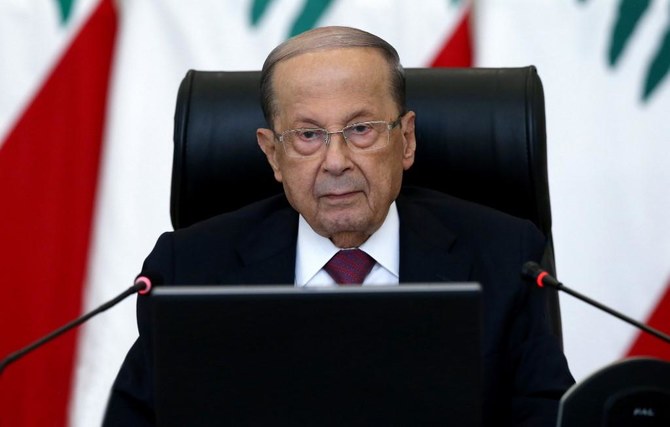

BEIRUT: A devastating explosion that destroyed much of Beirut might have been the result of a missile attack or bomb, Lebanese President Michel Aoun said, as the death toll from the blast rose to 154.
More than 2,700 tons of ammonium nitrate had been sitting in a port warehouse for six years, but there have been conflicting accounts about why Lebanese authorities decided to empty the shipment of explosive material. The vessel carrying the flammable cargo was heading from Georgia to Mozambique when it stopped in the Lebanese port to load up on iron, according to the ship’s captain.
By Friday, 19 suspects had been arrested and Lebanon’s former director general of customs Chafic Merhy had been questioned by military police.
Opinion
This section contains relevant reference points, placed in (Opinion field)
Lebanese President Michel Aoun said: “The incident might be a result of negligence or external intervention through a missile or a bomb, and I have asked French President Emmanuel Macron to provide us with aerial photos to determine whether there were planes or missiles, and if the French did not have such photos then we might seek them from other states to determine if there was a foreign assault,” said Aoun, referring to a flying visit from the French leader to Lebanon after the tragedy occurred.
The president said that Macron was “outraged” by what had happened and that the investigation would target all those who were directly responsible. Lebanon’s courts would try all officials regardless of their ranking, Aoun added.
The president told journalists that there was a lot of interest about how the explosive materials were emptied in the port, who was responsible for keeping them stored there for six years and whether the blast was an accident or deliberate.
Health Minister Hamad Hasan said the number of the injured people had risen to 5,000 according to hospital records and that 20 percent needed hospitalization, while 120 were in critical condition. The number of injured could be much higher, especially since hundreds of people went to pharmacies, dispensaries, or private clinics for treatment and nobody registered their names.
A search is still underway for eight missing silo employees: Ghassan Hasrouty, Joe Andoun, Shawki Alloush, Hassan Bachir, Khalil Issa, Charbel Karam, Charbel Hitti, and Najib Hitti. French rescue teams were able to locate six of them through scanners inside the elevator under the silos building.
Civil Defense and rescue teams found the body of Joe Akiki on Thursday midnight in one of the silo cellars. The bodies of Ali Mcheik and Ibrahim Al-Amin, two silo workers, have also been found.
But the possibility of finding survivors looked slim on Friday, according to a military source, despite the fact that Russian and French rescue teams detected signals from a mobile phone belonging to one of the missing individuals.
Lebanese Army Commander Gen. Joseph Aoun inspected the local and foreign search and rescue teams in the Port of Beirut, which has been declared a restricted area. Residents reported thefts in damaged households and shops during the evenings, especially since the damaged areas have lost power.
Mireille Girard, the UN High Commissioner for Refugees (UNHCR) representative in Lebanon, said the agency had decided to put its stocks of shelter equipment, plastic sheets, emergency tents and tens of thousands of other basic relief items at people’s disposal.
“More than 300,000 people have had their residence fully or partially damaged due to the explosion, which caused them to get displaced,” she added.
Volunteers are continuing to clear out damaged homes, businesses and places of worship, removing huge quantities of broken glass, as international aid began arriving in Lebanon.
Countries in the Gulf Cooperation Council have provided hospitals with medical supplies, given the homeless food and subsistence aid, and set up field hospitals in affected areas and in the capital’s downtown area.
UNICEF said that 100,000 Lebanese children have lost their homes due to the explosion in the Port of Beirut, and that 120 schools serving 55,000 children were damaged.
Patriarch John X Yazigi, who is primate of the Greek Orthodox Patriarchate of Antioch and All The East, moved from his headquarters in Syria to Lebanon and inspected hospitals and the patriarchate’s other institutions.
The US is donating more than $17 million in aid to Lebanon, in addition to financial assistance to the Lebanese Red Cross, while the Japanese Ministry of Foreign Affairs said it will provide tents, beds, blankets, and other aid through the Japan International Cooperation Agency.
The UK said that HMS Enterprise would sail to Lebanon to assess the damage in the Port of Beirut and help restore normal port operations, along with immediate military and civilian aid worth more than £5 million ($6.5 million).
Lebanese Finance Minister Ghazi Wazni said: “Lebanon is in a state of emergency and there is no cover for anyone, and the judiciary does not need permission to sue anyone.”