Pakistan jails five men for killing endangered snow leopard

This undated picture released Nov. 26, 2006 by the Pakistan’s Press Information Department (PID) shows an adult female snow leopard lying on the ground in Chitral, in northern Khyber Pakhtunkhwa, Pakistan. (AFP/File)
Short Url
Updated 06 August 2020
Follow

Pakistan jails five men for killing endangered snow leopard

  • Only 300 snow leopards are believed to be left in the wild in Pakistan in the areas of Himalayas, Hindukush and Karakoram mountains
  • The poachers were sentenced to two years in jail, after authorities caught them following a social media post

PESHAWAR: Five men were sentenced to prison in an expedited trial on Wednesday for killing a snow leopard in northern Pakistan, wildlife officials confirmed.

Four poachers and their facilitator were arrested by the Gilgit-Baltistan Wildlife Department on charges of killing a female leopard near the Hoper glacier in the region’s Nagar district in late July. The hunters uploaded their photos with the body of the endangered cat to social media, after which they were traced by the authorities.

“Informers told us that in the Hopar Nagar area someone shot the precious snow leopard. The concerned wildlife officials alerted local police and we arrested the illegal hunters and seized the leopard’s dead body,” Gilgit-Baltistan Wildlife Department spokesman Tariq Husain told Arab News on Thursday.

Divisional Forest Officer Jibran Haider, who has magistrate powers, convicted the accused in an expedited trial. Two were sentenced to two years in jail, two to one year’s imprisonment and their facilitator to one month behind bars, he said.

Only 300 snow leopards are believed to be left in the wild in Pakistan.
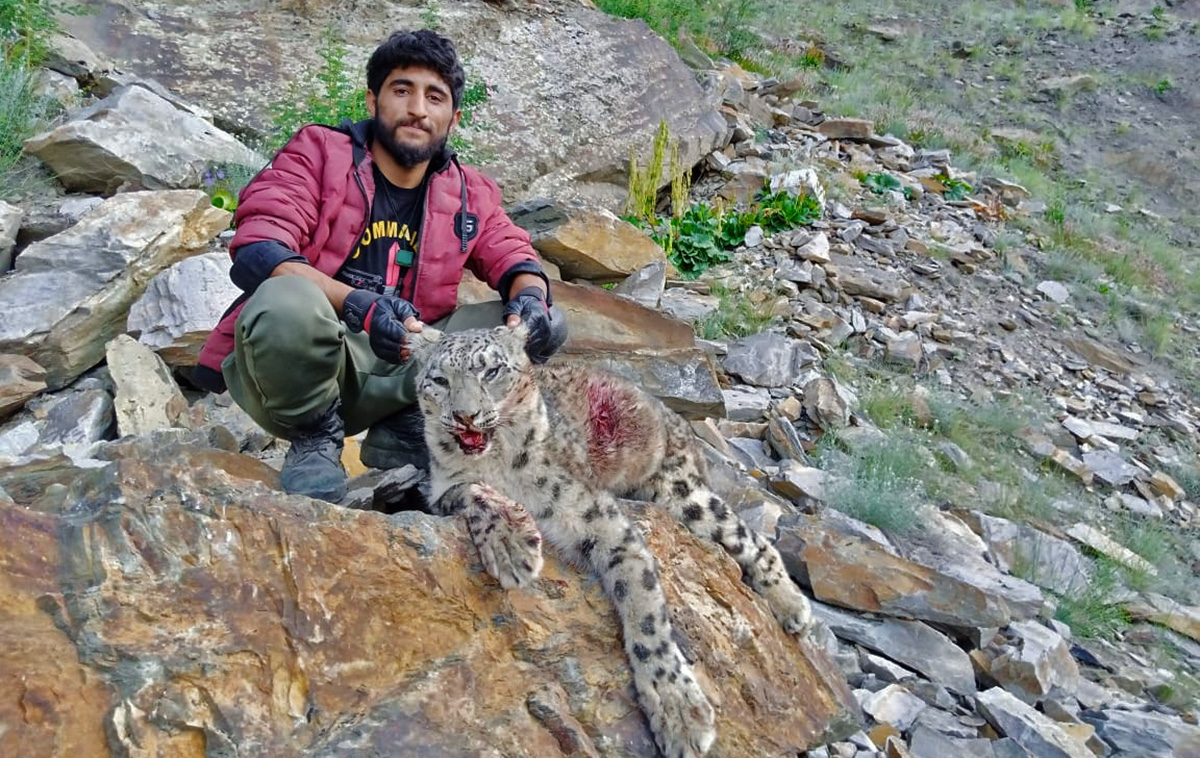


The photograph posted on social media, in which a poacher poses with a dead snow leopard, helped Gilgit-Baltistan authorities identify the men who killed the endangered cat in Nagar district last month. (Social media)

“There are about 300 snow leopards in Pakistan’s Himalayan, Hindukush and Karakoram regions,” Snow Leopard Foundation deputy director Jaffarudin said. 

However, not only poachers pose a danger to the wild feline.

The foundation has been working on improving the socio-economic conditions of mountain communities in Gilgit Baltistan, Khyber Pakhtunkhwa, and Azad Jammu and Kashmir which share the ecosystem with the endangered species.

Snow leopards often attack livestock and local residents sometimes kill them in defense.

“Leopards attack our kids and women too, they say, and that’s why they kill this precious animal,” Husain of the wildlife department said, adding that when it comes to actual poachers the department is on alert and several arrests have taken place in the recent past.

Activists lauded the recent arrest but say that law enforcement is still insufficient as local authorities do not have proper surveillance tools. 

“No doubt the wildlife department is facing problems as they can’t cover the whole area,” wildlife activist Mumtaz Gohar said, “If the hunter had not posted the photos on social media, the incident would definitely have gone unreported like many others.”


Pakistan military says 13 militants killed in counterterror operations across northwest

Updated 08 March 2026
Follow

Pakistan military says 13 militants killed in counterterror operations across northwest

  • Military says counterterror operations launched in Bajaur, Bannu, Dera Ismail Khan, Khyber and South Waziristan districts
  • The counterterror operations take place as Afghanistan and Pakistan remain locked in conflict since late last month 

ISLAMABAD: Pakistani security forces this week killed 13 militants in five separate counterterror operations in the northwestern Khyber Pakhtunkhwa (KP) province, the military’s media wing said on Sunday, vowing to eliminate militancy from the country. 

The counterterror operations were conducted on Mar. 6-7, with Pakistani troops killing five militants in the northwestern Bajaur district in the first operation. In two other encounters in Bannu and Dera Ismail Khan district, security forces killed three militants belonging to the Tehreek-e-Taliban Pakistan (TTP) militants, the Inter-Services Public Relations (ISPR) said. 

Meanwhile, five other militants were killed in two separate counterterror operations in Khyber and South Waziristan districts in which five more militants were slain. 

“Weapons and ammunition were also recovered from Indian-sponsored killed khwarij, who remained actively involved in numerous terrorist activities in the area,” ISPR said in a statement. 

Pakistan’s military frequently uses the term “Fitna al Khwarij” to describe TTP militants. The militant outfit has carried out some of the deadliest attacks against Pakistani civilians and security forces since 2007 in a bid to impose their strict brand of Islamic law across the country. 

Islamabad accuses Afghanistan of sheltering the TTP and facilitating their attacks against Pakistan, a charge Kabul has denied. Pakistan also accuses India of supporting these militant groups, which New Delhi has repeatedly rejected. 

The counterterror operations take place as Pakistan remains locked in conflict with Afghanistan since late February. 

The worst fighting between the two sides began late last month when Afghan forces launched a surprise attack on Pakistani military installations along their shared border. Afghanistan said the assault was in retaliation for Pakistan’s earlier airstrikes in February on what Islamabad described as militant camps inside Afghanistan.

Pakistan’s Information Minister Attaullah Tarar said on Saturday that Islamabad has killed 527 Afghan Taliban fighters and injured more than 755 since clashes began.

Afghanistan has also claimed attacking multiple Pakistani military bases and killing several Pakistani soldiers. Arab News has not independently verified the claims by both sides. 

Pakistan has ruled out talks with Afghanistan and said it will continue its military operations in the country till it withdraws support for militant groups that Islamabad says operate from Afghanistan.