

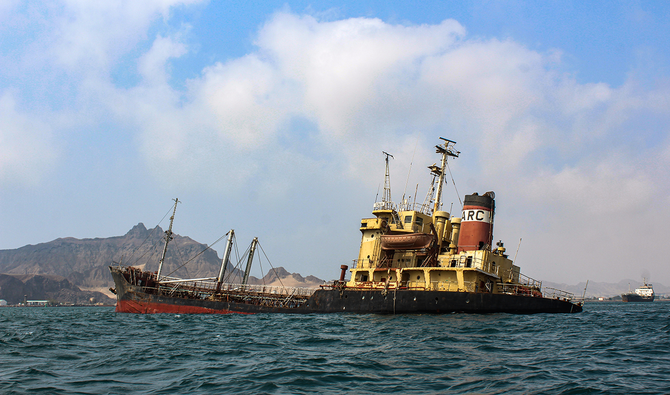
Yemenis fear decaying oil tanker could cause major disaster

A view of the Yemeni flagged oil tanker Rudeef GNA, sinking in the waters off Yemen's second city and port of Aden. (AFP)
Short Url
Updated 06 August 2020
Follow

Yemenis fear decaying oil tanker could cause major disaster

  • Beirut explosions spur activists and fishermen to warn of potential impact if Safer tanker is not repaired

AL-MUKALLA: Following Tuesday’s huge explosions in Beirut, Yemenis have been voicing their concern that the decaying Safer floating storage and offloading terminal could lead to a devastating disaster in Yemen if it is not repaired soon.

Having seen footage of the destruction wrought by the explosions in Lebanon, Yemeni fishermen, politicians, government officials, military officers and activists have urged the international community to pressure the Houthis to give experts from the United Nations access to the damaged ship so that it can be fixed.

The Safer has been stranded off the western city of Hodeida since early 2015. It reportedly carries around 1.1 million barrels of crude oil and has recently shown signs of rusting, with water entering the engine room. That leak prompted UN officials to warn of a major impending environmental disaster in the Red Sea, as well as the potential risk of a massive explosion caused by the build up of gases in the storage tanks, or by weaponry fired deliberately or accidentally.

Under pressure from local and international bodies, the Iran-backed Houthis, who control Hodeida, initially agreed to allow a UN team to board the ship to assess the damage and unload the oil. However, they later reversed that decision, citing a conspiracy between the UN, the US, and the Saudi-led Arab coalition.

Khaled Al-Rami, a Yemeni fisherman from Hodeida’s Khokha district on the shores of the Red Sea, told Arab News that his “first thought” on seeing the images from Beirut on Tuesday was that an equally devastating disaster could occur if the Safer spills oil into the water.

Last month, the Yemen-based environmental group Holm Akhdar (Green Dream) warned that an oil spill would have devastating consequences for fishermen, marine diversity, and the country’s fish stock.

“At least 115 of Yemen’s islands in the Red Sea would lose their biodiversity and their natural habitats. About 126,000 Yemeni fishermen — including 67,800 in Hodeida — would lose their only source of income because of the disaster,” the group said in its report.

“If the ship is not repaired, then after Lebanon, it will be Yemen,” Al-Rami said. “On WhatsApp, my friends and other fishermen shared their concerns about a predicted disaster from the ship. We are all worried about the impact of any oil spills on our lives. This is our major concern at the moment. It causes us great horror and panic. I appeal to the international community, the Arab Coalition and the UN committee (in Hodeida) to save us from a possible disaster.”

Nabiel Ali, also a fisherman from Khokha, told Arab News that his generation and his children’s would suffer the consequences of an oil spill from the Safer. “I urge the international community and all the good people in the world to find an urgent solution to this problem,” he said. “For the sake of humanity, please save Yemenis in general and the fishermen in particular.”

On social media, Yemeni activists echoed similar concerns about a possible disaster off the Yemeni coast.

“The Beirut Port explosion came to remind us of another imminent catastrophe that threatens Yemen and the whole world,” Mustafa Ghoules, a Yemeni journalist, said on Twitter. “The Safer tanker, which contains more than a million barrels of oil, is on the verge of leakage and explosion and is used by the Houthis as a weapon,”

Mohammed Saeed Al-Sharabi, an activist, called on his compatriots to save their country from disaster by emptying the decaying tanker before it is too late.

“The Safer tanker must be unloaded before oil spills and causes a major environmental disaster in the Red Sea. You must learn a lesson from the Beirut port disaster,” he said.

Abdullah Al-Saqqaf, another activist, called for mass protests across Yemen to pressurize the Houthis into allowing UN teams to maintain and unload the ship. “There must be popular demonstrations demanding the unloading of the tanker and exerting public pressure on the Houthis to abide by the United Nations resolution on the tanker,” Al-Saqqaf said.

The internationally recognized government of Yemen expressed its support for Lebanon and offered condolences to relatives of the victims of Tuesday’s explosions, according to a brief statement carried by the official Saba news agency on Tuesday night.

“We would like to assure everyone that the Yemeni community members are well and healthy and only two students were lightly injured,” the Yemeni Embassy in Lebanon said in a statement on its official Facebook page.


Historic decree seeks to end decades of marginalization of Syria’s Kurds

Updated 51 min ago
Follow

Historic decree seeks to end decades of marginalization of Syria’s Kurds

DAMASCUS/RIYADH: A decree issued by President Ahmad Al-Sharaa on Friday marks a historic end to decades of marginalization of Syria’s Kurdish minority and seeks to open a new chapter based on equality and full citizenship in post-liberation Syria.

The presidential action, officially known as Decree No. 13, affirms that Syrian Kurds are an integral part of the national fabric and that their cultural and linguistic identity constitutes an inseparable element of Syria’s inclusive, diverse, and unified national identity.

Al-Sharaa’s move seeks to address the consequences of outdated policies that distorted social bonds and divided citizens.

The decree for ⁠the first time grants Kurdish Syrians rights, including recognition of Kurdish identity as part of Syria’s national fabric. It designates Kurdish as a national language alongside Arabic and allows schools to teach it.

Al-Sharaa’s decree came after fierce clashes that broke out last week in the northern city of Aleppo, leaving at least 23 people dead, according to Syria’s health ministry, and forced more than 150,000 to flee the two Kurdish-run pockets of the city. The clashes ended ⁠after Kurdish fighters withdrew.

The Syrian government and the Kurdish-led Syrian Democratic Forces (SDF), that controls the country’s northeast, have engaged in months of talks last year to integrate Kurdish-run military and civilian bodies into Syrian state institutions by the end of 2025, but there has been little progress.

The end of an era of exclusion

For more than half a century, Kurds in Syria were subjected to systematic discriminatory policies, most notably following the 1962 census in Hasakah Governorate, which stripped thousands of citizens of their nationality and deprived them of their most basic civil and political rights.

These policies intensified after the now-dissolved Baath Party seized power in 1963, particularly following the 1970 coup led by criminal Hafez al-Assad, entrenching a state of legal and cultural exclusion that persisted for 54 years.

With the outbreak of the Syrian revolution in March 2011, Syrian Kurds actively participated alongside other segments of society. However, the ousted regime exploited certain separatist parties, supplying them with weapons and support in an attempt to sow discord and fragment national unity.

Following victory and liberation, the state moved to correct this course by inviting the Kurdish community to fully integrate into state institutions. This approach was reflected in the signing of the “March 10 Agreement,” which marked an initial milestone on the path toward restoring rights and building a new Syria for all its citizens.

Addressing a sensitive issue through a national approach

Decree No. 13 offers a balanced legal and political response to one of the most sensitive issues in modern Syrian history. It not only restores rights long denied, but also redefines the relationship between the state and its Kurdish citizens, transforming it from one rooted in exclusion to one based on citizenship and partnership.

The decree shifts the Kurdish issue from a framework of conflict to a constitutional and legal context that guarantees meaningful participation without undermining the unity or territorial integrity of the state. It affirms that addressing the legitimate demands of certain segments strengthens, rather than weakens, the state by fostering equal citizenship, respecting cultural diversity, and embracing participatory governance within a single, centralized state.

Core provisions that restore dignity

The decree commits the state to protecting cultural and linguistic diversity, guaranteeing Kurdish citizens the right to preserve their heritage, develop their arts, and promote their mother tongue within the framework of national sovereignty. It recognizes the Kurdish language as a national language and permits its teaching in public and private schools in areas with significant Kurdish populations, either as an elective subject or as part of cultural and educational activities.

It also abolishes all laws and exceptional measures resulting from the 1962 Hasakah census, grants Syrian nationality to citizens of Kurdish origin residing in Syria, including those previously unregistered, and guarantees full equality in rights and duties. In recognition of its national symbolism as a celebration of renewal and fraternity, the decree designates Nowruz Day (21 March) as a paid official holiday throughout the Syrian Arab Republic.

A call for unity and participation

In a speech following the issuance of the decree, President Ahmad al-Sharaa addressed the Kurdish community, urging them not to be drawn into narratives of division and calling on them to return safely to full participation in building a single homeland that embraces all its people. He emphasized that Syria’s future will be built through cooperation and solidarity, not through division or isolation.

The decree presents a pioneering national model for engaging with diversity, grounded not in narrow identities but in inclusive citizenship, justice, and coexistence. The decree lays the foundations for a unified and strong Syria that respects all its components and safeguards its unity, sovereignty, and territorial integrity.