

Beirut blast: ‘It was like the apocalypse’

1 / 3
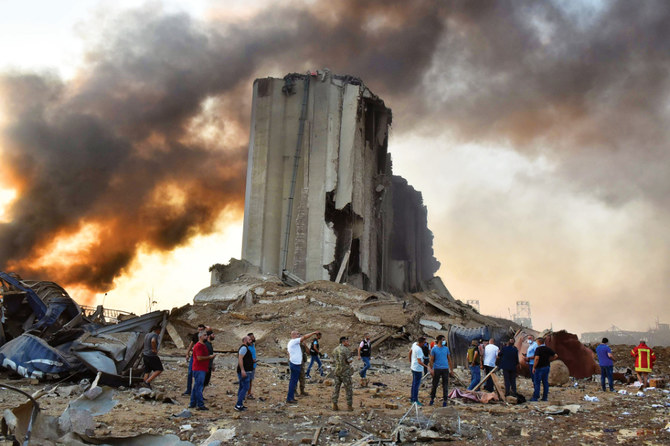
Emergency fire crews and shocked onlookers search for people trapped under rubble after two massive explosions rocked the Lebanese capital, sending plumes of smoke billowing into the air and damaging buildings miles away. (AFP)
2 / 3
Emergency fire crews and shocked onlookers search for people trapped under rubble after two massive explosions rocked the Lebanese capital, sending plumes of smoke billowing into the air and damaging buildings miles away. (AFP)
3 / 3
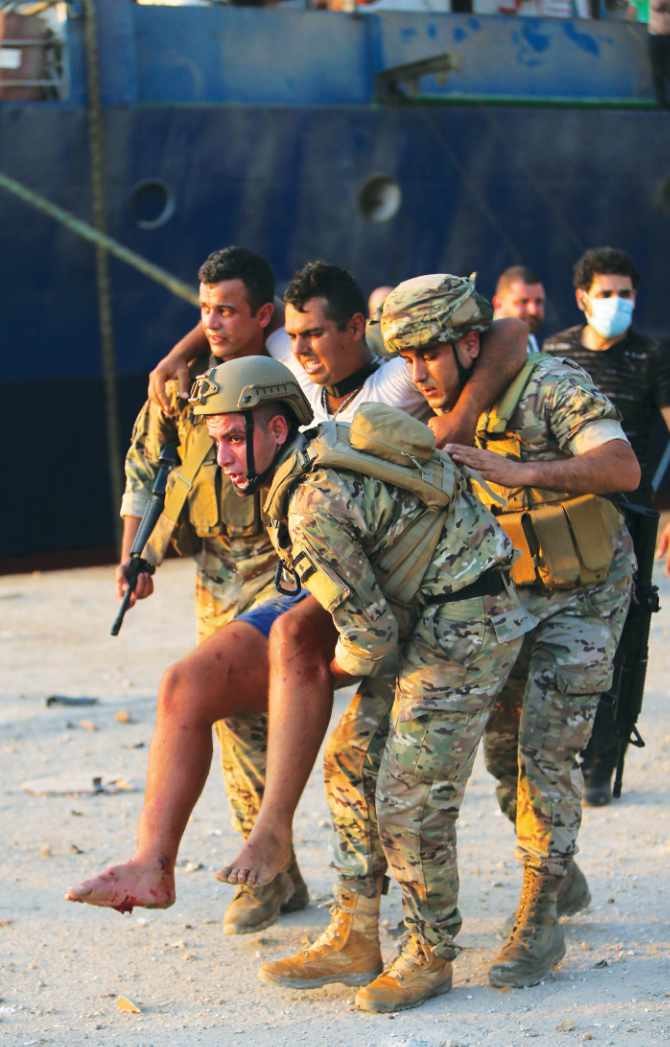
Lebanese soldiers carry an injured man to safety following the twin explosions. Beirut’s tearful governor described the capital as ‘a devastated city.’ AFP
Short Url
Updated 05 August 2020
Follow

Beirut blast: ‘It was like the apocalypse’

  • Two huge explosions that left more than 70 people dead and thousands injured have added to Lebanon’s grief

BEIRUT: Lebanon’s prime minister made a desperate plea for international help after twin explosions devastated Beirut and plunged his country deeper into crisis. 

The two massive blasts killed at least 73 people, injured more than 3,700, and destroyed and damaged buildings across the capital.

While the cause of the blasts remains unclear, Lebanese leader Hassan Diab vowed that those responsible would be punished.

“What happened today will not pass without accountability,” he said in a televised address. “Those responsible for this catastrophe will pay the price.”

With the country already trapped in a crippling economic crisis and battling COVID-19, Diab appealed for international assistance.

“I am sending an urgent appeal to all countries that are friends and brothers and love Lebanon, to stand by its side and help us treat these deep wounds,” he said.

The explosions took place at a warehouse in the city’s port shortly after 6 p.m.
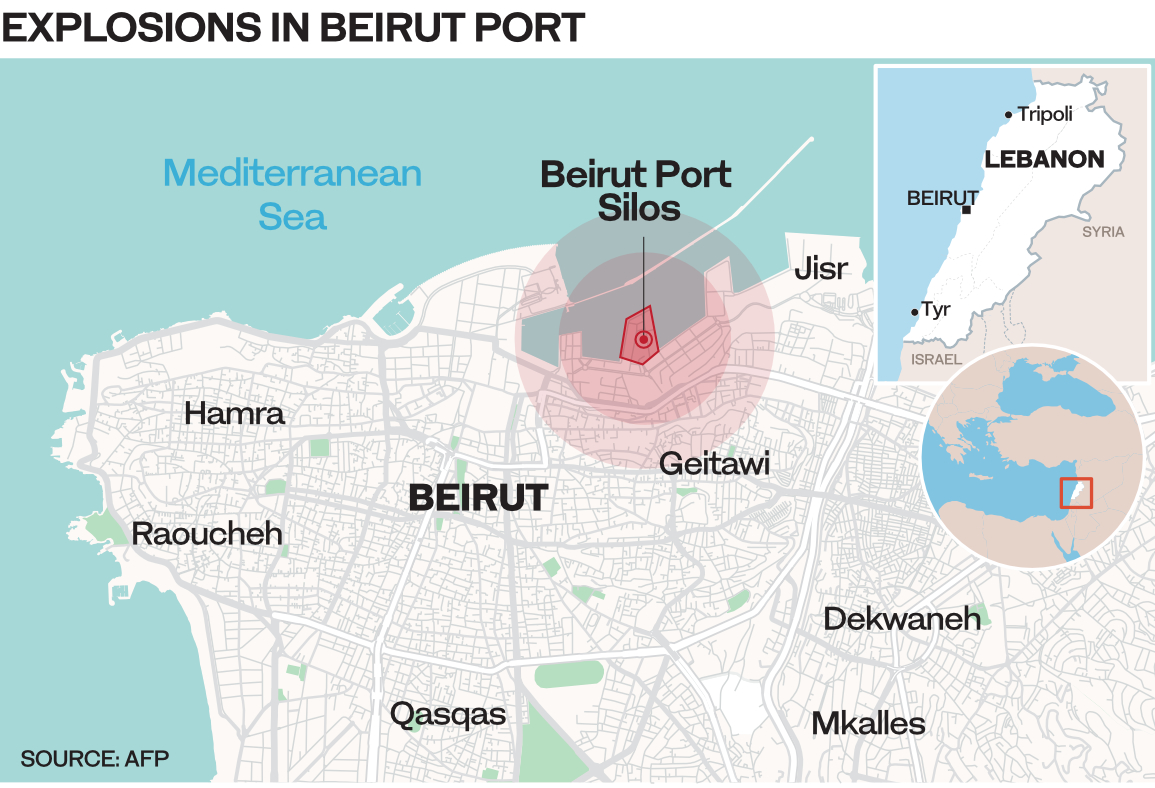
Lebanon’s internal security chief Abbas Ibrahim said the blasts occurred in a section of the port housing highly explosive materials that had been confiscated and stored there for years.

Diab said that the “dangerous warehouse” had been there since 2014.

Even in a city with a history of conflict, the scale of the explosions was unprecedented. The blasts were so strong the they were felt in Cyprus, 200 km away.

Videos showed an initial explosion and fire, followed by a massive blast and shockwave spreading through the city’s buildings. People could be heard screaming and running for cover in restaurants and from balconies. Many thought they had been hit by an earthquake.


INTERNATIONAL REACTIONS

  • "The Kingdom expresses its sincere condolences to the families of the victims and the injured." - Saudi Arabian Ministry of Foreign Affair
  • "We stand ready to assist the people of Lebanon as they recover from this horrible tragedy." - Mike Pompeo, US Secretary of State
  • "I express my fraternal solidarity with the Lebanese. France stands with Lebanon. Always." - French President Emmanuel Macron (tweeted in Arabic).
  • "The United States stands ready to assist Lebanon. We will be there to help." - US President Donald Trump 
  • "Our prayers are with our Lebanese brothers and sisters." - Sheikh Mohammed bin Zayed, Abu Dhabi Crown Prince
  • "My sincere condolences and sympathies to our brothers in Lebanon." - Egypt President Abdel Fattah El-Sisi
  • "We share the pain of the Lebanese people and reach out to offer our aid." - Israeli President Reuven Rivlin

“It was like a nuclear explosion,” Walid Abdo, a 43-year-old school teacher in the neighborhood of Gemayzeh, told AP.

Bloodied residents poured into the city’s streets as emergency teams rushed to the scene. Ambulances from across the country headed to the capital to help treat the injured.

Buildings across the entire city were damaged, with windows blown out and ceilings collapsed.

By nightfall the injured were flooding the city’s hospitals, with many being seen by medics on the pavements outside.

Health Minister Hassan Hamad said the hospitals were barely coping, and offers of aid were pouring in from Arab states and friends of Lebanon. Lebanese Red Cross official Georges Kettaneh said the injured were being taken to hospitals outside the capital because facilities there were full.

As speculation mounted over what had caused the explosions, an Israeli official said his country, which has fought several wars with Lebanon, had nothing to do with the blasts.

The explosions took place just days before a UN tribunal was due to deliver verdicts against four men accused of killing the former prime minister Rafik Hariri and 21 others in a 2005 bombing that shook the region. The suspects are members of Hezbollah, the Iran-backed militant group that has since increased its role in the country’s government as well as conflicts across the region.

Rafik’s son Saad, also a former prime minister, said the  explosions had left Beirut “crying.”

“Everyone is being called to rescue (the country) and (provide) solidarity with our people,” he said. “The magnitude of the losses is too great to be described”

Prime Minister Diab declared a day of mourning on Wednesday, while President Michel Aoun called for an emergency meeting of the Supreme Defence Council, which declared Beirut a disaster-stricken city.

Across Lebanon and among the country’s widespread diaspora, Lebanese were left in shock at the latest tragedy to befall their homeland. Many scrambled to contact relatives and friends.

Lebanese musician Jad Choueiri said the scenes near his home in the Achrafieh neighborhood “looked like the apocalypse.”

He posted an image of his apartment windows blasted across his living room. “I could have died,” he said. “Blood is everywhere on the streets.”

Lebanese journalist Rima Maktabi tearfully described the damage to her home. “My house is gone I think,” she told Al Arabiya, the channel where she works.

Raja Farah, a pastry chef, said he was just half a kilometer from the blasts.

“It is impossible to explain the magnitude of this explosion. I was about as far from the Hariri blast a few years ago, and this was 100 times more powerful,” he said.

Across the city shocked workers and businesses owners poured into the streets.

A video from inside the offices of the Daily Star newspaper showed scenes of devastation, with computers strewn across the floor and ceilings collapsed.

The foyers of the city’s most famous hotels — the Four Seasons and the InterContinental Phoenicia Beirut — were strewn with broken glass.

At the scene of the blast, fire crews battled the blaze into the evening. Helicopters dumped water on flattened buildings as a ship in the port remained on fire.

Beirut’s tearful governor Marwan Abboud toured the site, saying: “Beirut is a devastated city.”

As the scale of the tragedy unfolded, foreign governments, both in the Arab world and beyond, offered their support.

Saudi Arabia said it was following the tragedy with great concern and affirmed the Kingdom’s support and solidarity with the Lebanese people. The UAE’s Crown Prince Sheikh Mohammed bin Zayed said: “We pray that God grants you patience and solace. God bless Lebanon and the Lebanese people.”

Similar offers of support were sent from Bahrain, Kuwait, Egypt and Jordan. Israel, which is technically still at war with Lebanon, offered medical and humanitarian aid.

The US State Department said it stands ready to offer all possible assistance,” while France’s President Emmanuel Macron called Aoun to tell him French aid had been sent to Lebanon.


What do the leaked Assad videos tell us about the deposed Syrian regime?

Updated 9 min 56 sec ago
Follow

What do the leaked Assad videos tell us about the deposed Syrian regime?

  • Videos obtained by Al-Arabiya and Al-Hadath channels expose former president Bashar Assad’s inner circle, revealing toxic culture
  • Regional media coverage regard leaks as confirmation of critiques of Assad’s contempt for Syrians, cynicism toward allies

LONDON: The recent leak by Al-Arabiya of a series of videos allegedly showing Bashar Assad in candid, closed-door conversations has reopened longstanding questions about how his former regime functioned — and perhaps why Syria descended into such a devastating conflict.

Assad is shown in the Al-Arabiya leaks, prior to his Dec. 8, 2024, ouster, making contemptuous remarks about Syrians, Syria itself, Eastern Ghouta and even Russian President Vladimir Putin, while speaking privately with his late adviser Luna Al-Shibl.

While the new Syrian government of Ahmad Al-Sharaa has not verified the footage, analysts say the material is consistent with the behavior patterns of Assad’s inner circle: personalized decision-making, narrative obsession and a deep-rooted siege mentality.

Assad is shown in the Al-Arabiya leaks, prior to his Dec. 8, 2024, ouster, making contemptuous remarks about Syrians and Syria itself. (AFP)

“These videos don’t actually tell Syrians anything new — they merely reveal, with complete clarity, what people have known and lived through for decades,” Ibrahim Hamidi, editor-in-chief of Al-Majalla, who is himself from Syria, told Arab News.

“What stands out to me is the indifference and contempt he shows toward everything: his people, his cities, his allies, and the sense that power is an inheritance, not a responsibility.”

In one clip, when Al-Shibl asks him what he feels about the state of Syria, Assad says he does not only feel ashamed but “disgusted,” adding that this is “our country,” conveying revulsion rather than responsibility.

In another segment he says that when Syrians look him in the face he “loves them” yet is also “disgusted by them,” exposing a deeply cynical view of his own population.

He is also shown mocking ordinary Syrians for their spending priorities, saying they spend money on mosques even though they “cannot afford food.”

Several clips are from a tour of Eastern Ghouta and its surroundings, during or after the area’s reconquest in 2018. Assad is heard cursing Ghouta, directed at an area that had endured years of siege and bombardment.

“It showed that Assad is a weak dictator,” said Ghassan Ibrahim, a Syria expert and founder of the Global Arab Network. “He tried to present himself as a strong personality, but all these videos showed how easy it was to be manipulated by his assistant, his media officer.”

In another clip, Assad appears to mock the Russian president’s appearance, despite Moscow having been his main war-time ally.

When Al-Shibl draws his attention to how “puffy” Putin looks, Assad responds that it is “all procedures” or “all surgeries,” suggesting extensive cosmetic work.

The tone in these exchanges is casual and derisive, portraying Assad as privately belittling Putin’s looks while publicly thanking him. (AFP/File)

The tone in these exchanges is casual and derisive, portraying Assad as privately belittling Putin’s looks while publicly thanking him.

“Such remarks reflect Assad’s deep-rooted duplicity,” said Egyptian writer and political expert Hani Nasira. “The same man who publicly deferred to Putin — whose military intervention preserved Assad’s rule and offered him refuge — privately mocked him.

“These comments will likely erode whatever sympathy Putin may still have for the former Syrian leader and underscore Assad’s penchant for betrayal, even toward those who offered him sanctuary.”

Hamidi concurs: “The question now is: How will Putin respond? Especially since Bashar lives in Moscow — and Putin does not easily forgive any insult.”

The videos also capture Assad and Al-Shibl speaking dismissively about Hezbollah and pro-regime commanders.

Regional media coverage framed the Assad leaks as confirmation of long-held critiques of his contempt for Syrians and cynicism toward allies, with tone varying by outlet but broadly harsh.

Pan-Arab platforms like The New Arab and Asharq Al-Awsat foregrounded Assad’s insults toward Ghouta, Syrians and the army, highlighting his disgust at Syria, and mockery of soldiers as emblematic of an entrenched disdain for his own population.

Gulf-based media stressed his ridicule of loyalist figures and allies, using the leaks to underline his perceived disloyalty to those who fought for him and to question his past narratives of steadfastness and resistance.

Several clips are from a tour of Eastern Ghouta and its surroundings, during or after the area’s reconquest in 2018. Assad is heard cursing Ghouta, directed at an area that had endured years of siege and bombardment. (Supplied)

Syrian opposition-aligned and exile media amplified the footage as further evidence of his moral and political bankruptcy rather than a revelation, stressing that the content matched years of lived experience under his rule.

A recurring feature in the leaked clips is Assad’s habit of issuing direct orders to intelligence chiefs, senior officers and advisers, bypassing ministries and formal structures.

The informal tone — part off-the-record briefing, part reprimand — underscores the extent to which the Syrian state under Assad revolved around personal allegiance.

Assad postured publicly as a defender of the Syrian state but has since been unmasked as someone who harbors deep disdain for all around him.

In private, he mocks his loyal fighters, sneers at those who kiss his hand, and speaks of them with derision — as if unable to feel genuine empathy for their sacrifices.

“This is a man who views Syria through the lens of masters and servants, rulers and ruled,” said Nasira.

“To Assad, those who fought for him — in Syria and abroad — are nothing more than an annoyance. Speaking casually and comfortably to Al-Shibl, he reveals a condescending view of the nation, his people, and even his inner circle.”

The leaked videos stripped away the official image and exposed the toxic culture of a ruling circle that never viewed Syrians as citizens with rights but “as subjects expected to endure anything,” Hamidi said.

Assad postured publicly as a defender of the Syrian state but has since been unmasked as someone who harbors deep disdain for all around him. (AFP)

“For years, they endured hardships believing Assad was steady, serious, and above chaos. What hurts them now is seeing a completely different personality: careless, mocking, and seemingly dismissive of people’s suffering.

“This shakes the narrative they built in their minds to justify their loyalty. And when that narrative cracks, everything else becomes harder to defend.”

The footage also shows Assad fixating on media coverage, urging officials to safeguard the regime’s messaging and chastising those who, in his view, allowed “contradictory signals” to emerge.

His language mirrors longstanding regime strategy: project strength, deny missteps and attribute all instability to external interference.

Another pattern evident throughout the clips is Assad’s repeated framing of Syria’s crises as part of a coordinated foreign plot. Whether discussing political dissent, economic collapse or battlefield challenges, the theme of encirclement dominates.

The leaked comments reveal that “for Bashar Assad, there was never a true cause or message — just a regime to preserve, and a throne to protect,” Nasira said.

Despite the performative confidence, the videos reveal moments of frustration, especially when Assad chastises advisers for mismanaging situations or warns of rivalries within the security services.

The timing of the leaks is notable. Regional governments have reopened channels with Damascus, diplomatic rehabilitation is creeping forward, and the question of Syria’s postwar reconstruction looms large.

Assad is also shown mocking ordinary Syrians for their spending priorities. (AFP)

“Released on the anniversary of what pro-regime media called “Liberation Day” — marking the collapse of Assad’s rule — the timing could not have been more symbolic,” said Nasira.

For Syrians, the footage is less revelation than validation — an affirmation of what many lived through: a state defined not by institutions but by coercion, suspicion and the whims of an inner circle.

“Most Syrians no longer care about Bashar himself; they care about Syria’s future. They want to look forward, not backward,” said Hamidi.

For international observers, the videos offer one of the clearest windows yet into the operating logic of a regime that has survived sanctions, war, isolation and internal collapse.