



BEIRUT: Beirut is a devastated city. There is no other word to describe the aftermath of a massive explosion that rocked the Lebanese capital on Tuesday afternoon, killing dozens and injuring thousands.
The blast happened at a warehouse in the port area of the city that reportedly had been used for years to store about 3,000 tons of confiscated chemicals. It destroyed everything within a radius or more than half a mile, and caused damage to buildings as far away as nine miles. Warnings were also issued about a toxic plume of smoke that blanketed the city after the explosion.
Shortly before midnight, Lebanon’s Higher Defense Council declared Beirut a disaster zone and urged the cabinet to declare a state of emergency. The eastern part of Port of Beirut is completely destroyed. The damage to the capital is catastrophic, much worse than that caused by the Israeli attacks in 2006.
Military sources said the chemicals that exploded — believed to be ammonium nitrate, a common agricultural fertilizer — were confiscated several years ago and irresponsibly stored at the port, close to residential and commercial areas, under the orders of the judiciary.
Officials warned people to avoid inhaling the smog that shrouded the city after the blast, which they said could remain in the air until at least the following day. Despite this, people could be seen wandering around the city’s downtown area taking photographs of the devastation. Some were not even wearing masks to protect themselves from the toxins.
After enduring one crisis after another — from the economic crisis that has provoked sustained street protests against political corruption and mismanagement, to the pandemic and now the explosion — perhaps the people of Lebanon have simply become indifferent to disaster.
Ambulance sirens could be heard throughout the night as paramedics and volunteers worked tirelessly to rescue thousands of people injured by the explosion and take them to overwhelmed hospitals, and recover the bodies of the dead.
A number of hospitals close to Beirut’s downtown area, especially in the eastern suburb of Achrafieh, were badly damaged by the blast, leaving scores of people dead and injured. Those in less critical conditions were moved to nearby parking lots, while those with life-threatening injuries were taken to hospitals outside of Beirut. Health minister Hamad Hassan said all treatment costs will be covered by the state.
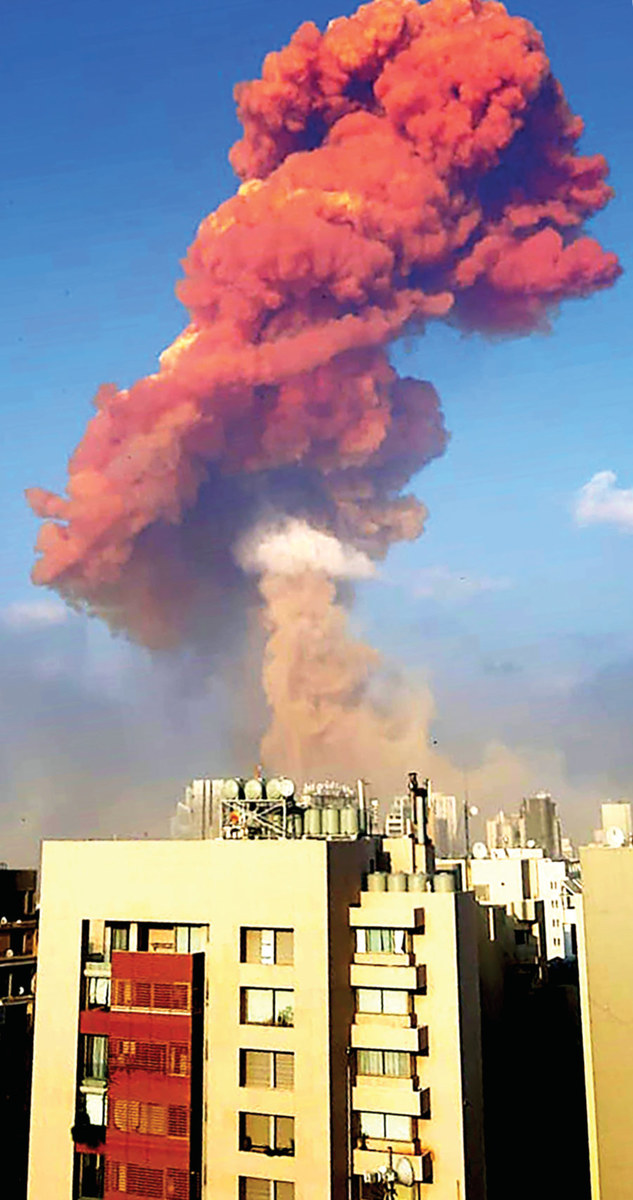
A giant plume of smoke soared as the explosion shattered windows throughout Beirut. (AFP)
Shortly before midnight, the official death toll reached 73 but this is expected to rise, according to health officials, because many missing persons “are turning up dead or critically injured under the rubble of houses and offices that were wiped out by the blast.”
A number of government buildings were damaged, including the The Grand Serail, which is the prime minister’s headquarters, the Finance Ministry and the Telecoms Ministry. The windows of offices at the Information Ministry, which is more than four miles from the Port, were shattered by the blast.
Prime Minister Hassan Diab’s daughter and wife, who live in the Serail, were treated for minor injuries. His health adviser, Petra Khoury, was taken from there to hospital with cuts that required stitches.
The explosion was heard more than 60 kilometers south of Beirut. It could be felt in other countries, with the Jordan Seismological Observatory reporting that it was equivalent to an earthquake measuring 4.5 on the Richter scale.
The heads of many Arab and other foreign states pledged to provide urgent assistance to Lebanon. Yet despite the disaster, some politicians in the country refuse to put aside their political differences to focus on helping the people of the city. As Diab and President Michel Aoun called for an immediate investigation into the cause of the disaster to determine who is responsible and what assistance is needed, opposition parties were already blaming the recently-formed government.


