BEIRUT: Dozens of Lebanese protesters tried to storm the Ministry of Energy on Tuesday, angered by prolonged power cuts as the country grapples with a crippling economic crisis.
Security forces pushed back against the angry protesters, chasing away some who breached the ministry perimeter. Scuffles ensued as protesters pushed the metal barricade and said they plan to set up a sit-in at the ministry.
“We came today and we will stay" said an unnamed protester who read a statement to the media, adding that they will liberate the ministry “from corruption ... and the management that plunged this country into darkness.”
Lebanon's economic and financial crisis poses the most significant threat to the country since a devastating 15-year civil war ended in 1990. The highly-indebted government is facing a rapid inflation, soaring unemployment and poverty, made worse by the coronavirus pandemic.
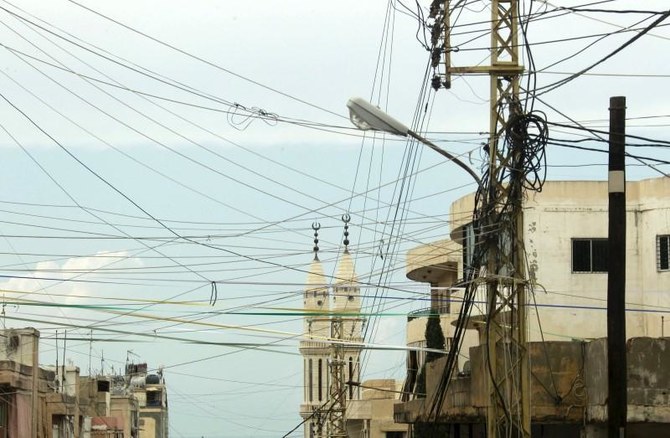
Amid the crisis, recurrent power outage worsened as the government failed to secure essential energy sources.
Lebanon has largely relied on fuel shipped in from neighboring countries and imported diesel for the powerful generators cartel that provides for the incomplete national grid, in shambles since the end of the war. For decades, the country struggled with power cuts and a huge public debt for the national electricity company that racks up a deficit of nearly $2 billion a year.
But the rationing increased since June, and became so severe that residents reported only a couple of hours of electricity per day in some areas. Generator providers shut down their machines to ration existing fuel and raised prices because of a plunging national currency. Lebanese turned to traditional kerosene lamps and candles while hospitals warned their fuel stock was running out.
Lebanon's problems are rooted in years of mismanagement and corruption. Nationwide protests that erupted last October subsided amid restrictions over the coronavirus pandemic and widening troubles.
But limited protests have recently returned, particularly since prolonged power cuts in the summer heat.
“We want to send a message that we are not leaving here until there is electricity" all day, said Ali Daher, another protester.


Lebanese try to storm energy ministry amid power cuts
https://arab.news/jkh8w
Lebanese try to storm energy ministry amid power cuts

- Security forces pushed back against the angry protesters, as they chased away some others
- Lebanon's economic and financial crisis poses the most significant threat to the country since a the end of a 15-year civil war


US condemns RSF drone attack on World Food Programme convoy in Sudan’s North Kordofan
- Denise Brown, the UN Humanitarian Coordinator for Sudan, also expresses concern over the drone attack
WASHINGTON: The US has condemned a drone attack by Rapid Support Forces on an aid convoy in Sudan’s North Kordofan state that killed one person and injured three others.
“The United States condemns the recent drone attack on a World Food Program convoy in North Kordofan transporting food to famine-stricken people which killed one and wounded many others,” US Senior Adviser for Arab and African Affairs Massad Boulos wrote on X.
“Destroying food intended for people in need and killing humanitarian workers is sickening,” the US envoy wrote.
“The Trump Administration has zero tolerance for this destruction of life and of U.S.-funded assistance; we demand accountability and extend our condolences to all those affected by these inexcusable events and terrible war,” he added.
The Sudan Doctors Network, on its social media accounts, said the World Food Programme (WFP) convoy was struck by RSF drones in the Allah Karim area as it headed toward displaced people in El-Obeid, the state capital.
The network described the attack as a “clear violation of international humanitarian law,” warning that it undermines efforts to deliver life-saving aid to civilians amid worsening humanitarian conditions across the country.
There was no immediate comment from the rebel group.
The United States condemns the recent drone attack on a World Food Program convoy in North Kordofan transporting food to famine-stricken people which killed one and wounded many others. This follows an attack earlier this week in Blue Nile state that injured a @WFP staff member.…
— U.S. Senior Advisor for Arab and African Affairs (@US_SrAdvisorAF) February 6, 2026
Denise Brown, the UN Humanitarian Coordinator for Sudan, in a statement also expressed concern over the drone attack which hit the aid trucks in North Kordofan.
“I am deeply concerned by a drone attack earlier today on trucks contracted by the World Food Programme (WFP) in North Kordofan, the aftermath of which I came across a few hours later, as I left the state capital, El Obeid.”
“The trucks were en route from Kosti to deliver life-saving food assistance to displaced families near El Obeid when they were struck, tragically killing at least one individual and injuring many more. The trucks caught fire, destroying food commodities intended for life-saving humanitarian response.”
Brown added that “Humanitarian personnel, assets and supplies must be protected at all times. Attacks on aid operations undermine efforts to reach people facing hunger and displacement.”
“Safe and unimpeded humanitarian access remains critical to ensure assistance reaches the most vulnerable people across Sudan.”
Since April 2023, the conflict between Sudan’s army and the paramilitary forces has killed tens of thousands, displaced 11 million and which the UN has described as one of the world’s worst humanitarian crises.
An alert issued by the Integrated Food Security Phase Classification (IPC), confirmed famine conditions in El-Fasher and Kadugli, the capital of South Kordofan, about 800 kilometers to the east.
The IPC said that 20 more areas in Sudan’s Darfur and neighboring Kordofan were at risk of famine.
Of Sudan’s 18 states, the RSF controls all five states in the western Darfur region, except for parts of North Darfur that remain under army control. The army holds most areas of the remaining 13 states across the south, north, east and center of the country, including the capital, Khartoum.
The conflict between the army and the RSF, which erupted in April 2023, has killed thousands of people and displaced millions.